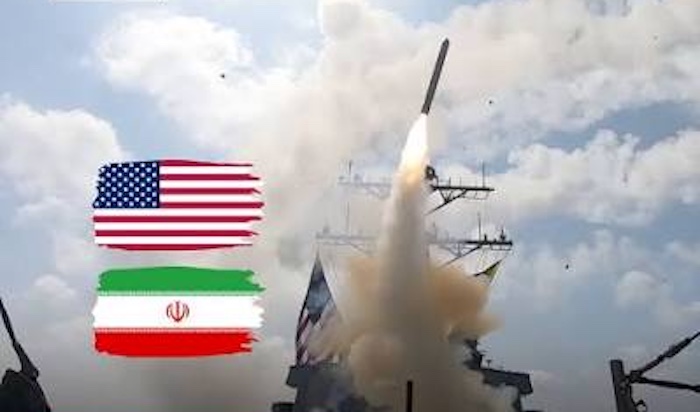
US forces carried out a ninth consecutive day of strikes on Iran on Monday, as renewed hostilities heightened concerns over security in the Strait of Hormuz after Iran claimed two oil tankers had exploded and become immobilised in the strategic waterway.
Iran’s Islamic Revolutionary Guard Corps (IRGC) said it launched ballistic missile attacks on US military positions, targeting aircraft at Jordan’s Aqaba airport as well as military facilities at Kuwait’s Al-Adiri camp, Ali Al Salem Air Base and locations in Syria.
Air raid sirens sounded across Bahrain on Monday morning, according to the country’s interior ministry, while the Kuwaiti army said it intercepted hostile drones during what it described as an Iranian attack.
The latest exchange marks another escalation in the conflict between the US and Iran following the collapse of an interim ceasefire agreement reached last month, further disrupting shipping through the Strait of Hormuz and raising fears over global energy supplies.
In a statement, US Central Command (CENTCOM) confirmed it had launched “a new wave of strikes” aimed at weakening Iran’s ability to attack commercial vessels operating in the vital shipping corridor, but did not disclose further operational details.
Iranian media reported that US missiles struck several cities early on Monday, with explosions heard in Tabriz, Chabahar, Konarak, Bandar Mahshahr and Bandar Imam Khomeini.
US Secretary of State Marco Rubio said Washington would continue military operations as long as Iran threatened commercial shipping.
“The Strait of Hormuz is an international waterway, and they continue to launch attacks against ships in those waters,” Rubio said.
“As long as Iran insists on controlling an international waterway, we’re going to respond. The United States remains open to a diplomatic solution.”
Kuwait also reported that a desalination plant came under attack for a second consecutive day, triggering a fire in what authorities described as a direct strike on critical civilian infrastructure.
Concerns over oil shipments through the Strait of Hormuz have intensified since both countries resumed open hostilities after accusing each other of repeatedly violating the ceasefire agreement.
The United Kingdom Maritime Trade Operations (UKMTO) said it received reports late Sunday of a vessel on fire near the Omani coast, although the cause had not been confirmed.
The IRGC later claimed that two oil tankers exploded and became stranded after attempting to use what it described as an unsafe southern route through the Strait of Hormuz, alleging the vessels had been directed there by the US military.
The claims could not be independently verified, and Iranian authorities did not provide details about the ships, their crews or possible casualties.
The IRGC warned that the Strait of Hormuz would remain unsafe while what it described as US aggression continued, adding that the passage would not be secure for the movement of oil, gas or petrochemical products.
Shipping data showed that only four vessels transited the Strait of Hormuz on Sunday, down from eight the previous day. At least three oil products tankers and one Very Large Crude Carrier have entered the waterway since Friday to load crude.
Oil prices climbed about two per cent on Monday, pushing Brent crude above $90 per barrel amid growing fears of prolonged supply disruptions.
Meanwhile, the US military confirmed that one service member was killed in northern Iraq on Saturday during the controlled detonation of unexploded ordnance from a downed Iranian drone.
The military had earlier announced the deaths of two personnel in Jordan and said another remained missing. On Sunday, CENTCOM said unidentified remains had been recovered from the site of Friday’s attack and were undergoing examination.
The latest casualty figures bring the number of US military personnel killed since the conflict began to 17, while more than 420 others have been wounded.
The conflict, which started after the US and Israel launched attacks on Iran on February 28 targeting its nuclear and missile programmes, has claimed thousands of lives, most of them in Iran and Lebanon.
Ojo Triumph