Football’s law-makers have approved a new rule mandating red cards for players who cover their mouths during confrontations at this summer’s FIFA World Cup, as authorities move to clamp down on abusive conduct and improve transparency on the pitch.
The decision comes after Vinícius Júnior alleged he was racially abused by Gianluca Prestianni during a UEFA Champions League match in February. The Real Madrid forward reported the incident to the referee after Prestianni, who plays for Benfica, covered his mouth while speaking to him on the pitch. Play was halted for 10 minutes in accordance with UEFA anti-discrimination protocols.
In response, FIFA proposed stricter sanctions, which were unanimously adopted at a meeting of the International Football Association Board (IFAB) held in Vancouver, Canada, on Tuesday.
An IFAB statement said: “At the discretion of the competition organiser, any player covering their mouth in a confrontational situation with an opponent may be sanctioned with a red card.”
The incident involving Prestianni has already led to disciplinary action. UEFA last week handed the player a six-match ban for discriminatory conduct deemed anti-gay in nature. Three of those matches have been suspended for two years, while one has already been served provisionally. The sanction remains subject to appeal.
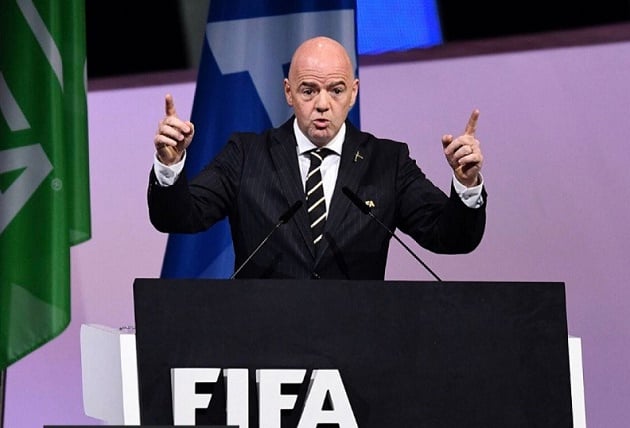
FIFA had initially raised the proposal during IFAB’s annual general meeting in Wales in February, shortly after the incident. Speaking the following day, FIFA president Gianni Infantino said he supported the introduction of red cards for players who conceal their speech while confronting opponents.
In a separate but related measure, players who walk off the pitch in protest at refereeing decisions — along with officials who encourage such actions — will also be immediately dismissed during the World Cup. Teams responsible for causing a match to be abandoned will, in principle, forfeit the game.
The move follows chaotic scenes at the Africa Cup of Nations final in January, when Senegal national football team players temporarily left the field in protest after a late penalty was awarded to hosts Morocco national football team. The incident delayed the match by 17 minutes.
Although Senegal initially went on to win the match after Brahim Díaz missed the penalty and the game proceeded to extra time, the result was later overturned. The Confederation of African Football stripped Senegal of the title, awarding the trophy to Morocco following an appeal.
Boluwatife Enome