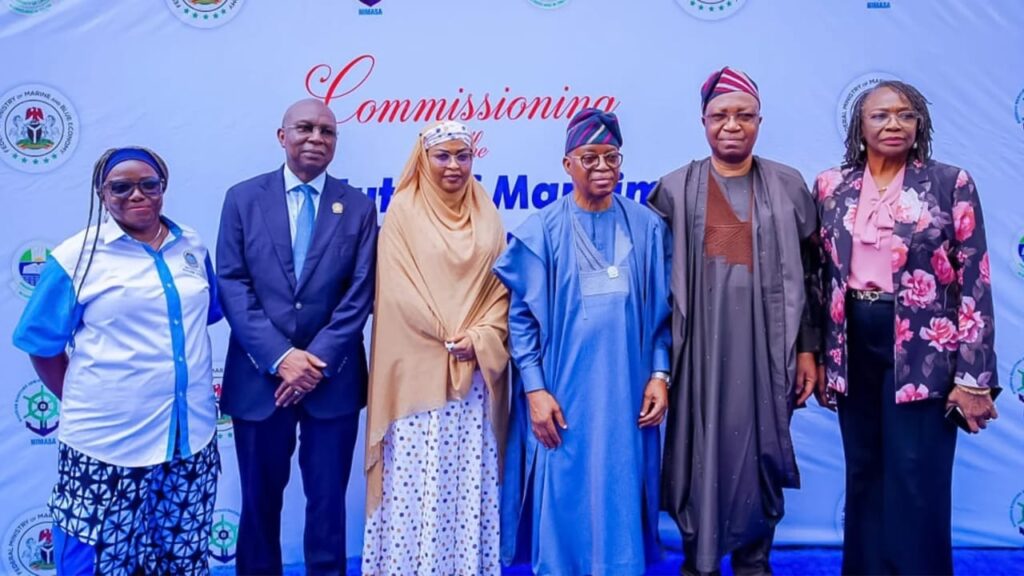
Minister of Marine and Blue Economy, Adegboyega Oyetola, Thursday, inaugurated the Institute of Maritime Studies (IMS) Multipurpose Building at the University of Lagos, reaffirming the federal government’s commitment to advancing Nigeria’s marine and blue economy through sustained investment in human capital and infrastructure.
The facility, donated by the Nigerian Maritime Administration and Safety Agency (NIMASA), is equipped with modern lecture rooms, laboratories, and specialised facilities to support teaching, research, and innovation in the maritime sector.
Describing the project as a milestone, Oyetola said the initiative reflected the government’s resolve to strengthen institutional capacity and position the blue economy as a key driver of national prosperity.
The minister said, “The future of the blue economy will be shaped not just by natural endowments, but by the quality of minds we nurture within institutions such as this.”
He emphasised that with over 90 per cent of Nigeria’s trade conducted via maritime channels, the sector was critical to economic diversification, job creation, and sustainable development.
Oyetola, in a statement by his Special Adviser, Bolaji Akinola, highlighted ongoing efforts to build manpower, disclosing that 2,459 Nigerians have been sponsored under the Nigerian Seafarers Development Programme (NSDP) for training in maritime institutions across countries, including the United Kingdom, Egypt, the Philippines, India, and Romania.
He added that 1,088 beneficiaries had obtained their Certificates of Competency.
The minister also pointed to opportunities in fisheries and aquaculture, stating that Nigeria’s annual fish demand of 3.6 million metric tonnes presents significant potential for food security and employment.
Oyetola further outlined key government initiatives, including the planned disbursement of the Cabotage Vessel Financing Fund (CVFF), expected to boost indigenous shipping capacity and create up to 30,000 jobs.
He said ongoing port modernisation projects were projected to “generate up to 20,000 jobs for our teeming youths, while significantly improving port efficiency, reducing turnaround time, and enhancing Nigeria’s competitiveness as a maritime hub in West and Central Africa”.
Director-General of NIMASA, Dr. Dayo Mobereola, said the agency was partnering with eight Nigerian universities, as well as international institutions, including World Maritime University, to strengthen maritime manpower development.
Mobereola stressed that building a skilled offshore workforce will enhance Nigeria’s global competitiveness, reduce dependence on foreign expertise, and create sustainable employment opportunities.
He said the NIMASA–UNILAG partnership will boost research, support data-driven policymaking, and produce industry-ready professionals to meet evolving demands in the maritime sector.
In her remarks, Vice Chancellor of the University of Lagos, Professor Folasade Ogunsola, said the new facility will enhance teaching, research, and professional training in areas, such as maritime law, shipping management, port operations, logistics, and marine environmental studies.
Ogunsola added that the institute was positioned to serve as a hub for innovation and interdisciplinary research that will support national development.
Pro-Chancellor and Chairman of the Governing Council, Chief Wole Olanipekun, SAN, commended the federal government for its support and pledged the university’s continued collaboration in advancing manpower development in the maritime sector.
Established in 2013, the Institute of Maritime Studies, UNILAG, has grown into a strategic centre for maritime capacity development in Nigeria and the wider African region.
The event was attended by key stakeholders from the maritime sector and the academic community.
Kasim Sumaina