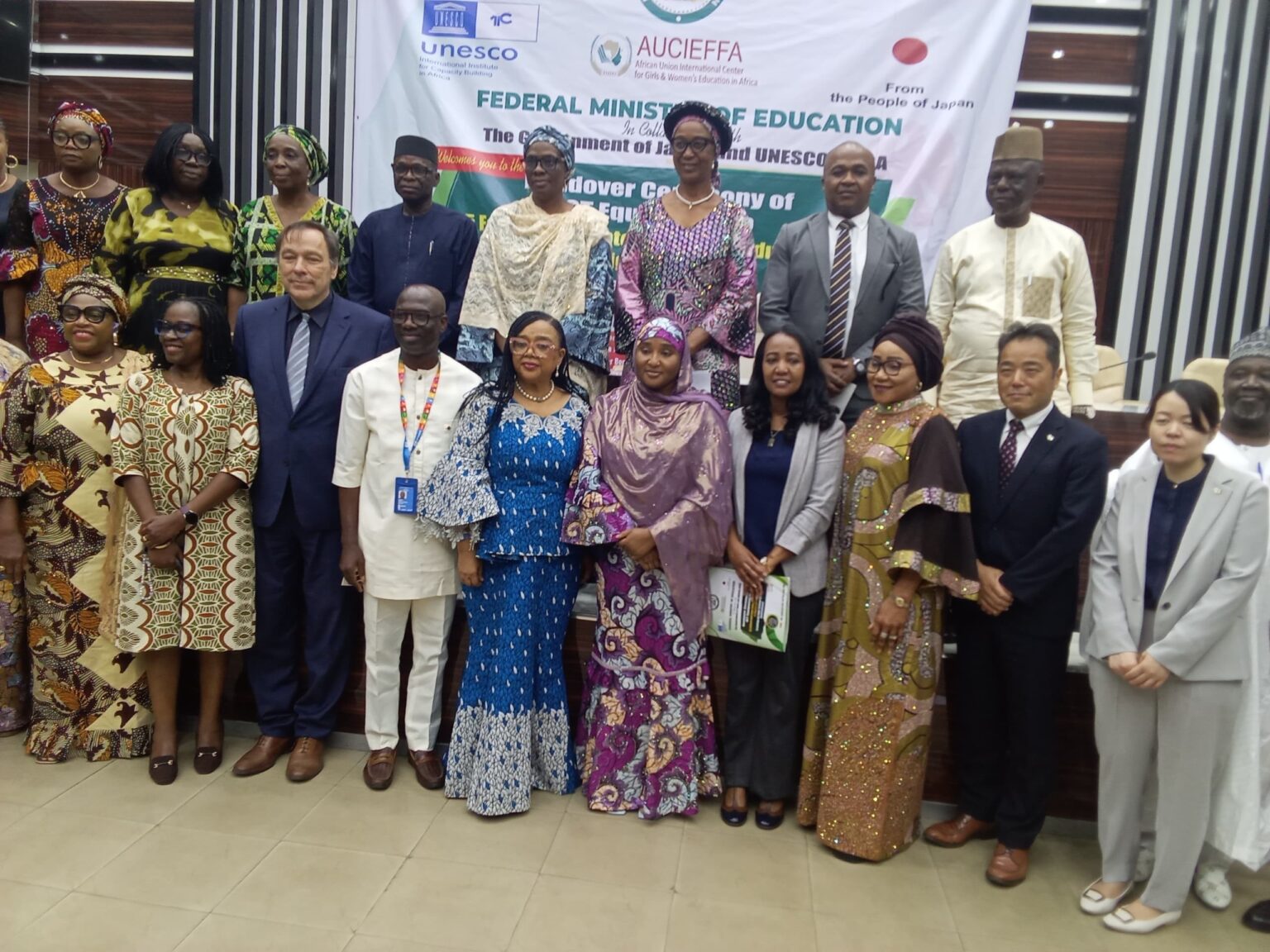
The Federal Government has handed over Information and Communication Technology (ICT) equipment donated by the Government of Japan to 15 Colleges of Education across Nigeria, in a move aimed at strengthening teacher training and expanding access to quality education, particularly for girls.
The equipment was provided under the project, “Capacity-building of Teachers to Promote Continuous and Inclusive Access to Safe and Quality Education for Girls in West Africa,” implemented through the partnership of the Government of Japan and the United Nations Educational, Scientific and Cultural Organisation International Institute for Capacity Building in Africa (UNESCO-IICBA).
Speaking at the handover ceremony, the Minister of State for Education, Professor Suwaiba Ahmad, commended UNESCO-IICBA, the Government of Japan, and the African Union for launching the regional initiative in March 2024.
She said the project reflects a shared commitment to strengthening teacher education systems and expanding educational opportunities for girls across West Africa.
According to the minister, the initiative covers six countries—Burkina Faso, Cameroon, Chad, Mali, Mauritania, and Nigeria—and aligns with the Federal Ministry of Education’s priorities under the Renewed Hope Agenda, particularly in the areas of equity, quality, digital transformation, and inclusive education.
Ahmad noted that the donated ICT resources would enhance both pre-service and in-service teacher training by improving access to digital learning materials, innovative teaching tools, and learner-centred instructional methods.
She also stressed the importance of school safety, describing secure learning environments as critical to achieving quality education outcomes.
“Safe schools are essential to achieving quality education, especially for girls and vulnerable learners. We must continue to ensure that our institutions remain secure, supportive, and conducive spaces for teaching and learning,” she said.
Also speaking, the Chargé d’Affaires of the Embassy of Japan in Nigeria, Hitoshi Kozaki, reaffirmed his country’s commitment to supporting education development in Nigeria.
Kozaki expressed appreciation for the longstanding partnership between Japan and Nigeria and expressed optimism that the project would positively impact teacher education institutions and future generations of learners.
He emphasised that Japan’s cooperation with African countries is anchored on mutual respect and local ownership.
“We do not seek to impose solutions from outside. Rather, we work alongside African governments, institutions, and communities as they pursue their own development values,” he said.
The diplomat added that the success of the initiative would depend on how effectively the beneficiary institutions utilise the equipment to improve teacher preparation and expand educational opportunities, particularly for girls.
In his remarks, the Director of UNESCO-IICBA, Quentin Wodon, praised Nigeria’s commitment to education reforms and active participation in international education programmes.
Wodon also highlighted the importance of female leadership in educational institutions, noting that research has consistently shown positive learning outcomes when women occupy leadership positions.
The 15 beneficiary institutions include Federal College of Education, Kontagora; Federal College of Education, Zaria; Federal College of Education (Technical), Gombe; Federal College of Education, Yola; Federal College of Education (Technical), Asaba; Federal College of Education (Special), Oyo; Federal College of Education (Technical), Umunze; College of Education, Zuba; Isaac Jasper Boro College of Education; Enugu State College of Education (Technical); Sa’adatu Rimi College of Education, Kano; Adamu Augie College of Education, Argungu; Shehu Shagari College of Education, Sokoto; Adamawa State College of Education, Hong; and Taraba State College of Education, Zing.
The ICT equipment distributed to the institutions comprised 65 laptop computers, 71 tablets, four desktop computers, five interactive smart boards, 19 all-in-one desktop computers, 14 projectors, 15 printers, and 15 backup hard drives.
The Federal Government said the intervention is expected to strengthen digital learning infrastructure in teacher-training institutions and improve the quality of education delivery nationwide.