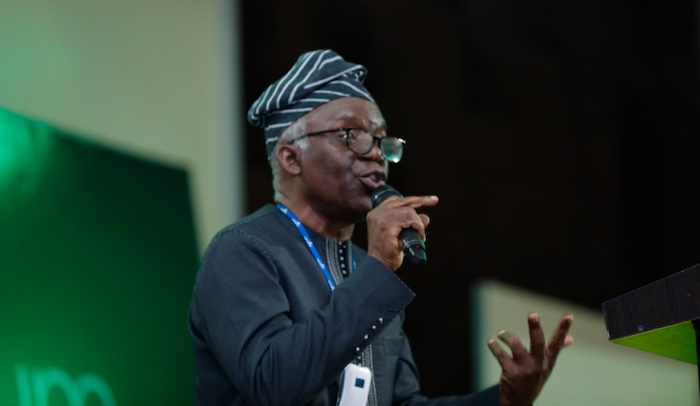
Renowned human rights advocate and Senior Advocate of Nigeria (SAN), Femi Falana, has sounded a stark warning over the future of Nigeria’s democracy, declaring that worsening insecurity, growing attacks on free speech and deepening poverty could jeopardise the credibility of the 2027 general elections if urgent corrective measures are not taken.
Falana issued the warning on Tuesday in Abuja while delivering the keynote address at the inaugural Annual Memorial Lecture held in honour of the late Professor Humphrey Nwosu, the former chairman of the defunct National Electoral Commission (NEC) whose stewardship of the historic June 12, 1993 presidential election remains one of the defining moments in Nigeria’s democratic evolution.
The event, organised by the National Human Rights Commission (NHRC) in collaboration with the Professor Humphrey Nwosu Centre for Democracy and Human Rights, brought together jurists, civil society leaders, academics and democracy advocates to reflect on the state of electoral integrity in Nigeria.
Speaking on the theme, “Electoral Integrity and the Future of Credible Elections in Nigeria,” Falana cautioned that the conditions necessary for free, fair and credible elections are being steadily eroded by insecurity and shrinking civic freedoms.
According to him, no democracy can thrive where citizens live in fear and where the right to freely express dissenting opinions is under threat.
“As we gather here today, many schoolchildren and teachers are still being held by criminals. Communities across the country continue to live under the shadow of kidnappers, terrorists and bandits. The question is whether a nation facing such grave security challenges can guarantee credible elections,” he said.
The senior lawyer warned that Nigerians are becoming increasingly vulnerable, arguing that the atmosphere of fear created by insecurity could undermine voter participation and confidence in the electoral process.
Falana also expressed concern over what he described as growing restrictions on freedom of expression, saying that democratic rights won through years of struggle must not be surrendered.
“If you criticise those in authority today, you run the risk of being prosecuted under the Cybercrimes Act. The space for free speech is shrinking, and that is dangerous for democracy,” he stated.
Paying tribute to late Nwosu, Falana described him as a courageous patriot whose commitment to democratic principles stood firm even in the face of intense pressure from the military authorities during the turbulent transition programme of the early 1990s.
He recalled that many pro-democracy activists had become convinced long before the June 12 election that the military administration of former Head of State, General Ibrahim Babangida, was reluctant to hand over power to a democratically elected government.
“We knew by April 1993 that General Babangida was not prepared to relinquish power through democratic means. Yet Professor Nwosu remained determined to conduct the election despite enormous pressure from powerful interests,” he said.
Falana noted that the courage displayed by Nwosu in defending the sanctity of the ballot remains a powerful lesson for contemporary electoral institutions and political leaders.
He urged Nigerians to become more active in demanding accountability from elected officials and called on voters to reject divisive politics based on ethnicity and religion.
According to him, the country’s future depends on citizens evaluating political leaders based on competence, integrity and their ability to tackle pressing national challenges.
Chairman of the occasion and retired Justice of the Supreme Court, Justice Abdul Aboki, described Nwosu as one of the architects of Nigeria’s democratic journey whose legacy continues to resonate decades after the annulment of the June 12 election.
He said electoral integrity must remain at the heart of the nation’s democratic project, stressing that credible elections are not merely administrative exercises but fundamental expressions of citizens’ rights.
“It is about the right of every Nigerian to freely choose leaders without intimidation, coercion or manipulation. It is about strengthening institutions, deepening the rule of law and building public trust in governance,” Aboki said.
He called on political parties, security agencies, civil society organisations, the media and ordinary citizens to work together to safeguard the integrity of future elections and strengthen democratic institutions.
Earlier, Executive Secretary of the NHRC, Dr Tony Ojukwu (SAN), said the memorial lecture was established to preserve and promote the enduring democratic ideals championed by Professor Nwosu.
He said the event also serves as a reminder of the sacrifices made by numerous democracy activists, civil society groups and pro-democracy movements in the struggle for constitutional rule, electoral justice and the protection of citizens’ political rights.
Ojukwu stressed that credible elections, freedom of expression, civic participation, accountability and adherence to the rule of law remain indispensable pillars of democratic governance.
As Nigeria inches closer to another electoral cycle, the gathering served as both a tribute to one of the nation’s foremost electoral reformers and a sobering reflection on the challenges confronting the country’s democratic future.
For many participants, the message was unmistakable: without security, accountability and respect for fundamental freedoms, the credibility of future elections may be difficult to guarantee.
Michael Olugbode