A girl checks for water in a tap with a candle in her hand in an apartment in Ukraine, there is no light, no water, people's difficulties
Eskom has reached a major milestone, but thousands of households in Gauteng should still brace for load reduction outages this week.
South Africa has gone 367 days without load shedding, a feat the country had not achieved in nearly a decade.
Eskom confirmed the milestone on Saturday.
“At 00:01 today, Eskom delivered for South Africa one full year without a single second of load shedding, a milestone last achieved eight years ago in September 2018,” the utility said.
Despite the celebration, the reality for many Gauteng residents remains one of daily disruption, with load reduction continuing across several areas in the region this week.
A structural shift, not just a streak
Eskom has described this achievement as more than a run of good days on the grid.
“This milestone marks a decisive turning point and a structural shift from a recovering grid to a stable, high-performing power system,” Eskom said.
The past three years of sustained reliability have also delivered significant financial relief.
Eskom said the uninterrupted supply has saved the country R26.9 billion in diesel costs, while ensuring that 100% of national electricity demand was met throughout the period.
While the legacy of load shedding once constrained economic activity and strained South African households, 365 consecutive days of uninterrupted power supply represent more than operational progress; it is a restoration of national confidence,” the utility said.
Load reduction in affected areas
While load shedding may be off the table, load reduction remains a daily challenge for many Gauteng households.
Eskom’s schedule for the week shows that outages will follow a rotating pattern, with some areas affected in the morning and others in the evening.
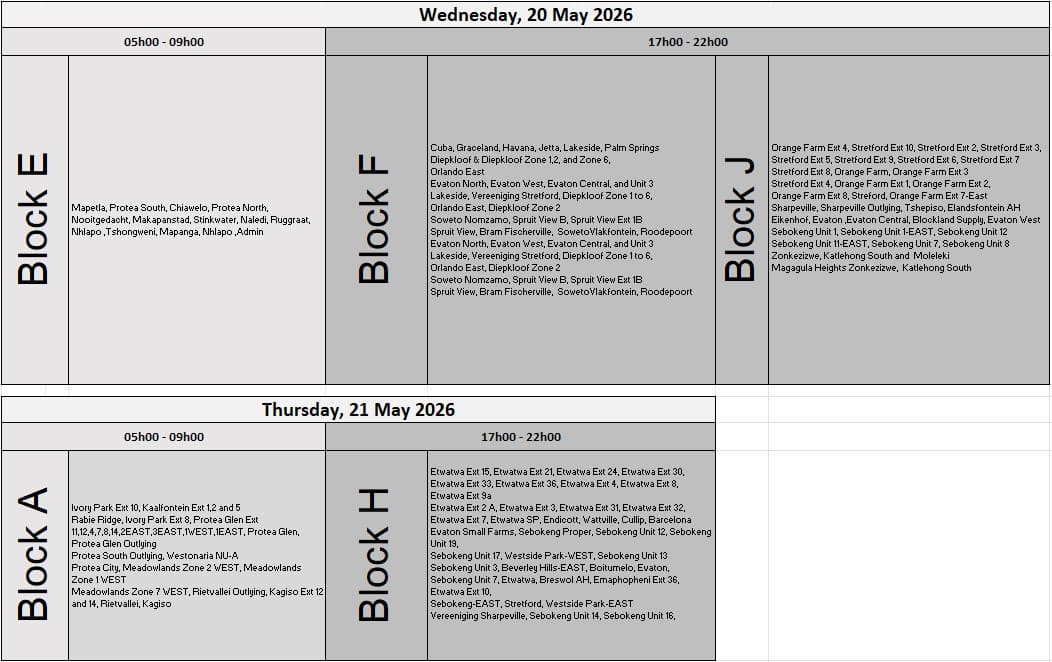
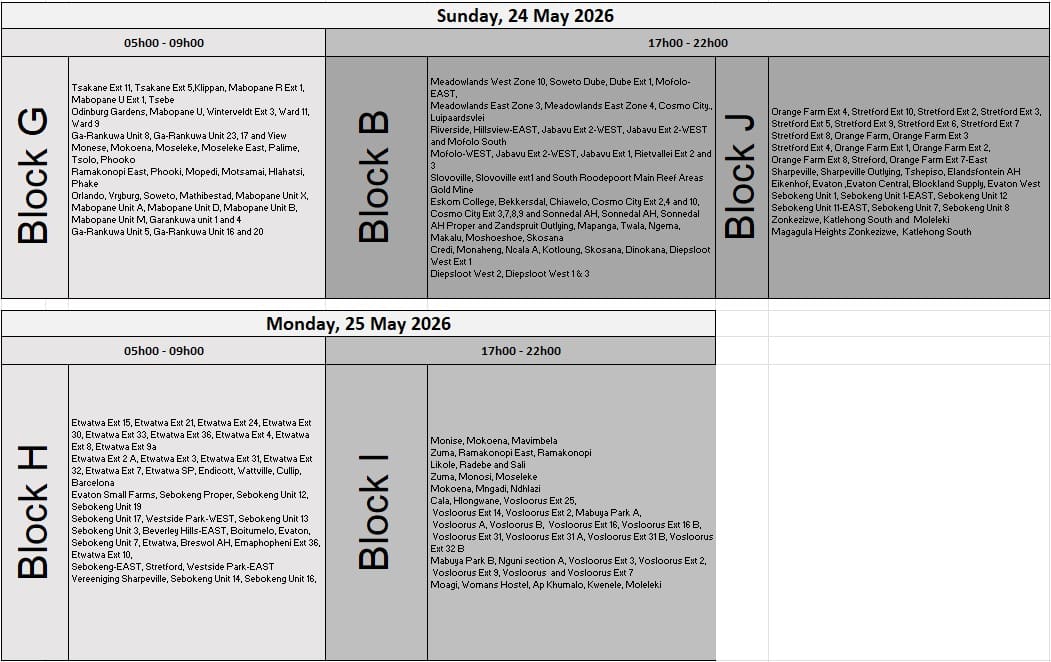
Areas facing morning outages between 5am and 9am include Meadowlands West Zone 10, Soweto Dube, Cosmo City and Luipaardsvlei, as well as Orange Farm, Stretford extensions and Sharpeville.
Tsakane, Mabopane, Garankuwa extensions, and Winterveldt are also scheduled for early morning cuts this week.
Evening outages, running from 5pm to 10pm, will affect areas including Vosloorus, Evaton Central, Sebokeng extensions and Katlehong South.
Residents in Monise, Mokoena, Mavimbela, Ramakonopi East and Hlongwane should also brace for interruptions during this window.
The schedule rotates across the week, with different blocks affected on different days.
Areas such as Etwatwa extensions, Moseleke, Diepsloot West, Ivory Park and Protea Glen also feature across the weekly timetable, alongside suburbs including Bekkersdal, Chiawelo, Mapanga and Skosana.
The following areas will also be affected by this week’s load reduction:
- Dobsonville and extensions
- Mabopane X and U
- Naledi and Langaville
- Tsakane Ext 8, 11, 12 and 15
- Ekangala and Moroka
- Klipspruit and Kagiso
- Etwatwa Ext 15, 21 and 24
- Sebokeng Proper and Unit 12
- Moleleki
- Magagula Heights
- Orlando and Vryburg
To see if your area is affected, click on or download the document below:


Eskom’s plan to end load reduction
Eskom has acknowledged that load reduction remains a problem and has committed to ending it.
The utility said progress is already being made, with more than half a million households across the country now receiving a continuous supply after previously experiencing regular cuts.
“Both the Northern Cape and Western Cape have fully eradicated load reduction, demonstrating the real impact of these efforts on people’s daily lives,” Eskom said.
Looking further ahead, the power utility said it is taking a careful, evidence-based approach to managing the transition away from ageing coal infrastructure.
A decision on the phased shutdown, repowering and repurposing of older coal-fired stations is expected between July and September 2026.
“Eskom is applying a rigorous, evidence-based approach to the timing and readiness of new generation capacity,” the utility said, adding that the goal is to ensure “that recent operational gains are preserved and that sufficient baseload capacity is maintained to support economic growth and investment.”