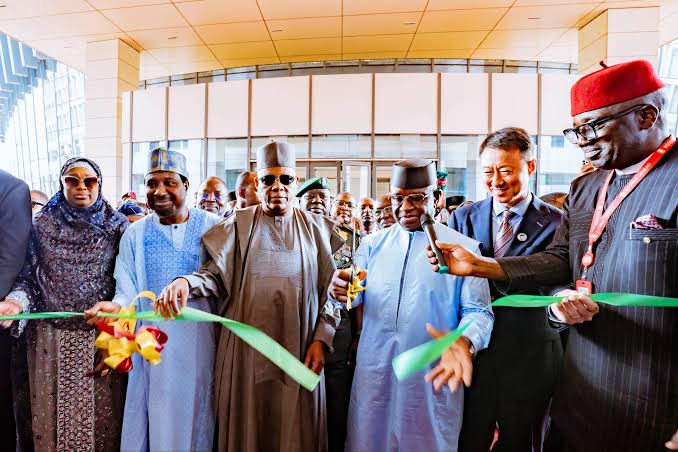
The Economic Community of West African States (ECOWAS) on Thursday inaugurated its new permanent headquarters in Abuja, with leaders describing the complex as a symbol of regional unity, institutional renewal and the deepening strategic partnership between West Africa and China.
The commissioning ceremony brought together senior government officials, diplomats and regional leaders, with Vice President Kashim Shettima representing President Bola Tinubu, while President of the ECOWAS Commission, Dr. Omar Alieu Touray, and China’s Ambassador to Nigeria and ECOWAS, Yu Dunhai, outlined a shared vision for stronger regional integration, economic transformation and closer Africa-China cooperation.
The headquarters, financed by the People’s Republic of China, was presented as more than an office complex, with speakers describing it as a lasting symbol of cooperation, resilience and renewed determination to build a peaceful, prosperous and integrated West Africa.
Touray described the inauguration as “a truly historic milestone” in the life of ECOWAS, noting that the headquarters fulfils a vision conceived during the groundbreaking ceremony in December 2022.
He thanked Chinese President Xi Jinping for supporting the project, saying China had once again demonstrated its commitment to West Africa by providing the regional bloc with a world-class headquarters.
According to him, China’s contributions to ECOWAS extend beyond infrastructure, recalling its support for regional peacekeeping through the provision of military equipment and vehicles, as well as other development interventions across member states.
Touray also praised Nigeria for its support as host nation, citing its provision of land, policy backing and institutional support that made the project possible.
He noted that the Commission had operated from offices spread across different locations in Abuja for decades, creating operational and logistical challenges.
According to him, the new integrated headquarters would improve coordination, efficiency and productivity by bringing Commission staff together under one roof.
The facility comprises a central nine-storey tower flanked by two seven-storey wings, with conference rooms equipped for simultaneous interpretation, archives, banking halls, restaurants, a clinic, gymnasium, shops and a daycare centre.
Touray, however, stressed that infrastructure alone would not deliver progress.
“Buildings do not deliver transformation; people and institutions do,” he said, urging member states to ensure the headquarters becomes a centre of excellence that drives innovation, strengthens collaboration and delivers tangible benefits across the sub-region.
Representing President Xi Jinping, Ambassador Yu described the building as the “Eye of West Africa” and a flagship achievement under the Forum on China-Africa Cooperation (FOCAC).
He said the headquarters reflects China’s enduring support for African integration and the strength of China-Africa relations.
According to Yu, China will continue supporting ECOWAS in promoting regional peace, economic development and improved living standards through cooperation in infrastructure, digital economy, agriculture, food security, trade and investment.
He also pledged full implementation of China’s zero-tariff policy for eligible African exports and called for stronger cooperation in education, culture, youth development and sports.
“China remains forever a trustworthy, sincere friend and a reliable partner to ECOWAS and all West African nations,” Yu declared.
Delivering President Tinubu’s message, Shettima described the commissioning as both the inauguration of a landmark building and a renewal of ECOWAS’ founding commitment to solidarity, integration and shared prosperity.
He commended the ECOWAS Commission for delivering the project and thanked China for financing the headquarters, describing Beijing as a dependable development partner whose economic transformation offers valuable lessons for Africa.
While acknowledging ECOWAS’ achievements in peacebuilding, democratic governance, economic cooperation and free movement, the Vice President warned that the region still faces terrorism, violent extremism, food insecurity, climate change, economic vulnerability, public health threats and youth unemployment.
He urged member states to deepen industrialisation, strengthen regional value chains, expand intra-regional trade and unlock investment opportunities for young people.
“The hour has come to transform our regional market into a regional production base,” he said.
“We must deepen industrialisation, strengthen regional value chains, expand intra-regional trade and unlock innovation, manufacturing and investment opportunities for our young people.”
According to him, West Africa cannot continue to depend on imported goods if it hopes to achieve genuine economic independence.
“Our integration must increasingly be driven by what we produce rather than by what we consume because a community that consumes what it does not make will forever remain at the mercy of the goodwill of others,” he added.
Shettima also urged member states to strengthen political cooperation and collective security while keeping the door open to countries that have withdrawn from ECOWAS, expressing confidence that the new headquarters would serve as a centre for visionary leadership, innovation and collective decision-making.
Michael Olugbode