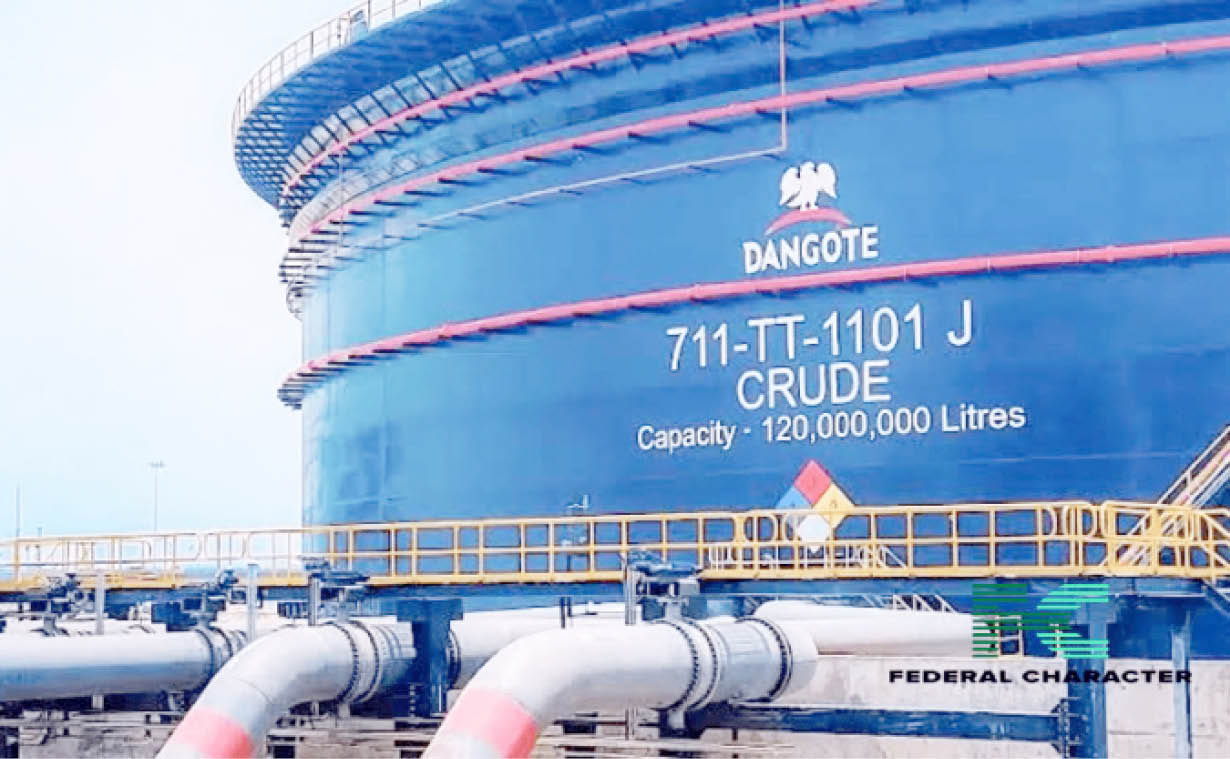
Record production outpaces local demand, marking a major shift in Nigeria’s downstream oil sector…
Nigeria’s fuel market is undergoing a historic transformation, with the Dangote Petroleum Refinery exporting hundreds of millions of litres of petrol after exceeding domestic demand.
New data from the Nigerian Midstream and Downstream Petroleum Regulatory Authority shows that the refinery exported about 434 million litres of Premium Motor Spirit (PMS) in March 2026, signaling a major shift for a country long dependent on fuel imports.
According to the regulator’s latest industry report, the refinery produced roughly 1.49 billion litres of petrol during the month but supplied only 1.06 billion litres to the local market. The surplus driven by strong output and relatively lower domestic absorption was redirected to international buyers.
Operating at an average utilisation rate of 93.62 percent, the facility has rapidly established itself as Nigeria’s dominant refining hub. On a daily basis, production averaged 48.2 million litres, with about 34.2 million litres distributed within the country.
The scale of exports highlights the refinery’s growing footprint beyond Nigeria, as it increasingly supplies fuel to markets across Africa. This marks a dramatic turnaround for the nation’s downstream sector, which for decades relied heavily on imported petroleum products to meet demand.
Industry data further confirms the shift. Gasoline imports into Nigeria dropped sharply in March to about 41,000 barrels per day, the lowest level on record while exports from the Dangote refinery climbed to around 44,000 barrels per day. This effectively pushed the country into a net export position for the first time, albeit marginally.
The refinery is also expanding its geographic reach. In a notable development, it shipped its first gasoline cargo to East Africa, delivering approximately 317,000 barrels to Mozambique, with additional shipments already planned. The move reflects rising demand for alternative fuel sources as global supply chains adjust to ongoing disruptions in traditional markets.
Beyond petrol, the refinery is making a significant impact in diesel supply. It produced about 16.5 million litres per day of Automotive Gas Oil in March but supplied only a small fraction domestically, indicating that most of the volume was also exported.
Despite these gains, Nigeria’s state-owned refineries remain largely inactive. Facilities in Port Harcourt, Warri, and Kaduna contributed little to no output during the period, underscoring the extent to which the Dangote refinery is carrying the country’s refining capacity.
Smaller modular refineries played only a limited role. Operators such as Walter Smith Refinery, Edo Refinery, and Aradel Holdings collectively supplied less than one million litres of diesel per day just a fraction of national demand.
With a nameplate capacity of 650,000 barrels per day, the Dangote refinery is reshaping Nigeria’s energy landscape. Its rising output is reducing dependence on imports, easing pressure on foreign exchange, and positioning the country as a potential export hub for refined products.
Even so, analysts caution that sustaining this momentum will depend on consistent crude supply, efficient distribution networks, and long-overdue reforms in state-owned refining assets.
For now, the message is clear: Nigeria is no longer just an oil producer, it is steadily emerging as a refining powerhouse with growing influence in regional fuel markets.