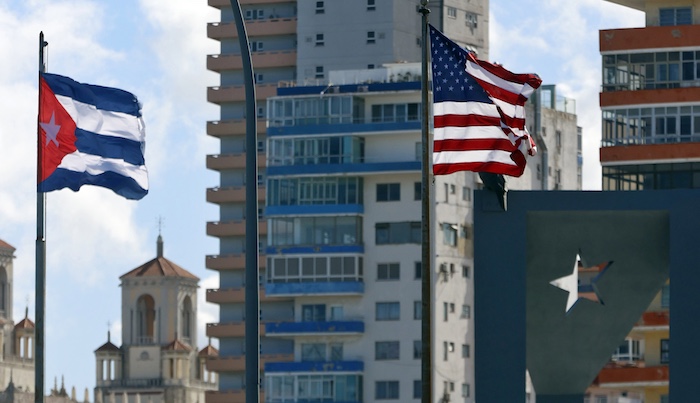
AME4896. LA HABANA (CUBA), 13/01/2026.- Fotografía del 9 de enero de 2026 que muestra las banderas de Estados Unidos y Cuba frente la Embajada de Estados Unidos, en La Habana (Cuba). Cuba llega a su momento de mayor tensión con EE.UU. en décadas en la peor situación nacional desde que triunfó la revolución en 1959, en donde se solapan y retroalimentan las crisis económica, energética, sanitaria, migratoria, social y política. EFE/ Ernesto Mastrascusa
The government of Cuba has accused the United States of escalating economic warfare against the island nation following a sweeping new executive order and fresh sanctions that Havana says could worsen an already severe humanitarian and economic crisis.
In a statement issued Thursday in Havana, Cuba’s Ministry of Foreign Affairs condemned the May 1, 2026 Executive Order signed by the White House, describing it as one of the harshest measures imposed against the communist nation in decades.
The Cuban government also denounced a subsequent decision by the United States Treasury Department on May 7 to place Cuban conglomerate Gaesa and mining company MoaNickel S.A. on the List of Specially Designated Nationals, effectively cutting them off from the American financial system and exposing foreign businesses dealing with them to possible secondary sanctions.
Havana described the move as a “ruthless act of economic aggression” aimed at tightening the long-standing United States blockade against Cuba and isolating the country from global trade and financial networks.
According to Cuban authorities, the latest measures threaten to deepen the island’s economic hardship at a time when the country is already battling chronic shortages of fuel, food, medicine and foreign exchange.
The Foreign Ministry argued that the sanctions go beyond bilateral relations between Washington and Havana by attempting to punish foreign companies, banks and governments that maintain economic ties with Cuba.
“The sovereign right of all states that have or wish to maintain economic, commercial and financial relations with Cuba is being explicitly attacked,” the statement declared.
Cuba accused senior United States officials, particularly the Secretary of State, of using intimidation and political pressure to force the international community into compliance with the blockade policy.
The statement further alleged that the new measures were intended to provoke economic collapse and social unrest within Cuba.
Havana warned that worsening economic pressure could create conditions for instability and potentially serve as justification for more aggressive actions against the island.
The Cuban government also accused Washington of attempting to manufacture a humanitarian crisis capable of triggering political upheaval.
The latest confrontation marks another sharp downturn in relations between the two Cold War-era adversaries whose ties have fluctuated between cautious engagement and hostility over the last six decades.
The United States first imposed trade restrictions on Cuba in the early 1960s following the Cuban Revolution led by Fidel Castro and the subsequent nationalisation of American-owned assets on the island. Relations deteriorated rapidly after Cuba aligned itself with the former Soviet Union during the Cold War.
In 1962, Washington formalised a broad economic embargo against Cuba, arguing that the measures were necessary to pressure Havana toward democratic reforms and respect for human rights.
Over the decades, the sanctions evolved into one of the world’s longest-running economic blockade regimes, affecting trade, banking, investment and travel.
Although there were signs of rapprochement during the administration of former President Barack Obama — including the restoration of diplomatic relations and the easing of some restrictions — many sanctions were later reinstated and expanded under subsequent administrations.
In recent years, Cuba has faced mounting economic difficulties caused by declining tourism revenues, inflation, fuel shortages and limited access to international credit markets.
The Cuban government has consistently blamed the United States embargo for worsening living conditions on the island, while Washington maintains that Havana’s centrally controlled political and economic system is primarily responsible for the country’s struggles.
The renewed sanctions are expected to intensify debates within the international community, where many countries and global organisations have repeatedly called for an end to the embargo.
For more than 30 consecutive years, the United Nations General Assembly has overwhelmingly voted in favour of resolutions urging the United States to lift its economic blockade against Cuba, describing the measures as harmful to ordinary citizens and contrary to international law.
Michael Olugbode