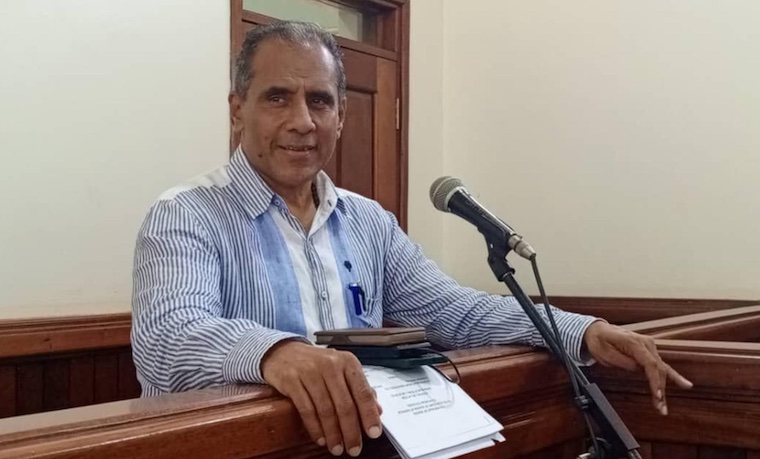
The commercial division of the High court has ruled that businessman Shukla Mukesh and his companies; Shumuk Springs Development Ltd, Springs International Development Hotel Ltd, and Shumuk Financial Services Ltd, have been illegally occupying part of Shumuk House in Kampala.
The ruling follows a protracted legal battle involving the late city businessman Bonney Mwebesa Katatumba and Mukesh over ownership of the commercial property formerly known as Blacklines House, located at Plot 2 Colville Street.
Alongside the broader ownership dispute, the court also resolved a separate contest involving Joseph Ssempebwa and Peter Lule, who claimed interests in 24 of the 92 condominium units that make up Shumuk House.
In his decision, justice Stephen Mubiru, formerly of the commercial division and now resident judge of Mukono, held that both Ssempebwa and Lule have equitable interests that cannot be extinguished.
“As regards the twenty-seven (sic) of the ninety-two (92) condominium units that are the subject of this suit, I find that the two agreements for the sale of property…did not in any way affect the rights of the 1st counterclaimant Mr Joseph Ssempebwa…nor the eleven (11) units which the 2nd counterclaimant Mr Peter Lule purchased from the late Bonney Mwebesa Katatumba,” justice Mubiru ruled.
Background to the dispute
Court records show that Katatumba was the registered proprietor of the commercial building under a 99-year lease that commenced on March 1, 1912 and expired on March 1, 2011. He sold 13 condominium units to Virani Bahadukali Mohamedalli, and separately sold 11 units to Peter Lule for $375,000.
Mohamedalli later sold his 13 units to Joseph Ssempebwa for $725,000. However, Ssempebwa was never given possession after discovering that Katatumba had lodged a caveat on the property during the transfer process.
Subsequently, Katatumba entered into agreements to sell the entire 92-unit property—first to Shumuk Springs Development Ltd for $5 million, and later to Springs International Hotel Ltd for $4 million.
Both agreements required part of the purchase price to be paid to Mohamedalli and Lule to settle their interests. However, court records show that both transactions collapsed after the companies failed to pay the agreed sums in full.
Court’s findings
Justice Mubiru found that Katatumba acted illegally by purporting to sell the entire property without resolving the interests of parties who had already acquired units.
“Virani Bahadukali Mohamedalli…owned the absolute, unconditional legal and exclusive title to the airspace of the specific units,” the judge ruled, adding that under the Registration of Titles Act, Mohamedalli was lawfully empowered to transfer the units to Ssempebwa.
The court further rejected attempts to bind Ssempebwa and Lule to later private arrangements between Katatumba and Mukesh’s companies.
“For lack of mutual agreement and consideration, a third party who never agreed to the contract cannot…be bound by the contract,” Mubiru held.
Compensation and eviction orders
The court ordered that Peter Lule, who took possession of his 11 units, be granted a lease over them and awarded Shs 50 million in general damages. For Joseph Ssempebwa, who never took possession of his 13 units, the court awarded mesne profits amounting to $3,822,000, representing 196 months of lost rental income over 16 years, plus an additional $58,500, all at an interest rate of 6 per cent.
Justice Mubiru further ordered Mukesh and his companies to vacate the 24 condominium units by March 23, 2026, warning that failure to comply would result in forced eviction.
The wider dispute over ownership of Shumuk House between Mukesh and the estate of the late Katatumba remains pending before the Court of Appeal. The High court had earlier ruled in favour of the Katatumba estate and ordered Mukesh and his companies to pay Shs 10 billion in damages.
About the Author