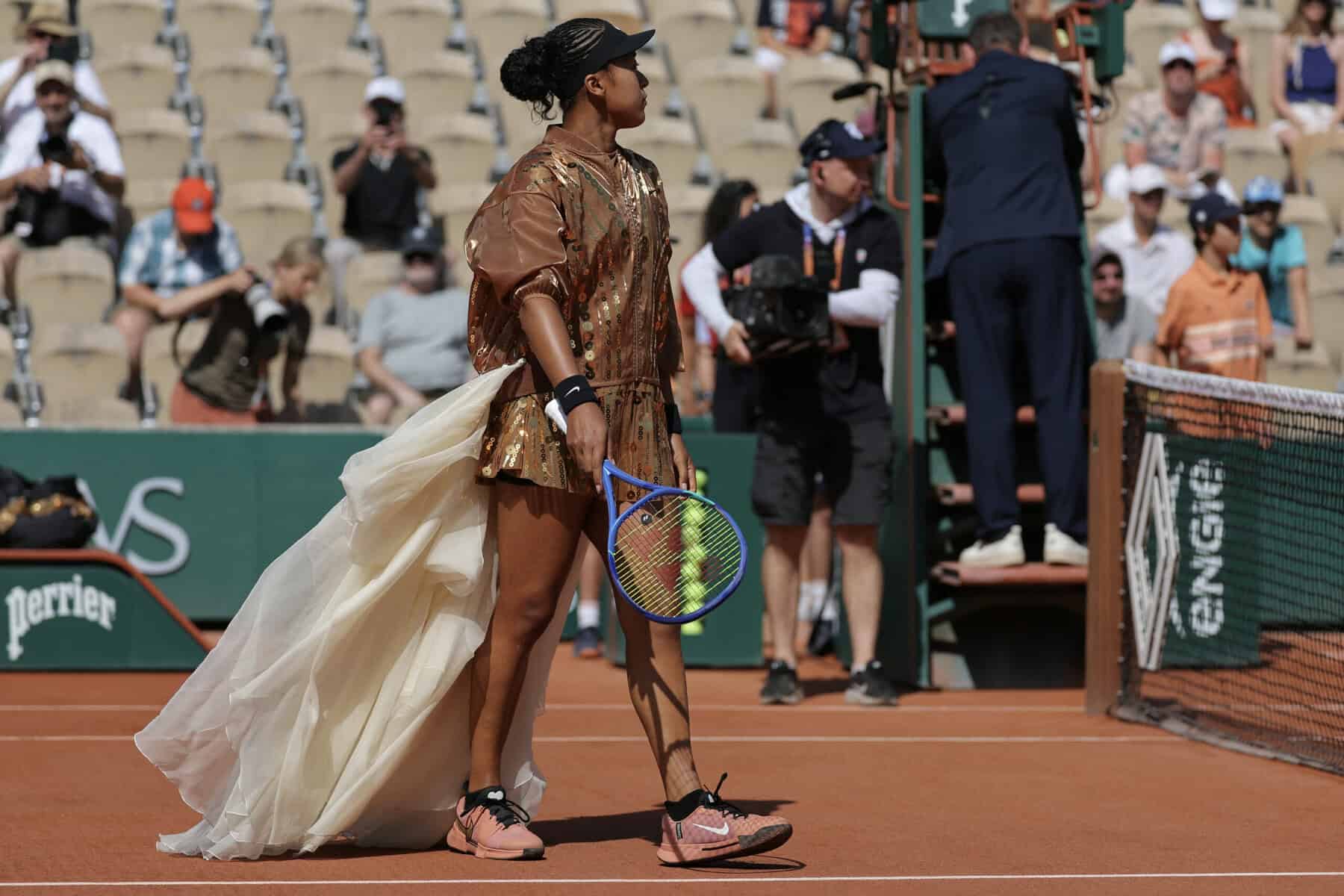
Japan's Naomi Osaka stand on the court prior to her women's singles match against Croatia's Donna Vekic on day 5 of the French Open tennis tournament on Court Simonne-Mathieu at the Roland-Garros Complex in Paris on May 28, 2026. (Photo by Thomas SAMSON / AFP)
There are Grand Slam entrances, and then there is what Naomi Osaka did at Court Suzanne-Lenglen this week.
For her first-round match at the 2026 French Open against Germany’s Laura Siegemund, which she won in straight sets, the four-time Grand Slam champion stepped onto the iconic Parisian clay in a custom two-part ensemble that fused haute couture with high-performance sportswear, drawing gasps, headlines and no small amount of debate along the way.
‘Court-ure‘ in the City of Light
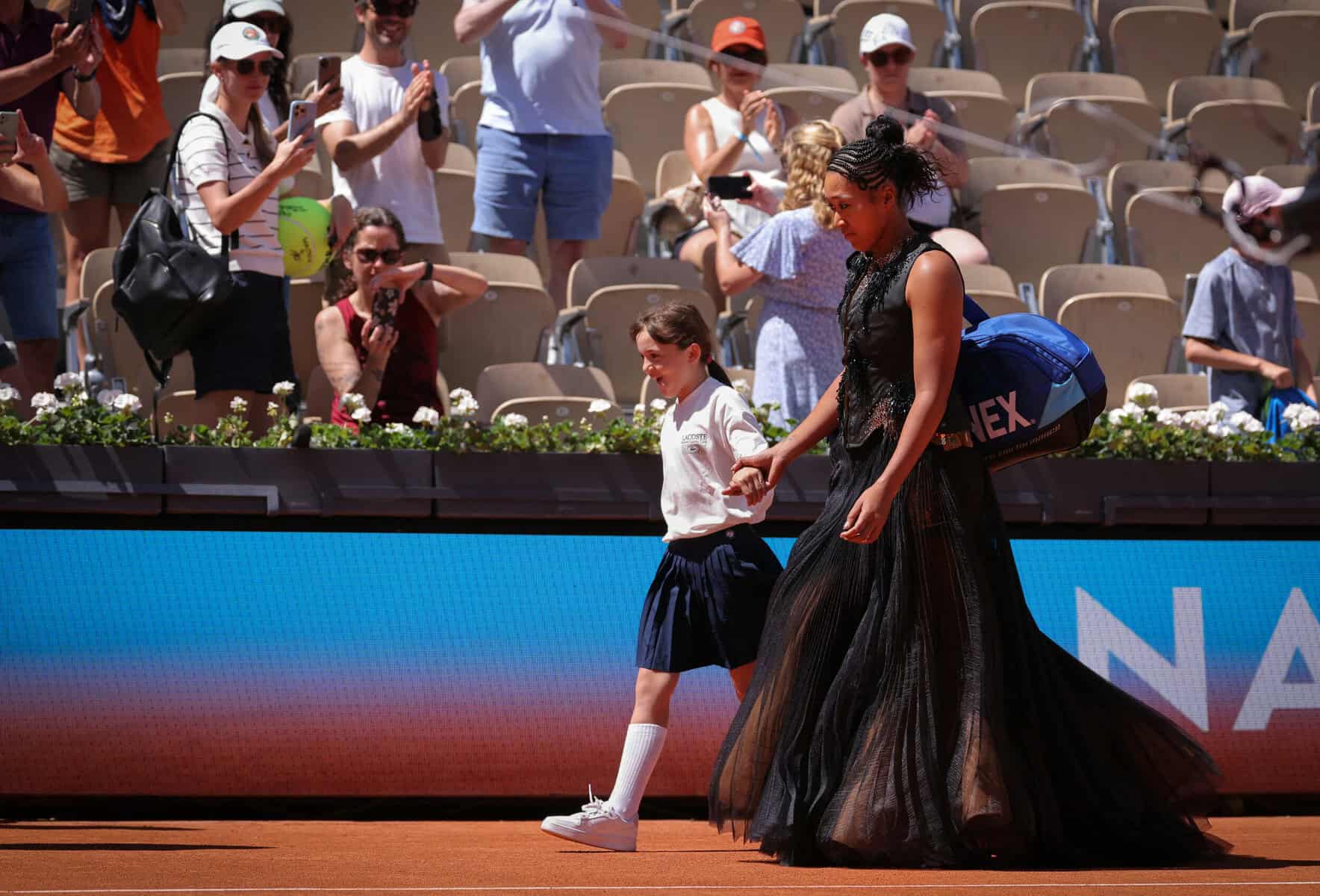
The outer layer was the work of Swiss couturier Kevin Germanier: an all-black, sleeveless beaded corset top paired with a semi-sheer, pleated cascading skirt. Crucially, the skirt was crafted using upcycled and deconstructed elements from Osaka’s own past competition wardrobe – a former tennis skirt, a jacket, and dress lining all finding new life in the City of Light.
Per a report by Vogue, the silhouette, architectural and dramatic, was widely noted as evoking the clean vertical lines of the Eiffel Tower itself.
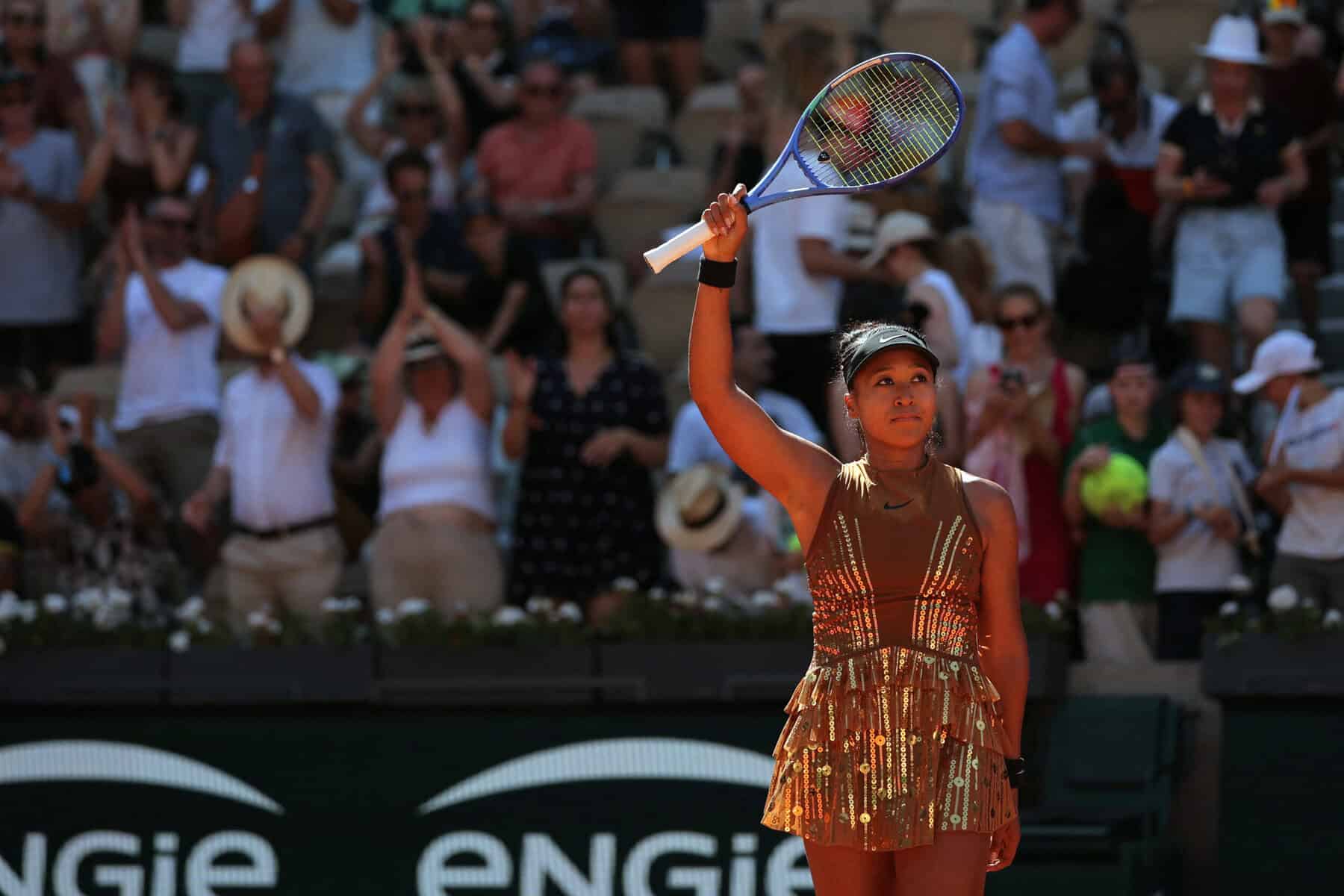
Beneath it, she wore a shimmering gold Nike tennis kit, described variously as a dress or a two-piece set with a peplum top, featuring vertical rows of gold sequins in graduating sizes set against a warm, light brown base. In the Parisian sun, the effect was, by Osaka’s own account, almost alarmingly brilliant.
“When I first saw the match dress in real life, I felt I looked like the Eiffel Tower at night,” she told Yahoo Sports reporters, laughing. “I actually got a little worried because when the sun hits the dress, it reflects a lot. So I was a little scared that the umpire was going to kick me off the court.”
She had, she admitted, packed backup plain Nike dresses, just in case.
Courtside, with help from young fans, Osaka removed the dramatic outer layers before play began, the gold sequins catching the light in a reveal that sent social media into something of a frenzy.
A philosophy of speaking through clothes
Germanier, whose label is known for its commitment to upcycling and circular fashion, described the brief as “romantic yet strong,” a reflection of Osaka’s energy on one of tennis’s most storied stages. The blend of couture craftsmanship and athletic function gave rise to what commentators affectionately dubbed “court-ure.”
For Osaka, however, the look was more than an aesthetic spectacle. She has spoken at length, at Roland Garros and in recent months, about fashion as a primary mode of self-expression, one she traces back to watching Serena and Venus Williams command attention before a single ball was struck.
“I feel like fashion, for me – I tell people, I don’t talk a lot, so that way I can talk through my clothes,” she said in a past interview with The New York Times.
“That means I can be as loud with colours or patterns or fabric as I want. That’s the fun part. I feel like we lost that a little in tennis. I always tell people I grew up with Serena and Venus’ grand reveals. I literally can look at a picture and probably tell you what year that outfit came from.”
She hopes, she added, that her own looks will one day be recalled with similar clarity. Particularly by the next generation of young fans watching from the stands.
The Paris ensemble was also, she noted in a conversation with CNN, “a nod to France and also couture, which is something that I really love.”
The Roland Garros look was not an isolated moment. It follows a jellyfish- and butterfly-inspired ensemble at the 2026 Australian Open and a striking appearance at the Met Gala, together signalling a deliberate and sustained commitment to Osaka’s identity as both athlete and fashion auteur.
Viral praise – and a dash of controversy
The response was, on balance, overwhelmingly positive.
Several established outlets led with effusive coverage, with social media posts amassing millions of impressions under declarations like “Nobody is doing it like Naomi.” World number one Aryna Sabalenka was among those who praised the look.
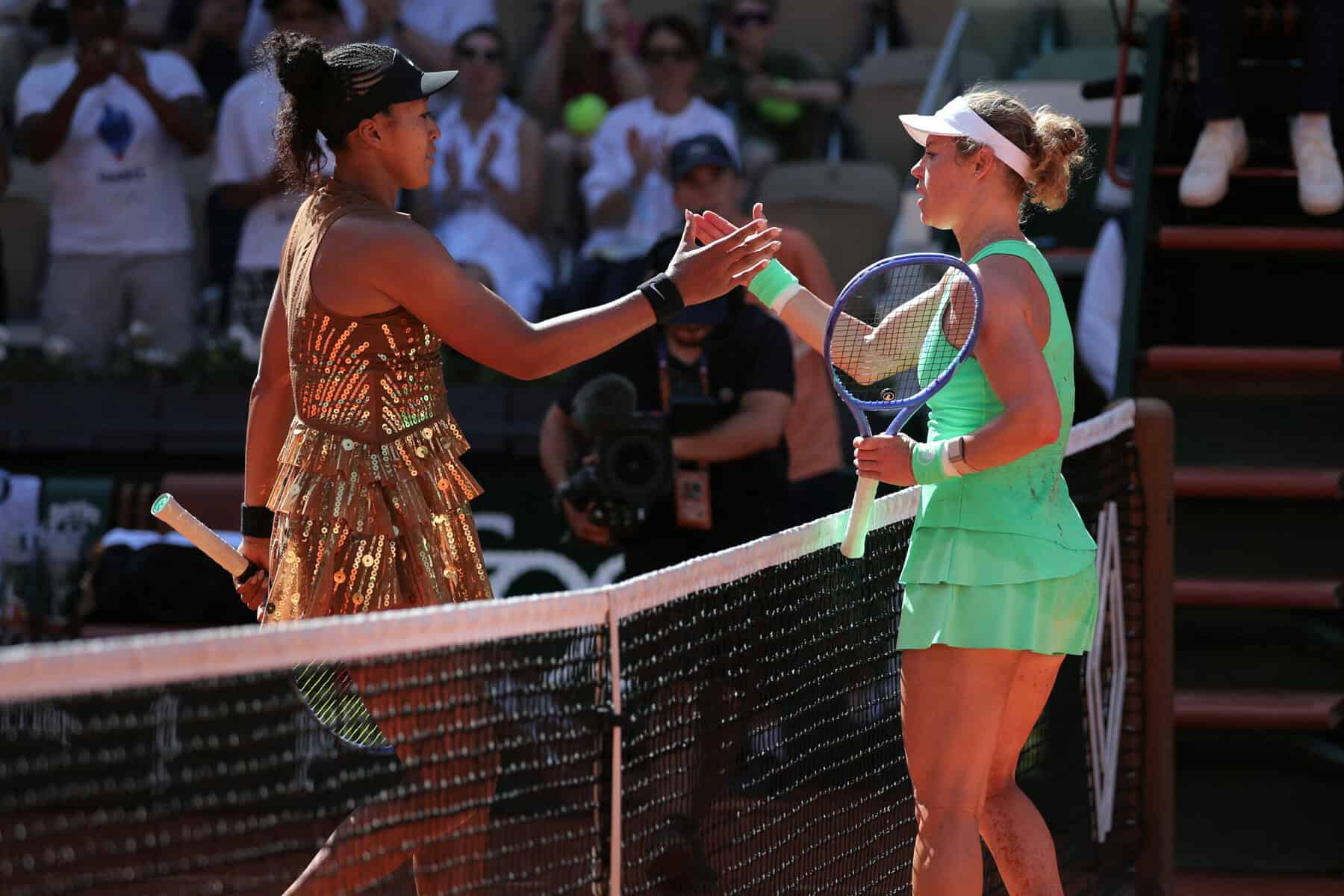
There was, however, some friction. Osaka’s opponent, Laura Siegemund, reportedly expressed irritation at the attention and logistical delays that accompanied the fashion reveal, with some coverage, notably in The Telegraph, framing the episode as symptomatic of a broader tension around the preferential treatment afforded marquee names at major tournaments.
A minority of voices also pushed back on what they characterised as spectacle at odds with the practicality championed by earlier tennis style icons. These, though, were largely drowned out by the chorus of admiration.