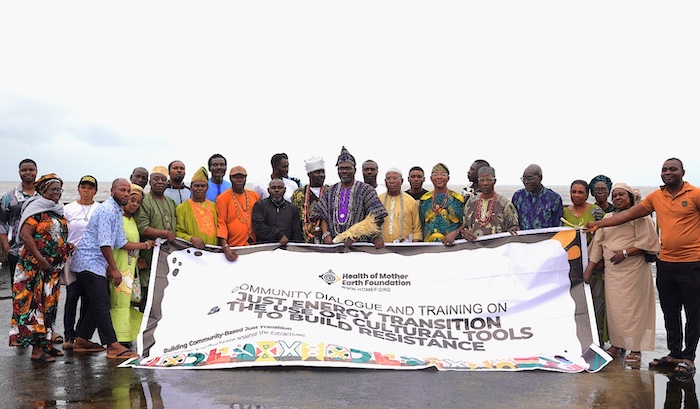
Residents and traditional leaders of the oil-producing Aiyetoro community in Ilaje Local Government Area of Ondo State have raised fresh concerns over the worsening impact of climate change and coastal erosion, warning that the historic coastal settlement is on the verge of extinction unless the Federal Government urgently intervenes with a permanent sea embankment project.
The alarm was raised during a one-day Community Dialogue and Training on Just Energy Transition and the Use of Cultural Tools to Build Resistance organised by the Health of Mother Earth Foundation (HOMEF) at the Aiyetoro Town Hall, where participants also advocated a people-centred transition from fossil fuels to renewable energy that protects host communities and their livelihoods.
Speaking at the event, Community and Culture Lead of HOMEF, Cadmus Atake-Enade, said the global conversation on energy transition would remain incomplete without justice, stressing that local communities must be active participants in decisions affecting their environment and natural resources.
“We need to transit from the use of fossil fuels into renewable energy. What they will not tell you is that there must be justice in the transition. The just energy transition simply states that everyone should be involved in the transition to cleaner energy processes. Communities must be involved in anything concerning their community that any company wants to do,” he said.

According to him, although Nigeria remains one of Africa’s leading producers of crude oil and liquefied natural gas, many host communities continue to suffer poverty, environmental degradation and underdevelopment despite decades of resource extraction. He alleged that extractive activities had been characterised by pollution, ecological destruction and disregard for the welfare of oil-bearing communities.
Atake-Enade explained that HOMEF’s project seeks to promote a just energy transition rooted in indigenous knowledge, cultural values and community participation while encouraging eco-tourism, agroecology and sustainable fishing as alternative means of livelihood. He added that the initiative also aims to strengthen environmental justice movements and push for policies that would accelerate the country’s transition from fossil fuels.
The Ogeloyinbo of Aiyetoro, Oba Oluwambe Ojagbohunmi (JP), painted a grim picture of the community’s plight, saying more than 85 per cent of the town had already been lost to persistent ocean surges over the last decade.
“Aiyetoro is at the verge of extinction. For over 10 years we have been ravaged by serious ocean surge. This has destroyed more than 85 per cent of the community. We need embankments. It has become a save-our-soul situation,” the monarch lamented.
The traditional ruler said community-built infrastructure, including electricity facilities and industries established through communal efforts, had been washed away by the advancing sea.

He appealed to the Federal Government and the international community to intervene, noting that the technology and financial resources required for a sea embankment were beyond the capacity of the state government and the community.
Echoing the monarch’s appeal, a community member, Mr Olaoye Olusegun, recalled that Aiyetoro once had a city hall, sports facilities and a mini stadium, all of which had disappeared as a result of coastal erosion.
“Today, this is the only place left for traditional and social gatherings. If people want to hold weddings, they have to use this place because there is nowhere else. We are citizens of Nigeria, and it is the responsibility of government to protect us and our property. We are crying. Please, they should come to our rescue,” he pleaded.
Another resident, Mrs Arowolo Mofeoluwa Victoria, urged government officials to visit the community to witness its condition firsthand, calling on Ondo State Governor Lucky Aiyedatiwa, whom she described as being from the locality, and the Federal Government to urgently intervene before the community is completely submerged.

Other participants at the dialogue maintained that achieving a just energy transition must go beyond replacing fossil fuels with renewable energy, insisting that it should also prioritise environmental justice, community participation and concrete action to protect vulnerable coastal communities threatened by climate change.
Fidelis David