Screenshot
This is the second and final part I am writing in honour of the silent celebrations marking Nakivubo Stadium’s centenary anniversary.
The first part covered mostly the events which happened from its official opening (April 1, 1926), up to the 1950s. As you read on, you will realize that this part takes you from the 1960s to this day.
UGLY SCENES AT NAKIVUBO STADIUM
To begin with, on Saturday October 15, 1960, the Gossage Cup was played in Uganda at Nakivubo Stadium. It attracted four teams: Uganda, Kenya, Tanzania and Zanzibar. It was played on a league basis.
Both Uganda and Kenya finished top, tied on points. So, the two countries contested the final game, which ended in a stalemate. By then, the football rules did not have extra- time or post-match penalties, and instead, the trophy was shared. This annoyed the Ugandan fans, who stormed the field to beat up the referee.
They accused him of poor officiation. Both the match officials and Kenyan players were assaulted physically, while in other cases, bottles and stones were used. Fortunately, the Uganda Police moved fast to calm the situation.
It was from that moment on, that glass bottles were banned at the stadium. Nonetheless, the incident set a bad precedent, which the stadium management failed to overcome for decades.
NAKIVUBO FOR BIG GAMES
It was around that time that the Muteesa II stadium, Wankulukuku was constructed, hosting both Bika and Masaza football tournaments, but Nakivubo remained the country’s national treasure.
Despite those ugly scenes aforementioned, on January 3, 1961, the Ethiopia national football team came to Uganda for an Olympics qualifier. The tie was played at Nakivubo, with the visitors emerging victorious, 1-0.
This was followed by a football tournament held in 1962 to mark Uganda’s Independence. The impressive Black Stars of Ghana were invited to participate in a mini tournament, which included other teams like the British Walthamstow Avenue FC, Kenya and Uganda.
At the end of it all, Ghana were far too superior and won the cup. By then, the stadium was improved with the installation of floodlights and a wooden inner fence. The stadium also hosted British touring Middlesex Wanderers FC, the Burundi national team, Swedish top Division side, AIK, ATK Mohun Bogan FC from India and the Sudan national team among others.
The venue also hosted several cup events like the regional Aspro Cup, Luwangula Cup, FIAT Cup and the Kampala District League. Nakivubo was rarely a ground that was rested. In fact, in 1965, Nakivubo also hosted the mini tournament for the All-Africa Games qualifiers which had hosts Uganda, Egypt and Kenya.
Uganda topped the group after whipping Egypt 5-1 to qualify for the inaugural Pan Africa Games held in Congo Brazzaville. Notably, in 1968 Nakivubo was where a combined East African select IX side faced off with English side, West Bromwich Albion in a friendly match.
Six Ugandan players featured in the regional select line-up: goalkeeper Joseph Masajjage, Parry Okech, Peter Okee, Polly Ouma, Steven Baraza and Alex Oundo. In the match the visitors nicked the combined East African side 2-1 with Oundo scoring for the hosts.
By and large, Nakivubo has been a platform for showcasing great talents, from football, netball, athletics, boxing and even motorcross.
NAKIVUBO’S NEW LOOK
Before the 1973 Cecafa Cup (formerly Gossage Cup) was held at Nakivubo Stadium in September, government gave the stadium a face lift. The Kampala and Kisenyi wings were roofed with iron sheets.
The concrete seats were also given numbers while the Kirussia wing, which remained uncovered, was improved, too. The dressing rooms for players and referees were renovated. The playing surface was improved with new natural grass and the goal posts were also replaced.
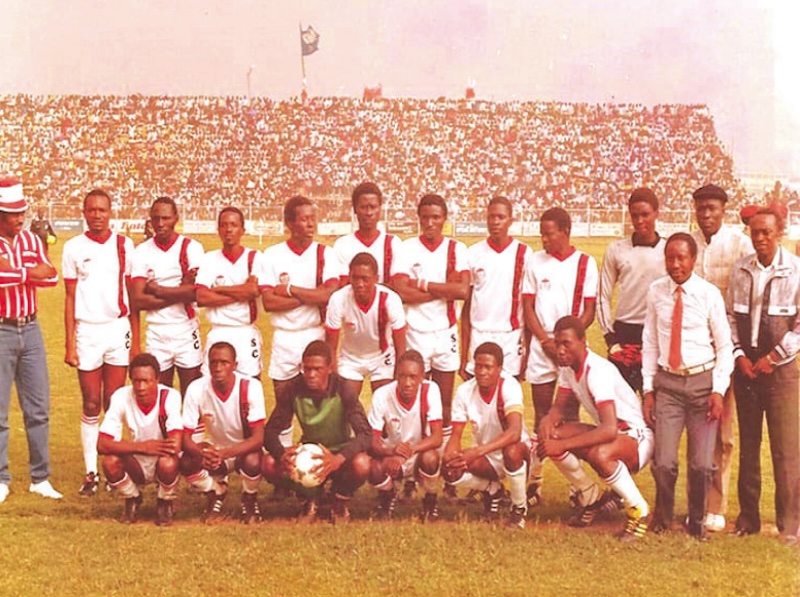
The stadium also got more restrooms, to cater for the increasing number of fans. In the inaugural Cecafa Cup, Uganda defeated Tanzania 2-1, with Polly Ouma and Stanley Mubiru `Tank’ scoring for the Uganda Cranes. Nakivubo also hosted the Africa Club Championship final where Simba (Uganda) lost to Guinea’s Hafia FC 2-3.
President Idi Amin handed over the trophy to visitors. In 1978, the stadium also hosted the first Cecafa club final where Uganda’s KCC defeated Tanzania’s Simba in a penalty shoot-out. This time, however, President Amin handed the trophy to the host’s captain, Sam Musenze.
THE 1984 RENOVATIONS
It was not until 1984, that Nakivubo got a new facelift. Before hosting the Cecafa Cup, both the Ministry of Youth, Culture and Sports, and the National Council of Sports made a couple of changes at Nakivubo.
The Kirussia wing was widened. The pavilion, too, was expanded as well as erecting a bigger inner fence around the pitch.
Notably, in June 1995, President Yoweri Museveni made a Shs 45 million donation to the Uganda Netball Association from which they constructed two netball courts at Nakivubo stadium, ahead of the January 1996 East Africa Netball Championship.
Meanwhile, the stadium did not only host sports events, but even Mega music shows of popular musicians like Franco Luambo’s TPOK Jazz band(1983), Yvonne Chaka-Chaka and South Africa’s Lucky Dube (1995).
However, in the late 1990s, Nakivubo lost some of its land to encroachers. The first to go was the park yard, which used to act as parking space for football loving motorists. It ended up in the hands of vendors and other Kampala businessmen.
In March 2017, government handed the stadium to Hamis Kiggundu’s Ham Enterprises for re-development.