Can it ever be possible to deploy technology for the purpose of extracting palm wine without having to go through the traditional process involving the harzadous risk of climbing palm trees.
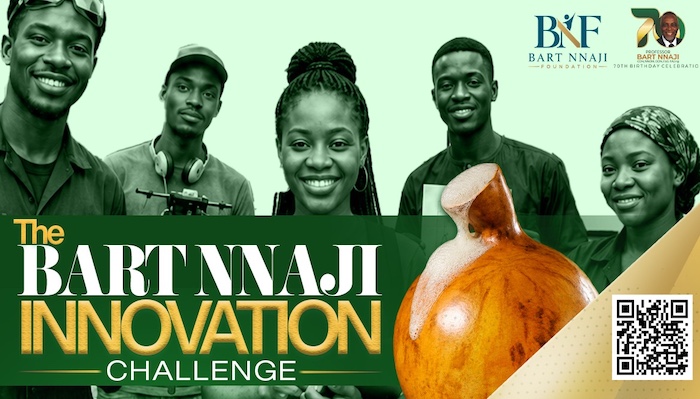
This is the problem that Prof. Bart Nnaji Foundation wants to solve. It has launched a practical innovation competition called the Bart Nnaji Innovation Challenge from which the needed technology for extraction of palm wine could emerge.
In a statement signed by David Nwobodo, the Foundation called on bold thinkers, builders, creators, and problem-solvers to design safer ways of harvesting palm wine without climbing the palm trees.
He said that the challenge is aimed at encouraging practical engineering solutions that can protect lives, support rural enterprise, and modernize palm wine harvesting without erasing its cultural value.
“The challenge focuses on a real and long-standing problem within Nigeria’s traditional palm wine industry: how to preserve an important cultural and economic practice while reducing the risks faced by traditional palm wine harvesters,” the statement said.
The Foundation noted the extraction of palm wine has “for generations remained an important part of community life, supporting families, local traders, small businesses, ceremonies, festivals, and social gatherings across many communities”.
However, it regretted that the traditional method often required tappers “to climb tall palm trees using ropes, pegs, and improvised tools, a process that is physically demanding and dangerous”.
The Foundation pointed out that even the traditional profession of palm wine tapping was already being phased out as there is no guaranteed succession in the trade.
This is because youths are not showing interest in taking up the traditional business of tapping palm wine as a means of livelihood.
Therefore, as many experienced traditional tappers grow older, and fewer young people are willing to embrace such hazardous work, the future of palm wine extraction now requires safer, smarter, and more practical solutions.
“The challenge is simple: design a safe way to harvest palm wine without climbing trees,” the Foundation said, adding that the ultimate goal of the challenge is to protect lives while supporting local enterprise”.
Participants in the innovation challenge are expected to develop practical ideas that can reduce or eliminate the need for tappers to climb tall trees.
Proposed solutions may involve engineering, mechanics, automation, local materials, improved tools, modified harvesting systems, or any creative approach that can make palm wine harvesting safer and more efficient.
In the statement, Professor Ifeabunike Joseph Dioha, a professor of Industrial Chemistry and Energy Studies, and Director of Renewable Energy Projects at the Admiralty University of Nigeria(ADUN), Delta State, was quoted as lauding the innovation challenge.
He described the initiative as a timely intervention that connects science, engineering, innovation, and community development.
“This is the kind of innovation challenge that should excite students, researchers, and practical problem-solvers because it applies science to a real-life problem,” Professor Dioha said.
The former Deputy Director-General of the Energy Commission of Nigeria in the Presidency, Abuja, noted that some of his postgraduate students were already participating in the challenge.
“I am pleased that some of my postgraduate students are participating. It gives them the opportunity to think practically, design responsibly, and contribute to a solution that can have direct impact on society,” he added.
According to the Bart Nnaji Foundation, the innovation challenge is open to individuals and teams with innovative ideas. It said that students, engineers, makers, builders, technicians, researchers, entrepreneurs, and practical problem-solvers should apply and take up the challenge of developing a home-grown technology for palm wine extraction.
The winner of the innovation challenge will receive a grand prize of N10 million while the Foundation would also provide prototype development funding support for the top three finalists.
This is to help them build and test their solutions, while travel support will also be provided for the top three finalists attending the pitch defense.
Entries for the Bart Nnaji Innovation Challenge closes on May 27, 2026 and interested individuals and teams are asked to register through the official competition page: www.bartnnaji.com/competition.
Emmanuel Ugwu-Nwogo