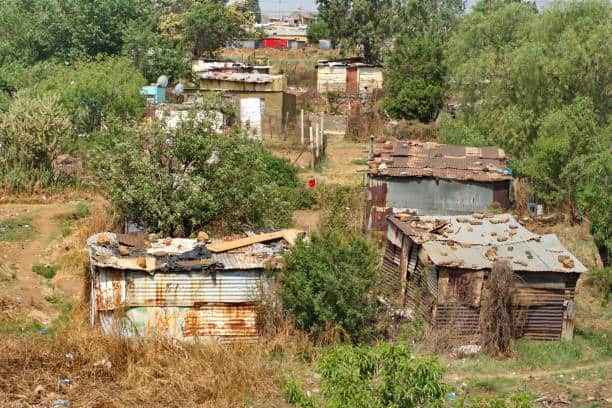
Slum made of tin shacks in Soweto, south of Johannesburg, South Africa
The department of human settlements has opened the Prevention of Illegal Eviction (PIE) from Unlawful Occupation of Land Amendment Bill for public commentary from 16 April 2026.
However, on Tuesday the General Industries Workers Union of South Africa (Giwusa) rejected the proposed PIE Amendment Bill, coining it an “all-out attack on the working class”.
The aim of the Bill
According to Minister of Human Settlements Thembi Simelane, this intervention comes at a time where unlawful land and building occupations across the country have been significantly increasing.
“When they occur, these incidents place a significant financial and administrative burden on us as government as well as the private sector.”
The proposed amendment seeks to empower municipalities, state entities and private property owners to respond more decisively to illegal occupations and evictions.
This while also strengthening the government’s ability to address individuals and organised groups who are responsible for orchestrating these invasions.
Identified challenges
One of the major challenges identified in the current PIE and Unlawful Occupation of Land Act of 1998 is the inconsistent interpretation of this law, which often leads to lengthy legal processes and increased costs.
“The new Bill aims to close these gaps, thus providing greater clarity for everyone involved.” said Simelane.
“There has been a call for commentary from all South Africans including ordinary community members, civil society organisations, and all interested parties to carefully study and review the bill, “and make their voices heard.”
The Bill will be revised by July 2026 after 60 days of public commentary submissions and tabled before the National Assembly by late July or early August 2026.
‘It must be defeated’
However, Giwusa president Mametlwe Sebei says the Bill is an all-out attack on the working class.
“It must be defeated.”
“Millions of people are excluded from access to land and housing.”
“For these people, the occupation of urban land is not a choice, but a necessity.”
He said progressive legislation is needed to resolve the housing crisis, legislation that will place the social value of land before its commercial value.
“This Bill, if adopted will deepen the crisis and open the way to more violent evictions and the criminalisation of popular organisations.” said Sebei.
Criminalising the working class
Under the current PIE Act, courts are required to consider whether eviction is just and equitable, including whether alternative accommodation is available. Giwusa says the new Bill seeks to erode these protections and make eviction easier, faster and more punitive.
“One of the most dangerous aspects of the Bill is the criminalisation of organising,”
It makes it a crime to “incite, arrange or organise” and occupation, even where no money is involved.
According to Sebei this is an attack on collective action and democratic organisation, that carries severe penalties including fines of up to R2 million and imprisonment.
“The basic practices through which working-class communities organise their lives and sustain themselves are redefined as criminal acts.”
He claims that by implementing the new Bill, it further criminalises membership fees and contributions for infrastructure in occupations.
Homelessness on a mass scale
Sebei emphasised that another dangerous provision which opens the door to eviction into homelessness on a mass scale, is that courts can evict people even when there is no alternative accommodation and the state claims it lacks resources.
“The Bill explicitly targets organised action.”
Sebei added that courts are instructed to consider the “pace, scale and frequency” of occupations when deciding urgent evictions.
“Being organised becomes grounds for repression.”
Sebei stressed that when temporary accommodation is provided, it is temporary, and people can be evicted again without a new court order, creating a cycle of displacement and renewed homelessness.
“Taken together, these measures amount to a fundamental shift to the right by the GNU and an all-out attack on the working class and working-class communities.”
‘Clearly unconstitutional’
“Giwusa rejects the attempt to resolve a social crisis through criminalisation and repression.”
Sebei said that the Bill is clearly unconstitutional because it threatens the right to housing and undermines the rights in the Constitution, “many of which are themselves limited and unevenly realised.”
“Evictions do not produce housing. Repression does don’t resolve inequality.”
He emphasised that the Bill’s implementation would intensify conflict, deepen poverty and escalate violence.
Immediate withdrawal
Based on the latest report released by Giwusa, they have called for: the immediate withdrawal of the PIE Amendment Bill, a programme of rapid urban land reform, the expansion of public housing on well-located land, recognition and support for democratic organisation in shack settlements.
“We call on all workers, trade unions, community organisations and progressive forces to oppose this Bill in the public consultation process, through mass action, and in every space where this attack on the working class can be resisted.”
Ministry’s response
Despite Giwusa’s call for resistance, the department of human settlements has noted that the Bill does not lose sight of the rights and needs of vulnerable individuals and ensures that those who require alternative or temporary accommodation following eviction are treated with fairness and dignity.
“At the same time, the PIE Amendment Bill takes a firm stance against criminality.”
It targets those who unlawfully sell land or property that does not belong to them and those who incite unsuspecting people to unlawfully occupy land.
“It proposes stronger measures, including the forfeiture of assets acquired through such illegal means and hefty fines.”
According to Simelane, the measure is ultimately about restoring balance, protecting property rights, supporting municipalities, safeguarding vulnerable communities and strengthening public confidence in the legal system.