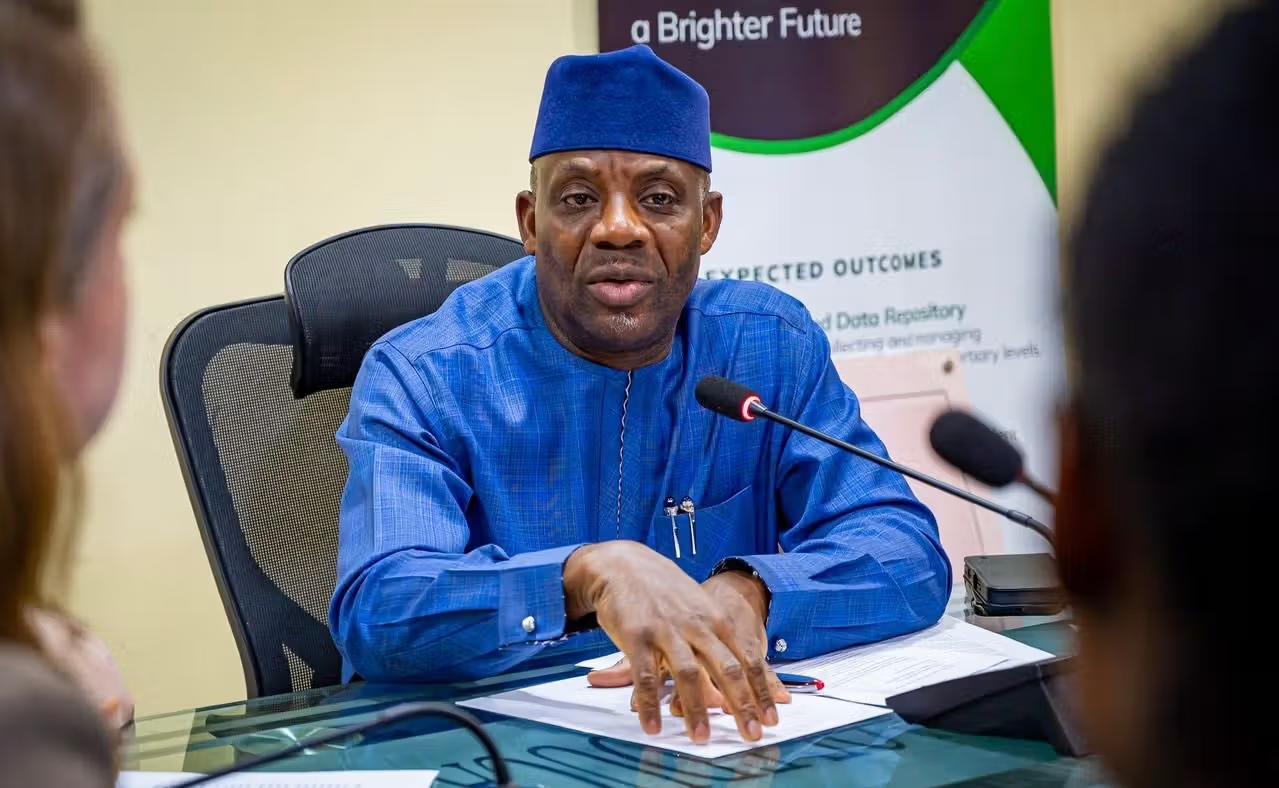
The Federal Government has reaffirmed its commitment to transparency, accountability and the safety of learners across Nigeria, with the Minister of Education, Dr. Maruf Tunji Alausa, assuring lawmakers that the Safe Schools Initiative will be implemented under a strengthened institutional framework.
The assurance came as the Senate Ad-hoc Committee on the Safe Schools Initiative commended the minister for his consistent cooperation with the National Assembly and respect for parliamentary oversight during an interactive session on the implementation of the initiative.
The committee reviewed the utilisation of appropriated funds, international grants and other external support provided for the programme.
Chairman of the committee, Senator Orji Uzor Kalu, praised Dr. Alausa for honouring invitations from the National Assembly and engaging constructively with lawmakers in the discharge of their oversight responsibilities.
Kalu also lauded the minister’s ongoing reforms in the education sector, describing them as bold initiatives that are strengthening Nigeria’s education system and contributing to national development. He reaffirmed the committee’s commitment to supporting efforts aimed at improving the safety of schools, teachers and learners nationwide.
Responding to questions from the committee, Dr. Alausa explained that the funds under review, including international grants, foreign donations and appropriated funds, were disbursed several years before his appointment as Minister of Education. He noted that the Safe Schools Financing Unit responsible for administering the funds was then domiciled in the Federal Ministry of Finance.
Despite this, the minister stressed that the government remains committed to full accountability.
“Government is a continuum. We have a responsibility to account to Nigerians for how public resources have been managed, and we will continue to cooperate fully with the distinguished Senate in the discharge of its constitutional responsibilities,” he said.
Dr. Alausa disclosed that the Federal Ministry of Education has established a full-fledged Safe Schools Department to provide strategic leadership, coordination and oversight of school safety programmes across the country.
According to him, the new department replaces the former unit with a stronger institutional structure and now coordinates the initiative through a unified national framework aimed at improving implementation, accountability and monitoring across Nigeria’s 774 local government areas.
He said the ministry is working closely with the Office of the National Security Adviser, the Department of State Services, the Armed Forces of Nigeria, the Nigeria Police Force, the Nigeria Security and Civil Defence Corps and other relevant agencies to develop and implement a comprehensive national framework for safer schools.
“School safety cannot be handled in a fragmented manner,” the minister said. “The Safe Schools Initiative has many interconnected components that require a coordinated national approach.”
He explained that the renewed initiative extends beyond physical security to include perimeter fencing, solar-powered lighting, water, sanitation and hygiene facilities, surveillance technology, trained security personnel, technology-driven early warning systems and stronger collaboration among federal and state governments, local communities and security agencies.
The minister said the establishment of the dedicated department reflects the Tinubu administration’s commitment to ensuring that every Nigerian child, from foundational to tertiary education, has access to a safe, secure and conducive learning environment.
Dr. Alausa thanked the Senate committee for what he described as its constructive engagement and reaffirmed the ministry’s commitment to working with the National Assembly, security agencies, state governments and other stakeholders to strengthen accountability, improve coordination and deliver sustainable solutions that safeguard schools and improve learning outcomes.
He assured Nigerians that the ministry would continue to provide the leadership, policy direction and strategic partnerships required to build a safer and more resilient education system where every child can learn without fear.