Screenshot
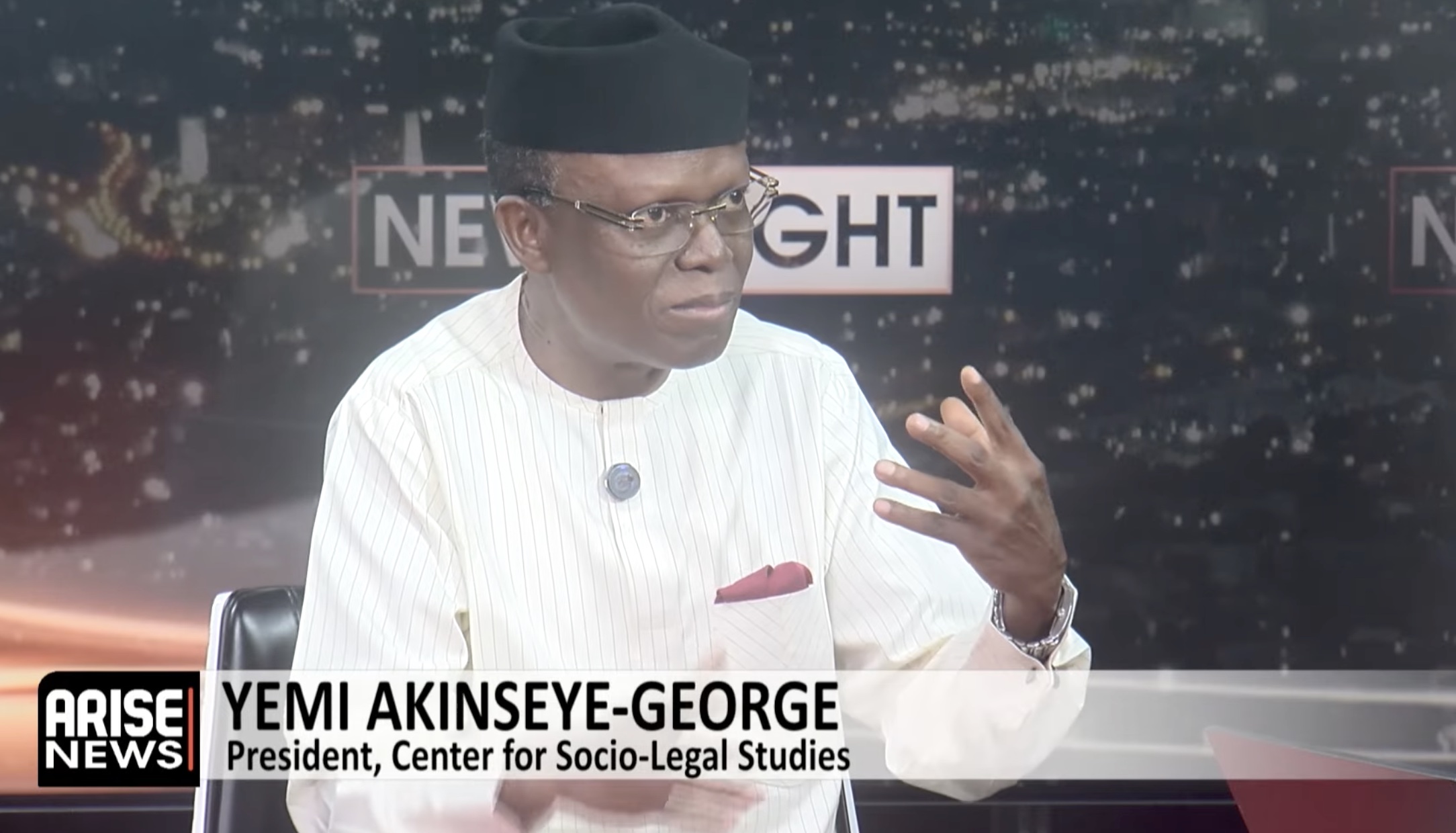
Professor Yemi Akinseye-George, President of the Centre for Socio-Legal Studies, has said it is wrong to make blanket claims that Nigeria’s bail system has become politicised, commercialised or punitive, arguing that every bail application should be determined on its individual merits.
Speaking during an interview with ARISE News on Thursday, Akinseye-George said while concerns over stringent bail conditions have been raised in some cases, judges exercise discretion based on the law and the peculiar facts before them, making it inappropriate to generalise about the entire bail system.
“Bail, it’s a very critical instrument in the administration of criminal justice. It proceeds on the premise that every defendant is presumed innocent until proven guilty,” he said.
According to him, the Constitution guarantees the right to bail for non-capital offences, while the Administration of Criminal Justice Act and corresponding state laws provide the legal framework guiding judges in deciding bail applications.
He explained that judges consider several factors before granting or refusing bail, including whether there is a provable offence, the likelihood that a defendant will appear for trial, the gravity of the alleged offence, the defendant’s influence and the possibility of interfering with witnesses, as well as the defendant’s antecedents.

“You will not generalize and say that bail is abused, bail has been commercialized, bail has become punitive. You can’t make a general statement. You have got to apply that statement in regard to the specific facts of each case,” he said.
On complaints about difficult bail conditions, Akinseye-George referred to a Court of Appeal decision discouraging requirements that only civil servants with landed property in certain locations can serve as sureties, saying such conditions should not become the standard.
He also noted that the Administration of Criminal Justice Act adopts a liberal approach to bail by placing the burden on the prosecution to justify why a defendant should remain in custody.
“The onus is on the state… to place before the court materials in an affidavit to show why that defendant should not be granted bail,” he said.
Addressing concerns over overcrowded correctional centres, he urged greater attention to the large number of indigent Nigerians awaiting trial, arguing that many remain in custody because they lack legal representation or have not had timely access to the courts.
He added that where bail is refused or conditions are considered excessive, defendants have legal remedies, including applying for a review before the trial court or challenging the decision on appeal.
“If a judge imposes conditions that are too onerous, you give bail with one hand and take it with the other. Your counsel has responsibility to approach the judge for a review. If the judge fails to review, you go and appeal,” he said.
Akinseye-George maintained that while concerns over the application of bail conditions should be addressed through the courts and existing legal processes, sweeping conclusions that bail has become politicised or commercialised fail to reflect the case-by-case nature of judicial discretion.
Ademide Adebayo