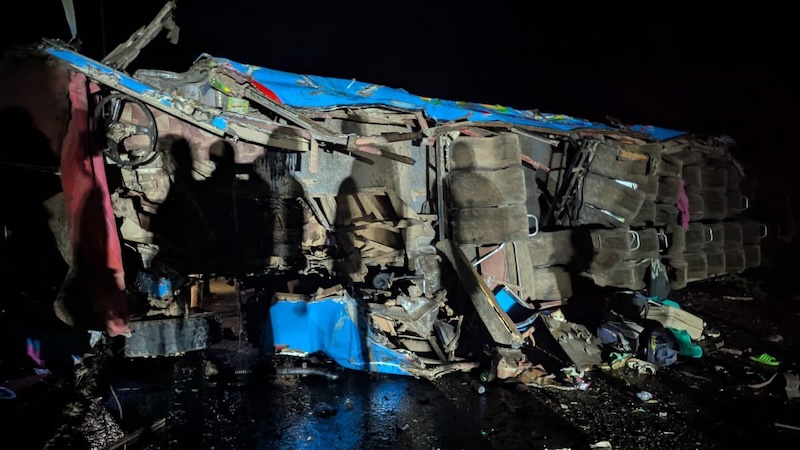
The deaths of 20 pupils and one adult in Friday’s school bus crash in Kapchorwa have reignited calls for Uganda to fully implement smart enforcement, with commercial drivers and road safety experts arguing that technology-driven enforcement could help curb reckless driving before it turns fatal.
An Isuzu bus belonging to King David Junior School in Ndejje was returning from an educational tour to Sipi Falls when it reportedly lost control, crashed into a roadside boulder and overturned, killing 21 people and injuring dozens more.
The tragedy came only hours before another school bus carrying students from Nalango Secondary School collided with a sugarcane truck along the Jinja-Kamuli highway, leaving several students injured.
The twin accidents have renewed calls to the government to accelerate the rollout of automated smart enforcement like the Express Penalty System (EPS). This solution automatically detects speeding and other traffic violations using video cameras and AI-supported Automatic Number Plate Recognition technology.
Timothy Agaba, a bus driver operating on the Kanungu route, said automated enforcement would improve compliance with traffic laws.
“The EPS system would help reduce traffic offences and instil a sense of discipline among drivers because everyone would know that violations cannot go unnoticed,” Agaba said. “Government needs to act fast because the situation is getting out of hand.”
Peter Chekwech, a taxi driver on the Kapchorwa route, said the technology would discourage dangerous driving habits.
“EPS would come at the right time because many drivers would fear the fines. It would reduce recklessness and the impunity we see on our roads today,” Chekwech said.
For long-distance bus driver Deus Okello, who plies the Gulu route, the system offers an opportunity to identify habitual offenders before they cause catastrophic crashes.
“EPS helps in detecting poor drivers early enough. It’s a preventive way of addressing accidents instead of waiting until lives have already been lost,” Okello said.
The calls to the government to implement the EPS project come as Uganda continues to grapple with worsening road safety statistics.
According to the Uganda Police Annual Crime Report 2025, the country recorded 26,044 road crashes, a 3.7 per cent increase from the previous year. Fatal crashes rose to 4,602, while police identified speeding and careless overtaking as the leading causes of road accidents, accounting for more than 40 per cent of all crashes.
Road safety specialist Albinius Twesigomwe said automated enforcement should be complemented by stronger vehicle inspection systems to improve roadworthiness, particularly for passenger service vehicles.
He further recommended that buses and taxis, which transport thousands of passengers daily, undergo mandatory roadworthiness inspections every 90 days, with inspections offered free of charge or heavily subsidised to encourage compliance.
“Preventive inspections are far less costly than the human and economic consequences of fatal road crashes,” Twesigomwe said.
The renewed push for EPS comes weeks after stakeholders endorsed reforms to Uganda’s traffic enforcement regime, including reducing speeding fines to a flat Shs 160,000, extending the payment period from 72 hours to 28 days, establishing an appeals mechanism for motorists, and restricting the 30km/h speed limit to schools, hospitals, markets, places of worship and other high-risk zones.
The proposed reforms are awaiting Cabinet consideration. A similar debate over the fairness of traffic fines has surfaced elsewhere in the region. In Namibia this month, a senior traffic law-enforcement official suggested that lower, more realistic fines would improve compliance rather than simply punishing motorists who are already struggling financially.
Meanwhile, the ministry of Education has suspended all school educational trips pending investigations into the Kapchorwa tragedy, while the ministries of Education, Works and Transport, and Internal Affairs are reviewing additional safety measures for school transport.
Road safety advocates argue that while automated enforcement alone will not eliminate crashes, combining the EPS with regular vehicle inspections, mandatory speed governors, stricter licensing standards and continuous driver education could significantly reduce the country’s persistently high road death toll.