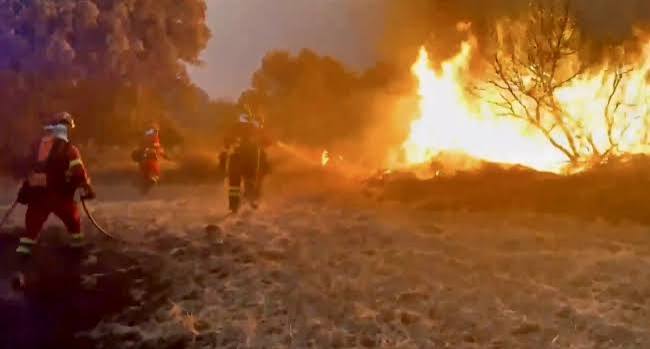
Military joins firefighting efforts in France as blazes near Bordeaux and Madrid overwhelm emergency crews, destroy thousands of hectares and trigger mass evacuations……
More than 160,000 people have been forced to flee their homes as devastating wildfires continue to sweep across parts of France and Spain, prompting military intervention, widespread evacuations and appeals for assistance from the European Union.
The blazes, which have burned uncontrollably for several days, have stretched emergency responders to their limits, with hundreds of firefighters battling flames around the clock in what officials describe as one of the worst wildfire crises either country has experienced.
In France, President Emmanuel Macron ordered the deployment of military personnel to reinforce firefighting operations as the country’s largest wildfire on record continued to spread through the Gironde region near Bordeaux.
French Interior Minister Laurent Nunez described the scale of the disaster as unprecedented, saying the country had never before faced wildfires of such magnitude.
Authorities said the blaze has already consumed about 22,000 hectares of land an area roughly twice the size of Paris while threatening communities surrounding Bordeaux, including parts of the region famous for its world-renowned vineyards.
Prime Minister Sebastien Lecornu convened an emergency meeting of senior government officials and announced the deployment of 1,000 military personnel to support ongoing firefighting operations.
He also confirmed that 1.5 million protective face masks would be distributed to residents and emergency workers exposed to heavy smoke across the Gironde department.
The fires have forced the evacuation of approximately 141,000 people in southwestern France, including around 44,000 residents and holidaymakers from the upscale Cap Ferret peninsula. Hundreds of evacuees were transported to safety by boat as emergency shelters were opened in schools, gymnasiums and other public buildings.
Among those displaced was 49-year-old Caroline Larrode, who sought refuge in a large emergency shelter in Bordeaux after fleeing her home in Saumos with her three cats.
Authorities said about 40 firefighters have been injured while battling the Cap Ferret blaze. Earlier this week, three firefighters also lost their lives in separate wildfire incidents in France and Italy.
Across the border in Spain, at least 25,000 residents have been evacuated from communities west of Madrid, while nearly 40,000 others have been instructed to remain indoors because of the thick smoke and advancing flames.
The smell of burning reached central Madrid on Saturday as Prime Minister Pedro Sánchez prepared to visit the affected region and attend an emergency response meeting in Cenicientos, one of the communities hardest hit by the disaster.
Officials said two of the three major fires burning near Madrid have merged into a larger blaze, raising fears that they could combine further into an even more destructive wildfire just a short distance from the Spanish capital.
Carlos Novillo, the Madrid regional government’s environment official, said firefighters were struggling to contain the rapidly expanding fire, describing the situation as being beyond current firefighting capacity.
One evacuee, audiovisual technician Luis, said he had spent part of the day helping other residents escape before receiving evacuation orders for his own hometown.
He described the emotional toll of leaving behind the place where he grew up, saying uncertainty over the fate of his home had left him feeling both frustrated and helpless.
Spanish authorities expressed cautious optimism after weather forecasts predicted slightly cooler temperatures, which could improve firefighting conditions. However, officials warned that changing wind patterns could continue to complicate efforts to bring the flames under control.
Elsewhere in Spain, the country’s largest active wildfire remains in Guadalajara province, about 100 kilometres north of Madrid, where it has already destroyed roughly 32,000 hectares of land.
Scientists have linked the intensity of the fires to prolonged heatwaves and exceptionally dry conditions that have affected large parts of southern Europe in recent months. They say climate change is increasing the frequency of extreme weather events, creating conditions that allow wildfires to spread more rapidly and become more destructive.
With firefighters still battling multiple fronts in both countries and thousands of residents displaced, authorities have continued to urge people in affected areas to follow evacuation orders and emergency safety instructions as efforts to contain the blazes intensify.