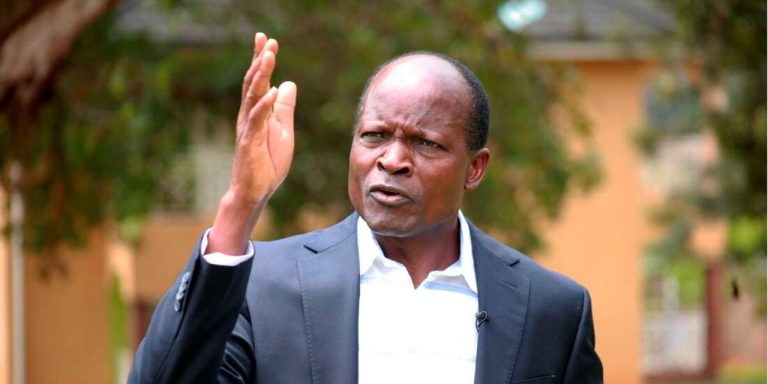
I was preparing my review to the just concluded 2026 Fifa World Cup when news filtered in, on Friday evening July 17, that General Moses Ali had passed on at Nakasero hospital.
Ali had been sick for some time and had reportedly spent two days on a life support machine before he breathed his last. At 87 years, Ali had been a Member of Parliament, representing the people of Adjumani West Constituency.
Undoubtedly, Ali was a Statesman, who unified the people of West Nile through his political approach that was non- abrasive.
LOVE FOR FOOTBALL
Yet even more remarkable, was Ali’s contribution to the development of sports in this country. Ali’s involvement in football, particularly, was markedly about honesty, dignity and passion.
I remember when Ali was the sports minister, back in the late 1980s, it was his undying efforts behind the scenes that ensured that the Uganda Cranes won the Cecafa Cup title in 1989 after 12 years in the cold.
Due to Ali’s influence, the team was backed with the necessary logistics to enable it compete more than it had done in the past. Of course, this did not just happen out of the blue. Ali had been an ever present figure in Uganda’s stadiums, especially Nakivubo, to support his beloved Express FC.
But this also allowed him to watch a host of other club players that made The Cranes team then. He knew them well, and therefore, expected a lot bearing in mind the amount of potential a host of them had at the time.
Ali knew that backing a team with players like his very own club’s Isaac Nkaada in defence and Majid Musisi (RIP) would definitely be a worthwhile move. Ali had seen vividly how such players battled one another in the Super League, and therefore had enormous potential to conquer the Cecafa region as well.
While Ali might not have played top level football, he had passion for it. But at the same time, he stood out as one of the few gentlemen that were principled and honest.
A HUMBLE GIANT
On a personal note, he was a down- to-earth man, who freely mingled with ordinary folks, something which continued to endear him to the general public. Like the rest of us suffered from the excesses of football hooliganism, so did Ali.
Back in 1997, when an Express and SC Villa game turned violent at Muteesa ll Stadium at Wankulukuku, Ali was among the rest of us, as we crawled out of the stadium to safety, after tear gas canisters were fired by the riot Police. Ali truly had his hands dirtened by football, despite his status as a government minister.
SPORTS AND POLITICS
Ali joined the military in late 1960s alongside the likes of Captain Mohammad Seruwagi and Colonel Abdallah Nasur. However, when Amin became President in 1971, his soldiers controlled and managed sports.
But Ali remained focused on politics and military affairs, after President Amin appointed him Minister of Finance. Yet, because of Ali’s passion for Sports, he usually released funds to facilitate Uganda’s teams participating in international sports engagements.

Ali also went further to convince President Amin to buy rally cars from England for Ugandan drivers in 1975, for the OAU Rally Championship that was hosted in Kampala. But in 1978, Ali was sacked as Minister, which compelled the army man to flee to South Sudan.
After Amin’s government fell, leading to the eventual return of Apollo Milton Obote as President in the early 1980s, Ali waged war against that regime through his Uganda National Rescue Front (UNRF), which was commanded by Major Amin Onzi.
ALI JOINS THE MOVEMENT
When President Yoweri Museveni took over power in January 1986, Ali agreed to work with him and he was appointed to several ministerial positions until his death. His first sports assignment was Minister of Youth, Sports and Culture in 1989, replacing Doctor Edward Kakonge.
This followed Uganda’s poor showing at the 1988 Seoul Olympics. In the same year, the Uganda Cranes failed to get out of the group stages of 1988 Cecafa Cup held in Malawi. This was unprecedented.
As if that was not bad enough, government’s funding was poor, as it had been decided that the Uganda Cranes withdraw from both the 1990 Afcon and the 1990 Fifa World Cup qualifiers.
ALI TO THE RESCUE
All this stopped once Ali became Sports Minister. He swung into action and made changes at the ministry and also in federations. He started with football, inviting the Zimbabwe national team, which played a couple of games with both the Uganda Cranes and some domestic clubs.
He also helped ensure that the Uganda Cranes played in the Arab Friendship and Sports Games which were held in Kuwait in November 1989. Ali travelled with the team to Kuwait and he was impressed with the team’s performance there.
Uganda Cranes finished runners- up to Iraq, which won the trophy after a penalty shoot-out. A beaming Ali gave each of the team members $100 from his pocket. At the time, Uganda played against Lebanon, Iran and Iraq.
It was from that tournament, that the Uganda Cranes travelled direct to Nairobi, Kenya for the Cecafa Cup. While there for the two week tournament, Uganda did wonders when they defeated Malawi in a penalty shoot-out during a dramatic and heart- stopping final.
Ali’s contribution and support esnsured that The Cranes ended their 12 year Cecafa Cup drought. He ensured that the entire Cranes team met President Museveni at Nile hotel, now Serena, for a golden handshake.
Each of the team members received Shs 500,000 from the President on that occasion, all thanks to the wittiness of Ali as Sports Minister. Uganda were able to defend their Cecafa title in 1990, when they travelled to Zanzibar, beating Sudan 2-0.
This was followed by another big reward from government for the players and coaches. Under Ali, Uganda also returned to the Commonwealth games in 1990, where they had last participated in 1982 in Brisbane, Australia.
So, the 1990 games in Auckland, New Zealand saw Team Uganda finish eleventh overall, winning four medals in boxing. Justin Juuko and Godfrey Nyakana both won gold, while Abdul Kaddu Sabatta and Charles Matata returned home with bronze medals.
Again, it was Ali’s efforts that ensured that the Uganda Cranes registered for the 1992 Afcon qualifiers and also helped Team Uganda feature in the 1992 Olympics, held in Barcelona.
ALI THE FUFA BOSS
In 1990, the plain-speaking minister was up in arms with the Uganda Olympic Committee (UOC). Ali blocked the UOC founding members from participating in the March 30, 1990 elections.
The 12 founding members claimed to be UOC life members, and threatened to sue the minister if he did not change his directive. Ali stuck to his guns and asked the embattled UOC founders to go ahead with the civil suit, but at the end of the day Ali won the battle.
In April 1990, Ali was arrested and charged with treason and terrorism and was sent to prison. However, those charges were dropped in 1992. In April 1994, Ali surprised sports pundits and fans too, when he offered himself to stand for Fufa leadership.
For starters, in 1994, Fifa asked government through National Council of Sports (NCS) to put a Fufa Intermediary Committee (FIC) for one year before a new Fufa executive was put in place. Ali stood against Godfrey Kwizera (who represented John Baptist Semanobe’s camp). He won the elections and served for a year.
In his time, Ali made sure Fufa drafted a new constitution as per Fifa’s requirements. On August 18, 1994, NCS and a Fifa representative from Europe organized elections which brought Hajji Twaha Kakaire into office.
Ali handed over power to his successor without the usual chaos. That was Ali for you: Selfless, respectful and humble! He was soon returned to government, where he served until his passing.