Nigeria and Germany have reaffirmed their commitment to achieving universal electricity access by 2030, signing a joint statement to strengthen their long-standing partnership on sustainable energy, digital innovation and private sector investment.
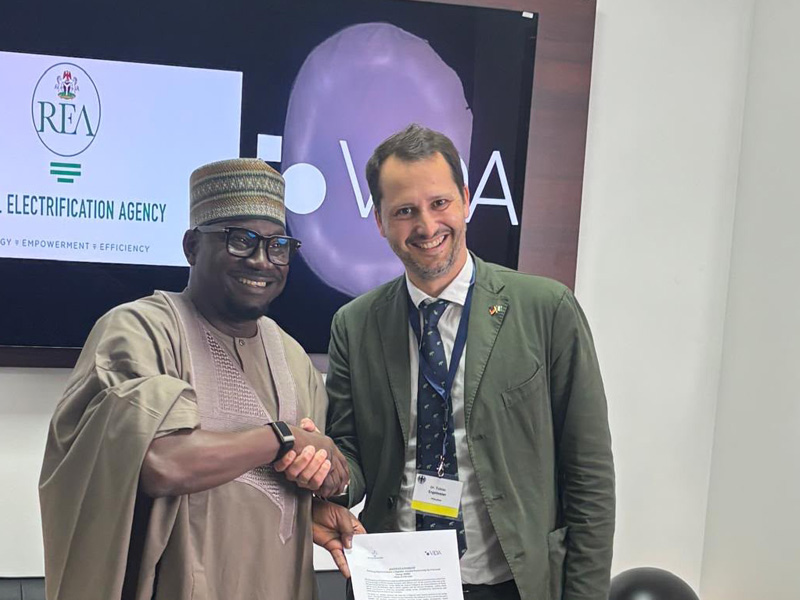
The joint statement, signed in Abuja on Tuesday by the Managing Director/CEO of the Rural Electrification Agency (REA), Dr Abba Aliyu, and the Chief Executive Officer of VIDA.place GmbH, Dr Tobias Engelmeier, follows the visit of German Federal Minister for Foreign Affairs, Dr Johann Wadephul.
According to the statement, the partnership is aligned with Nigeria’s National Energy Compact under Mission 300, which targets universal access to electricity by 2030.
It said: “The Government of Nigeria has set itself an ambitious goal of achieving universal access to electricity by 2030 through its National Energy Compact under Mission 300.”
The statement noted that Germany has remained one of Nigeria’s most trusted energy partners for nearly two decades, with cooperation expanding beyond policy dialogue into renewable energy market development, digital innovation, technical capacity building and private sector mobilisation.
It described the REA as the centre of Nigeria’s energy access transformation, highlighting the agency’s role in implementing large-scale decentralised electrification programmes.
The statement added: “REA has already brought electricity to 4.5 million Nigerians, one of the fastest electrification efforts anywhere in the world.”
It also highlighted the role of German artificial intelligence and data company VIDA, whose analytics and mapping platform supports electrification planning under the Distributed Access through Renewable Energy Scale-up (DARES) Programme.
According to the statement, VIDA’s technology has enabled the REA and the World Bank to “save over USD 100 million in public funds, extend electrification to harder-to-reach communities through better targeting, and make subsidy allocation transparent and simple.”
The statement said the platform has also given private sector companies access to market intelligence, helping to accelerate investment in new electricity connections.
It further noted that Nigeria’s data-driven approach to energy access is becoming a model for other African countries, with the REA-VIDA platform already serving as a reference for governments pursuing universal energy access under Mission 300.
The two organisations said they are now extending their collaboration, reaffirming the commitment of Nigeria and Germany to harness digital innovation, data and artificial intelligence to support universal energy access and sustainable economic development.
Faridah Abdulkadiri