Screenshot
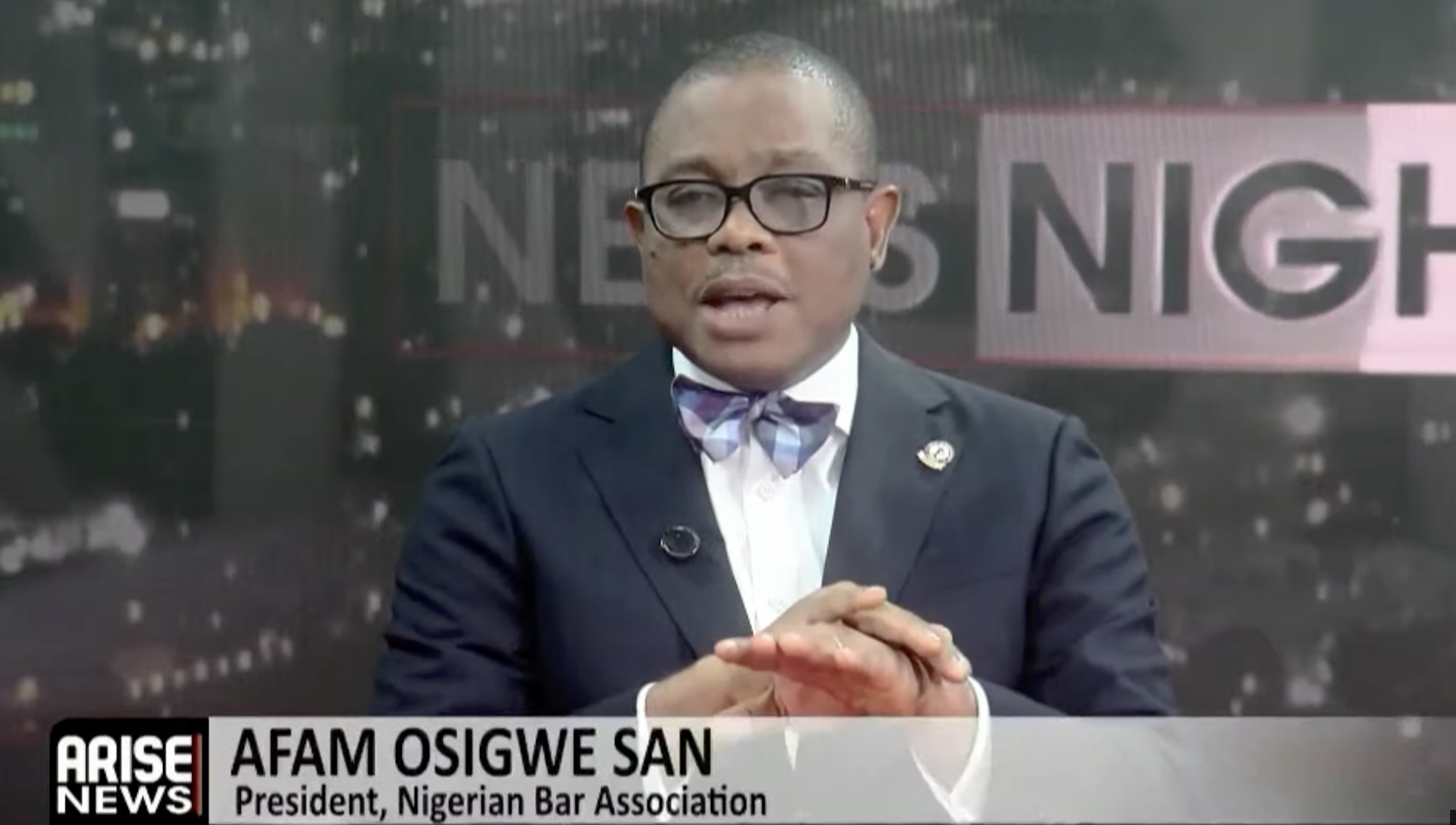
The president of the Nigerian Bar Association, Senior Advocate of Nigeria, (SAN), Afam Osigwe, has insisted that the Attorney General of the Federation has no legal authority to postpone the association’s forthcoming national elections, warning that any attempt to subject the NBA’s electoral process to executive control would undermine the Bar’s independence and violate its governing laws.
This comes after the Attorney General of the Federation, Prince Lateef Olasunkanmi Fagbemi, (SAN), reportedly issued an advisory directive to postpone the 2026 NBA’s July 18 national elections, called for the disbandment of the Election Committee, and proposed the introduction of the National Identification Number (NIN) as part of the voter verification process amid disputes surrounding the electoral exercise.
Speaking with ARISE NEWS on Friday, Osigwe maintained that while the Attorney General is entitled to express his views, he lacks the legal authority to issue directives to the NBA, stressing that the association’s affairs are governed by its Constitution, the Legal Practitioners Act and other applicable rules.
“No, obviously not. He doesn’t have the legal bs king to postpone our elections.
“Suggesting that he does would mean that the NBA is no different from a department under the Office of the Attorney General of the Federation.
“That is not to suggest that if the Attorney General gives views, the Bar would not consider them. But the fashion the directives were couched—as a must-do directive—would be unacceptable for the Bar to willingly carry out. We have a constitution, the Legal Practitioners Act, and other rules that regulate the profession. In none of these instruments was the Attorney General given the power to do what he is trying to do,” he insisted.
Addressing the controversy over zoning and calls for a consensus candidate, Osigwe argued that the NBA Constitution clearly sets out the eligibility requirements for contestants and does not recognise endorsements by external groups as a basis for qualification or disqualification.
He maintained that any eligible member is free to contest and urged stakeholders to campaign for their preferred candidates rather than seek to impose them on the association.
“First of all, the NBA constitution lists conditions for eligibility to contest. You must have been a member of the National Executive Council of the NBA for at least two years preceding the date of your nomination. You must be at least 15 years post-call. You must have paid your practice fee and branch dues for the three years preceding the election, including the year of the election,” he outlined.
“There is no provision in the NBA election guidelines that changes eligibility based on being presented by any specific group, whether known to the NBA constitution or not. This simply means that once you meet these conditions in your own right, if you have the confidence to run, you can run.
To suggest that a group—which, like the NBA, is registered with the Corporate Affairs Commission—can sit in their own corner, choose their person, and then insist that the Bar must accept them or face being delegitimized is illogical. They accuse the Bar of various things and turn around to accuse others of trying to impose a candidate, when they are actually the ones imposing a candidate. The NBA promotes the rule of law. For as many persons as want to run for office, it is their right,” he stressed.
On the prospect of a female NBA president, Osigwe said the presence of a woman in the race reflects the association’s commitment to equal opportunity, stressing that the presidency is open to any member who meets the constitutional requirements, regardless of gender.
“It suggests that any qualified person can be the president,” he said.
The NBA president also defended the NBA’s decision to invite independent observers, including international partners and civil society organisations, saying the move underscores the association’s commitment to transparency.
He maintained that all concerns raised about the electoral process had been addressed and urged contestants to test their popularity at the polls rather than seek a postponement of the election.
“We are working to ensure that the election is free and transparent, and that all participants, whether voters or contestants, trust that the process is fair. All concessions to assuage the fears of those who claim the election will be rigged—in the absence of any proof—have been addressed to give them comfort. That is why we say there is no reason to postpone the election. Everything is in place, and the electoral body is ready to conduct it. Go out there and test your popularity; don’t drag the association down or tarnish people’s images. May the best man or woman win.
“That is why we invited the EU, YIAGA, and the embassies. So that those who are accusing us know that we are accountable, and we want people to come and see the transparency,” he concluded.
Favour Odima