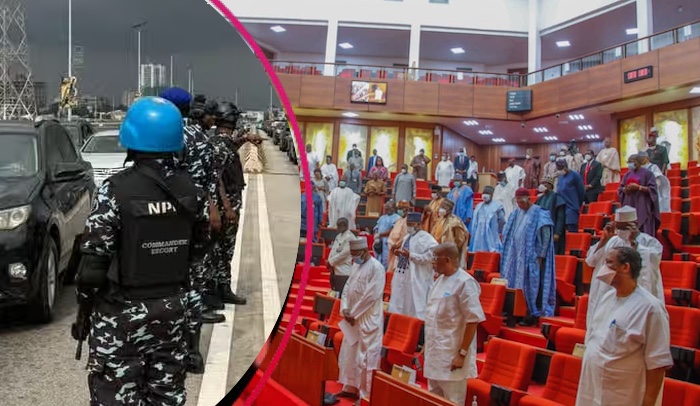
Leader of the Senate, Senator Opeyemi Bamidele, on Wednesday, said funding of the proposed state police services should be established as a first-line charge in the 1999 Constitution, stressing that it is the only way to protect it from possible interference by state governors.
Bamidele insisted that financial autonomy was key to prevention of political interference and protection of the integrity of the new policing structure.
Similarly, Speaker of the House of Representatives, Hon. Tajudeen Abbas, said a proper funding mechanism must be well spelt out before the establishment of state police.
Bamidele, who also served as Vice Chairman of the Senate Committee on Review of the 1999 Constitution, warned that without constitutionally guaranteed funding, the proposed state police could become vulnerable not only to manipulation by governors but also to undue influence from powerful business interests, cabals, and criminal networks.
The senate leader made the remarks while responding to concerns raised by stakeholders over the proposed constitutional amendment seeking to establish state police, according to a statement by his Directorate of Media and Public Affairs.
He acknowledged that the reservations expressed by Nigerians over the proposal were legitimate and deserved careful consideration.
According to him, “Nearly all the public concerns on the state police proposal are well founded and, obviously, cannot be swept under the carpet considering their weight and enormity.”
Bamidele stated that many of the concerns stemmed from Nigeria’s experience during the First Republic, when the 1960 and 1963 constitutions empowered regional governments to establish their own police forces, a development that was widely criticised for political abuse.
He, however, assured Nigerians that the National Assembly was building robust constitutional safeguards to ensure that the proposed state police system operated independently, professionally, and in the public interest
He disclosed that lawmakers were considering a multi-layered framework that would guarantee discipline among personnel, institutional independence, and fiscal autonomy.
Central to the proposal, he said, was a constitutional provision making the funding of state police services a first-line charge, similar to the financial arrangement already guaranteed for the judiciary.
Bamidele explained that under the current constitutional framework, the judiciary enjoyed financial independence because its statutory allocations were charged directly on the Consolidated Revenue Fund, thereby insulating it from executive interference.
He stated, “The funding of the judiciary is provided for in the 1999 Constitution. The Chief Justice of Nigeria, for instance, does not have to take her file to the President for approval on every procurement, unlike a minister or any member of the Federal Executive Council that must secure presidential approval to spend any money.
“That is why we call it a first-line charge. In other words, the Commissioner of Police and the State Police Service Commission must have a guaranteed source of funds provided for in the constitution in such a way that the police chief will not be subject to the whims and caprices of a state governor.”
He stressed that financial independence would prevent situations where governors could withhold funds from state police commands simply because they disagreed with operational decisions.
Bamidele stated, “Part of the critical issue we must resolve in amending the 1999 Constitution is to guarantee the financial independence of state police services. It should not be left entirely to the discretion of a governor whether he wants to fund the state police service or not.
“If a state police service is not responding well to the directives of a governor, he may choose not to fund it. We must prevent such a situation.
“We are, therefore, under the obligation to make provision for a certain percentage of a state’s budget specifically for the operations of state police services.
“Access to funds must be clearly spelt out.”
The senate leader also assured Nigerians that the constitutional amendment process would produce a state police system that will be accountable to the people while addressing genuine concerns raised by stakeholders.
He stated that creating state police without adequate and guaranteed funding would defeat the objective of improving internal security across the federation.
Bamidele further explained that the constitutional review sought to transfer policing powers from Exclusive Legislative List to Concurrent Legislative List, thereby empowering state governments to establish and operate their own police services alongside the Nigeria Police.
While fears over political interference had dominated public debate on the proposal, Bamidele cautioned that the risks went beyond politicians.
He stated, “Those who expressed concerns only talked of political abuse. But it is more than political abuse. If a state police service is not well funded, it is not only political actors that can abuse state police services.
“Business class can also abuse it. Some other organisations, even criminals or cabals, can abuse state police service because it is a question of ‘he who pays the piper dictates the tune’.
“If a state police service is not well funded by any means, we have a situation where it may as well be a highway to nowhere. That is one thing all of us must prevent.”
Bamidele maintained that the National Assembly remained committed to delivering a constitutional framework that would strengthen security while safeguarding the operational independence and accountability of state police services.
Adedayo Akinwale