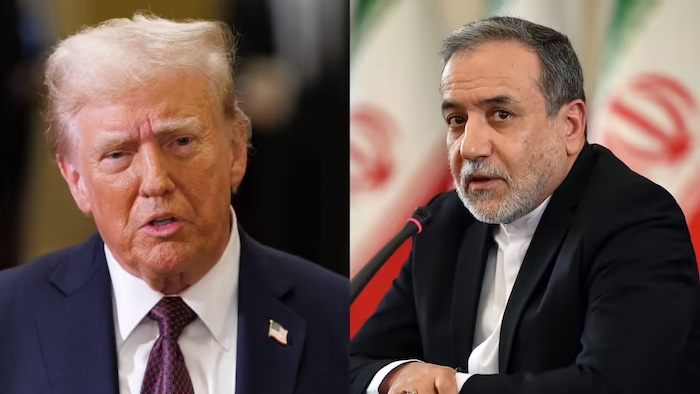
US President Donald Trump has said the United States and Iran have agreed to continue talks despite renewed hostilities, but declared that the ceasefire reached between the two sides last month is over.
His comments came after a week of fighting that saw three Qatari and Saudi commercial tankers come under fire, prompting US strikes on Iranian sites and retaliatory Iranian attacks on US military facilities in Gulf states.
No new attacks were reported on Friday as regional mediators worked to secure a permanent end to the war, which began on 28 February with US-Israeli strikes on Iran.
Trump wrote on his Truth Social platform: “The Islamic Republic of Iran has asked us to continue ‘talks.’ We have agreed to do so, but the United States has stated to them, in no uncertain terms, that the Cease Fire is OVER!”
Iran rejected Trump’s account, saying it had not requested talks with Washington but had agreed to receive a Qatari mediator. Iranian state television reported that Qatari negotiators were meeting officials in Tehran to discuss tensions and the Strait of Hormuz.
Trump also warned Iran against any attempt on his life, saying he had instructed the US military to be ready to respond.
He posted: “1000 Missiles are Locked and Loaded and aimed at the Islamic Republic of Iran, with thousands of more to immediately follow, should the Iranian Government act on its threat, pronounced in many corners of the Globe, to assassinate, or attempt to assassinate, the sitting President of the United States of America, in this case, ME!”
He added: “Orders have already been given, and the U.S. Military is ready, willing, and able, for a one year period of time, subject to extension, to completely decimate and destroy all areas of Iran – PRAISE BE TO ALLAH!”
The Wall Street Journal and other US media reported this week that Israel had shared intelligence with Washington alleging Iran had recently developed a plan to assassinate Trump. Iran has not commented on Trump’s latest remarks.
At the funeral of Iran’s slain Supreme Leader, Ayatollah Ali Khamenei, on Thursday, large crowds gathered carrying banners that read, “We Will Kill Trump.” Khamenei was killed in an airstrike on the first day of the war.
Attention has also turned to the Strait of Hormuz, a vital shipping route for global oil supplies.
Iranian Foreign Minister Abbas Araqchi arrived in Oman on Saturday for discussions on arrangements for the safe passage of ships through the strait, according to the semi-official Tasnim news agency.
US officials said Washington wants Iran to publicly commit to ending attacks on ships in the waterway and guarantee unrestricted passage without tolls.
During the conflict, Tehran has largely controlled the strait, creating a prolonged stand-off with the United States.
Iran’s Health Ministry said at least 17 people were killed and 115 wounded in US strikes carried out on Wednesday and Thursday across six Iranian cities.
Despite the fighting, US officials said recent discussions between Washington and Tehran had been productive.
Iran said any violation of commitments by the United States would be met with “reciprocal action,” according to the foreign ministry spokesperson.
The interim agreement reached last month was intended to create a path towards ending the conflict, which has now entered its fifth month, disrupted global energy supplies and increased concerns about the world economy.
Oil prices also recorded their biggest weekly gain in eight weeks following the renewed fighting in the Gulf.
Faridah Abdulkadiri