Screenshot
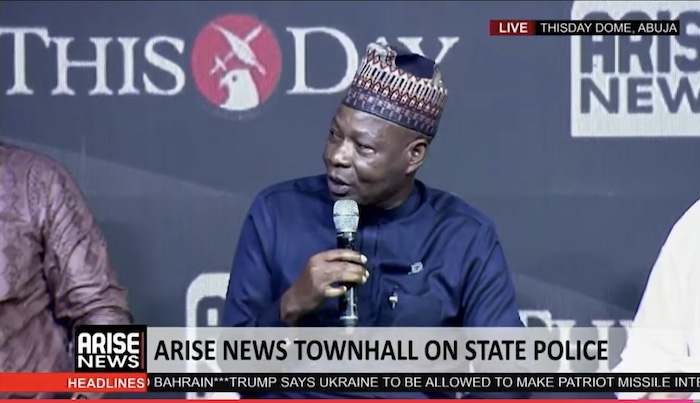
Chairman of the Nigeria Police Force Steering Committee on State Police, Prof. Olu Ogunsakin, has assured Nigerians that the Inspector General of Police (IGP), Kayode Egbetokun, is fully committed to the ongoing process of establishing state police, saying extensive safeguards have already been built into the proposed framework to prevent abuse of power and ensure accountability.
Speaking on behalf of the IGP at the ARISE News Town Hall on State Police, Prof. Ogunsakin said he had spoken with Egbetokun the previous night and was mandated to represent him as Chairman of the Police Steering Committee on the establishment of state police.
“I spoke with the Inspector General of Police on Wednesday night, and he asked that I should represent him as the Chairman of the Police Steering Committee on the establishment of state police,” he said.
Responding to concerns over whether state Commissioners of Police could become instruments of political oppression or disregard the authority of governors, Ogunsakin said the committee had already proposed multiple institutional safeguards in its submission to the Senate.
“The issue you raised is quite important, but we have to understand that there are processes in place. Within the submission of the committee to the Senate, we outlined several steps that can be taken to address these concerns,” he said.
He explained that the proposed framework provides mechanisms to resolve disputes between governors and state police commissioners, stressing that the process would not rely solely on the discretion of any individual.
“In the case of Commissioners of Police disregarding the instructions of governors, there are already provisions within the framework that set out the processes to be followed. There will be boards, ombudsmen, State Police Service Commissions and several other oversight mechanisms that have been carefully taken into consideration.”
Ogunsakin said the recent inauguration of the policing bill marked a significant milestone in the reform process, noting that the legislation would address many of the fears expressed by stakeholders.
“Having attended the inauguration of the policing bill two days ago, a great deal of work is expected to begin that will help alleviate those fears. The concerns that have been raised over the years are now being formally addressed.”
He described the current exercise as the first comprehensive effort to examine both the benefits and potential risks of decentralising policing in Nigeria.
“This is the first time we are putting all these issues on paper. This is the first time we are carefully examining both the advantages and the challenges. In a democracy, there will always be differing opinions, but ultimately, the views of the majority are taken into consideration.”
According to him, concerns surrounding the transition from a centralised policing system to a decentralised model are expected, but should be resolved through legislation, implementation and continued stakeholder engagement.
“Because we are moving from a centralised policing system to a decentralised one, many issues will naturally arise. Until the legal framework is completed and implementation begins, concerns will continue to be raised. That is why forums like this are important—they allow stakeholders to identify issues, discuss priorities and contribute to strengthening the process.”
Ogunsakin said the Inspector General remained committed to ensuring that the Nigeria Police Force plays an active role in shaping the reforms rather than being sidelined.
“For the Inspector General of Police, he is very keen on ensuring that he supports this process. This is an ongoing process, and once it reaches its conclusion, we can then discuss the next steps.”
He disclosed that the IGP was already establishing a committee within the Nigeria Police Force to work alongside the committee constituted by the Presidency to ensure a coordinated approach to the reform.
“I can assure you that the Inspector General of Police is setting up a committee to support the one already established by the Presidency because they cannot work independently of one another.”
Ogunsakin noted that both the policing framework and the constitutional amendments required for state police must progress together, emphasising that the police must remain central to the reform process.
“When you look at the issues before us, there is the policing framework and there is the constitutional framework. As the Inspector General of Police has said many times, you cannot shave a man’s head in his absence.”
“This is why the Nigeria Police Force is critically involved as a partner in supporting this process, and I believe the President is taking the right approach at this point,” he added.
Boluwatife Enome