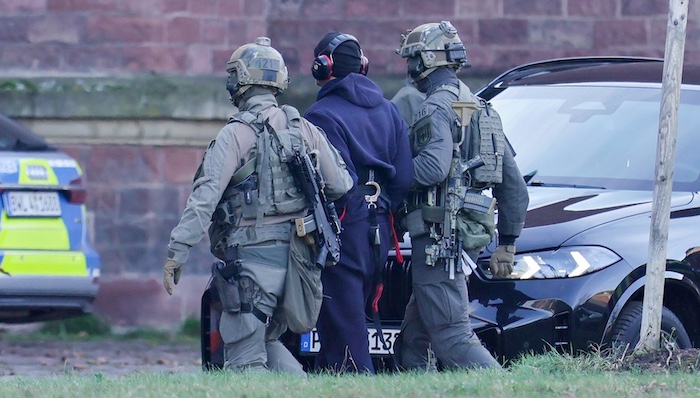
The charges, announced on Thursday, were filed before a regional court in Hamburg against Serhii K., whose full identity has been withheld under German privacy laws.
According to prosecutors, the defendant faces allegations of participating in a war crime by directing an attack against civilian infrastructure, causing explosions, destroying critical energy facilities and disrupting public services.
German investigators allege that Serhii K., who was serving as an officer in the Ukrainian military at the time, worked alongside other personnel to orchestrate the destruction of both the Nord Stream 1 and Nord Stream 2 pipelines.
Prosecutors contend that the objective of the operation was to permanently halt Russian gas exports through the Baltic Sea pipelines and deny Moscow revenue that could support its military campaign in Ukraine.
The indictment claims the accused led a team that included professional divers, a skipper and an explosives specialist. Investigators say the group entered Germany in September 2022 using forged Ukrainian travel documents before boarding a yacht allegedly rented with falsified identification.
Authorities further allege that the team transported military-grade explosives through international waters to a site near Denmark’s Bornholm Island, where explosive devices were attached to the pipelines on the Baltic Sea floor before being detonated using timed fuses.
Serhii K. was arrested in Italy in August before being extradited to Germany in November. He has denied any involvement in the pipeline explosions.
Responding to the case, Ukrainian authorities said they currently lack sufficient information to comment on the allegations. President Volodymyr Zelenskyy also stated that he had only recently received details of the indictment and that Kyiv would issue a response after reviewing the case.
“The relevant authorities of our countries will communicate, and once we receive the necessary details, we will be in a position to respond,” Zelenskyy said.
The September 2022 explosions, widely described by both Russia and Western governments as acts of sabotage, severely damaged the Nord Stream 1 pipeline and one branch of Nord Stream 2, which had not yet begun commercial operations.
At the time, Russia had already suspended gas supplies through Nord Stream 1, citing technical problems and Western sanctions, while European governments accused Moscow of using energy exports as political leverage.
German prosecutors said the case falls under the country’s jurisdiction because the pipelines terminate in Lubmin, in the state of Mecklenburg-Vorpommern, and the damage directly affected Germany’s energy infrastructure and national security.
If convicted of directing an attack against civilian infrastructure under German law, the accused faces a minimum prison sentence of three years, with lighter penalties possible in less serious circumstances.