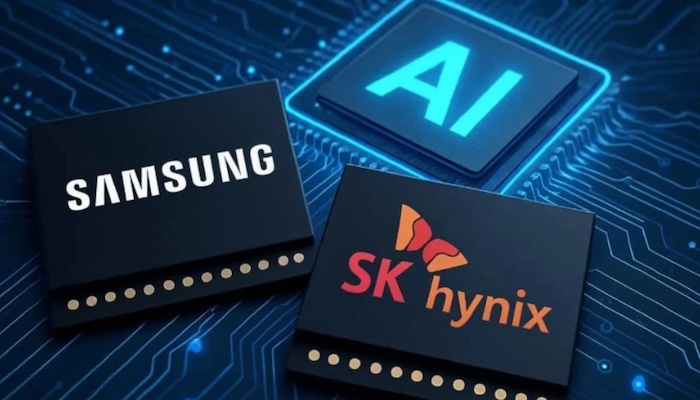
South Korea’s semiconductor giants, Samsung Electronics and SK Hynix, are launching one of the industry’s most ambitious investment drives, committing trillions of won to expand artificial intelligence chip production as global demand for AI technologies continues to soar.
The expansion has received strong backing from President Lee Jae Myung, who has pledged government support for the companies as part of South Korea’s long-term strategy to strengthen its position as a global semiconductor powerhouse.
As part of the initiative, South Korea aims to double its memory chip production capacity over the next five years. Samsung and SK Hynix also plan to accelerate construction of fabrication facilities within the Yongin semiconductor cluster, shortening development timelines to bring additional production capacity online more quickly.
Together, the companies have outlined long-term investment plans totaling approximately 3,200 trillion won ($2.07 trillion), including an 800 trillion won semiconductor complex planned for the country’s southwest alongside previously announced manufacturing projects.
South Korea has emerged as one of the biggest beneficiaries of the global AI boom, with Samsung and SK Hynix dominating the market for high-bandwidth memory (HBM) chips, which enable advanced AI processors to handle massive volumes of data at high speeds.
Demand from major AI infrastructure providers and global technology companies has surged amid ongoing shortages of advanced memory chips. However, industry analysts caution that semiconductor fabrication plants take years to build, meaning much of the additional production capacity will not come online until the next decade.
That has raised concerns that today’s aggressive investment could eventually lead to oversupply if spending on AI infrastructure slows in the years ahead. Analysts say memory chip prices remain highly sensitive to the balance between supply and demand, and excessive capital investment could put downward pressure on prices if production ultimately outpaces market demand.
Industry and academic experts have also urged caution, noting that while manufacturers must capitalize on today’s AI-driven boom, accurately forecasting semiconductor market conditions several years into the future remains highly uncertain.
The renewed confidence marks a dramatic turnaround for the memory chip industry. Strong AI demand and constrained global supply have significantly boosted profitability for Samsung and SK Hynix after the sector suffered severe losses during the downturn in 2023.
Both companies said faster regulatory approvals would enable them to accelerate construction at Yongin while retaining the flexibility to adjust future investment plans should market conditions shift.
Government officials have pledged to fast-track permits and infrastructure development, aiming to complete the Yongin semiconductor cluster before President Lee’s current term ends in 2030.
Despite concerns over future market cycles, many analysts believe the investment strategy will help South Korea maintain its leadership in the rapidly expanding AI economy while giving manufacturers the flexibility to moderate spending if signs of excess production capacity begin to emerge.
Goodness Anunobi