Screenshot
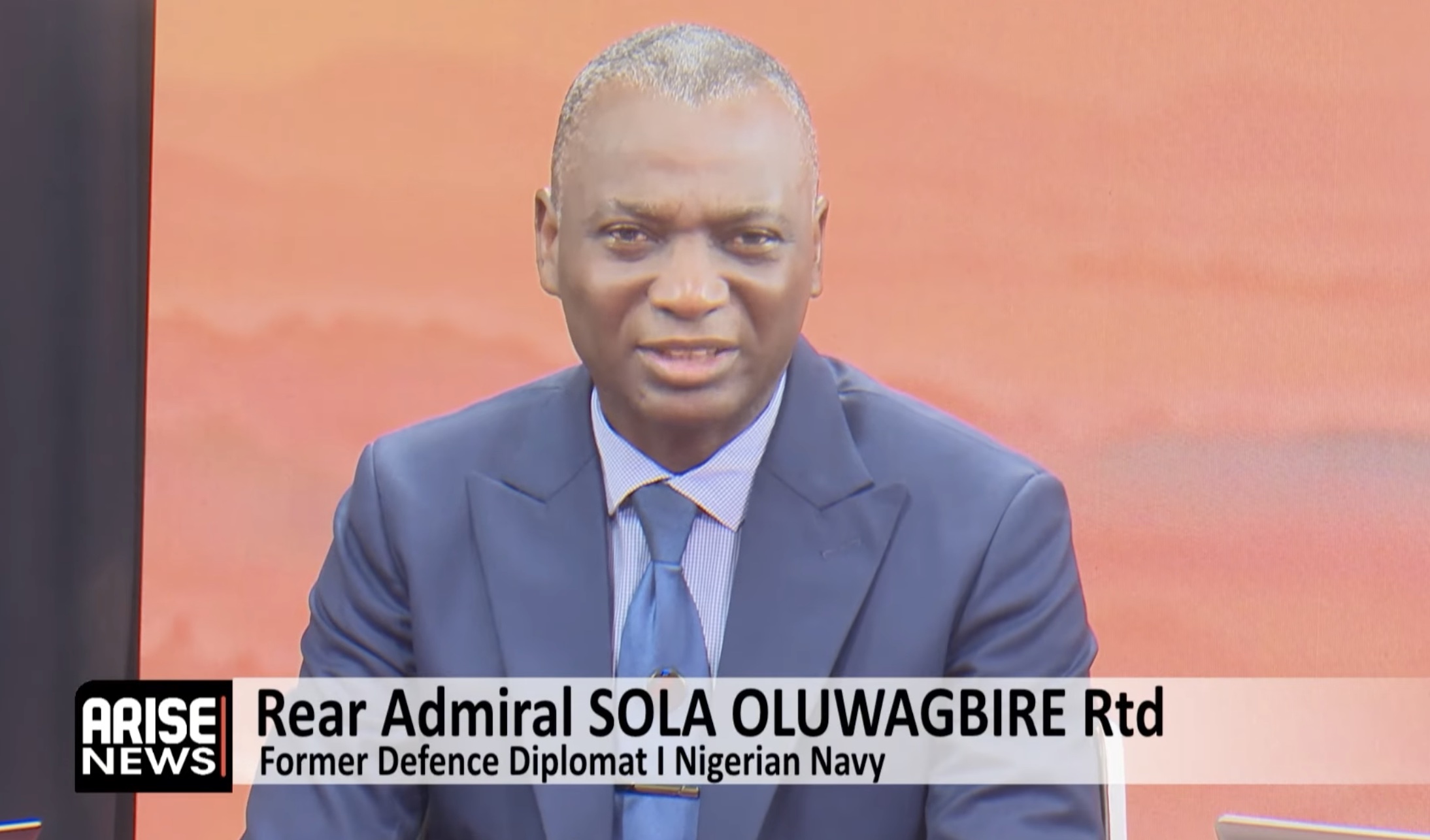
The former Defence Diplomat of the Nigerian Navy, Rear Admiral Sola Oluwagbire, (Retired), has said Nigeria remains largely reactive in global affairs rather than shaping international outcomes.
Speaking on national security, economic development and foreign policy, the retired naval officer urged the country to strengthen its productive capacity, reduce dependence on foreign powers and take a more influential role in global affairs.
“I think on the global level, we stand just as somebody who is pushing the game and not—we stand as reactors, not as effectors, basically. That’s basically where we stand for now. We are just reacting and not effecting like we should, like we ought to. So, there are also things like that that we too, as a nation, could do so that we can actually influence things and not just stand and watch,” he urged.
Rear Admiral Oluwagbire argued that Nigeria’s reliance on foreign powers for military equipment and support weakens its strategic independence.
“‘Anatomy of dependence’ means that we just rely on the foreign powers to give us everything we need to do the things we ought to do. They give us the guns, they give us the missiles, they give us anything. For example, the US AFRICOM, they come, they help us get the basic things right, they leave or they stay, and we still have to keep on referring to them for help. But until such a time when we can do the things that we need to do by ourselves, it will always be a circle. We’ll always be dependent on them. And that’s what we should try to break off from. So, if we don’t do the things by ourselves, we’ll just keep on going round in circles,” he stressed.
Adding, he called for stronger local production and economic growth.
“First and foremost, economically, we start to produce more than we consume. Then talking about militarily, a country that does not produce its own arms, at least 90%, will always have to be dependent on other nations. So, the government has set a policy now of actually making our defense factory in Kaduna to at least reach a certain—I think 40% in the next 10 to 20 years. So, it’s a good step, but the earlier and the faster we do this, the better, so that we have what we need to do to shield our people from any form of insecurity or danger,” he urged.
On the proposed creation of state police, Oluwagbire said security reforms must go hand in hand with economic development. He argued that improving livelihoods would help create a safer and more stable society, noting that “happy people will make a safe nation.”
“I think once we can get the simple things right, everything will fall into place. So we can’t divorce one issue and treat the other. All these things have to be taken pari passu. So, hopefully, when the state police is enacted, everybody at their own level of governance will do what they can do to make the economy better, to make life better, and everything will work together. Happy people will make a safe nation. If people are not happy, the nation will not be safe,” he maintained.
Addressing concerns over rising insecurity and calls for state policing, the retired Rear Admiral said the Federal Government is doing its best within existing constraints, stressing that a combination of strategies is needed to improve security nationwide.
“I believe that the federal government is doing all that they can do within the given circumstances. We can even put 10,000 CCTVs, it doesn’t mean that crime will stop. CCTVs are just to aid investigation, not to actually prevent crime. We should just keep on urging the government with what they are doing, and they should just keep on doing the things they are doing better,” he said.
On foreign policy, Rear Admiral Oluwagbire said Nigeria should adopt a more practical and benefit-driven approach, arguing that the country has long carried Africa’s burdens without receiving commensurate returns. He urged policymakers to prioritise national interests, stressing that “charity begins at home.”
“I wouldn’t say our foreign policy has exacerbated our problems. In fact, I would say that we’ve not gotten the most benefits that we can get from our foreign policy as we have gotten. For a long time, like I wrote in the book, we’ve carried Africa’s burdens without reaping necessary benefits. So, I think that our foreign policy is okay but should be more practical, more dynamic, more benefit-oriented, less charity-focused. No need for any ‘Big Brother Africa,’ just do what is good for Nigeria in all those circumstances.
“But before anything, at least let us take care of our home first before we go outside, basically. Charity begins at home,” he stressed.
Advocating for a “Nigeria First” doctrine, Oluwagbire said the country’s foreign policy should prioritise national interests above all else. He argued that Nigeria must adopt a more reciprocal approach in its dealings with other nations.
“100%, I think Nigeria should adopt a ‘Nigeria First’ doctrine. We should basically do what is good for us first before thinking of others. That is the starting point, and charity must begin at home. As it is in diplomacy, the first law in diplomacy is tit-for-tat. So, I think the earlier and the more firmly we start to do this, the better,” he insisted.
While acknowledging the scale of Nigeria’s challenges, the retired Defence Diplomat said the Tinubu administration is addressing them progressively and cautioned against drawing conclusions about consultations between current and former leaders based solely on public information.
“The first business of any government is the security and welfare of its citizens. And I believe, and I know, that the Nigerian government wants the best for its citizens, but there are so many challenges. When he came on board, President Bola Tinubu said the problems are huge, but he will do his best to sort them one after the other. And I think he is sorting them out one after the other.
“You may not see it happening, but I think that it’s happening at levels that we may not know. Those are things that we may not know, that are not in public. So, just leave these two big men to themselves. That’s it.”
On Nigeria’s security partnership with the United States, Oluwagbire maintained that while Nigeria should maximise the relationship, responsibility for the country’s security ultimately rests with Nigerians.
“I think the US government is offering what it can in terms of intelligence assistance, logistics support, training, and everything. But also, one of the first basic rules in foreign policy is that every government pursues its own national interest first. Americans could not love Nigeria more than Nigerians love Nigeria, so that’s the starting point.
“But again, there’s always a way we can make the best of the relations that we have with them. At least from as much as I know, I think the Ministry of Defense is doing all they can to exploit these relations. But the buck stops on our table, on our own table. We don’t expect Americans to do for us what we should do for ourselves,” he reiterated.
Favour Odima