Moscow has come under its largest Ukrainian attack since the start of Russia’s full-scale invasion, with nearly 200 drones striking targets around the Russian capital and sending thick columns of smoke into the sky.
According to Moscow region governor Andrei Vorobyov, 17 people were wounded during the attack. Russia’s defence ministry said almost 1,000 drones and four Ukrainian cruise missiles were intercepted and destroyed across the country within 24 hours. An oil depot in the southern Rostov region was also hit, leaving one person dead.
Ukrainian President Volodymyr Zelensky said Kyiv had once again targeted the Moscow region with what he described as “long-range sanctions”, a term used by Ukrainian officials to refer to long-distance strikes on Russian territory.
“It’s time to end this war, and Russia must take the necessary steps in diplomacy,” Zelensky said.
He added that the massive drone operation was retaliation for Russia’s strike on Kyiv last week, which set a major religious landmark on fire.
“We don’t want this war and have never wanted it,” Zelensky said. “But if Ukraine burns, your Moscow will burn too.”
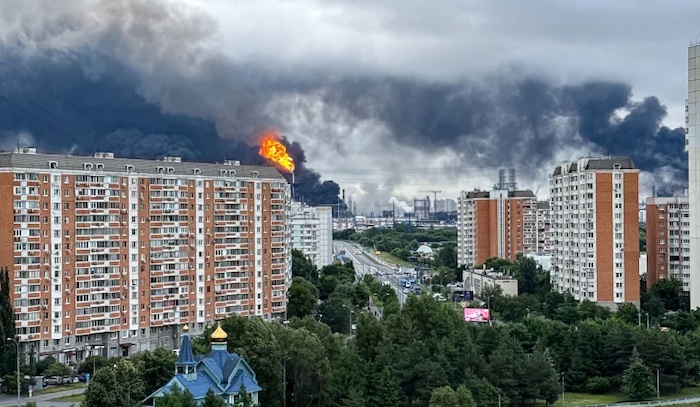
Fires erupted after the Kapotnya refinery in south-east Moscow was struck for the third time in a month and for the second time this week. The attack blanketed parts of the capital in black smoke.
Videos circulating online showed the lid of a large oil storage tank being hurled dozens of metres into the air following a powerful explosion.
A nearby shopping centre also caught fire, reportedly after drone debris fell onto the building, while several residential high-rise blocks were evacuated as a precaution.
The disruption extended across the city, with all four Moscow airports temporarily closed and more than 500 flights either cancelled or delayed.
Despite restrictions imposed by Russian authorities on publishing images from strike sites, numerous videos appeared on social media showing drones crossing the sky in broad daylight and explosions over industrial districts on Moscow’s outskirts.
More than four years after Russia launched its full-scale invasion of Ukraine, fighting continues along the front lines, largely removed from the daily lives of many Russians. However, Kyiv’s increasingly frequent long-range attacks on targets across Russia, including Moscow and St Petersburg, reflect Zelensky’s stated goal of bringing the consequences of the war closer to ordinary Russians.
Drone strikes on Moscow, located about 500 kilometres from the Ukrainian border, have increased as Ukraine has expanded its long-range capabilities. The first successful Ukrainian drone attacks reached the Russian capital in spring 2023, though those early operations were sporadic and involved far fewer aircraft.
Russia has since strengthened air defences around Moscow, but Ukraine has significantly increased the scale of its drone operations, with some aircraft continuing to penetrate those protective systems.
Meanwhile, Ukrainian authorities said Russia launched more than 200 drones and multiple ballistic missiles against Ukraine overnight.
Russian President Vladimir Putin, who is hosting Southeast Asian leaders at a summit in Kazan, has not publicly commented on the large-scale strike against the Russian capital.
Reacting to the attack, Ukrainian Foreign Minister Andriy Sybiha wrote on X: “One of the most popular questions asked by Muscovites this morning is ‘What is going on?’”
“I can answer. Your country started a war of aggression against ours. For years, it has been killing our people,” Sybiha wrote.
“Now that you know what’s going on, ask Putin when he is planning to end it.”
Faridah Abdulkadiri