South Africa is still lagging behind in the global race to adopt next‑generation Wi‑Fi, despite being one of Africa’s most advanced broadband markets.
This is according to Ookla’s Global State of Wi‑Fi 2026 report, which shows that while countries like Singapore, South Korea, and the United States surge ahead with Wi‑Fi 6 and Wi‑Fi 7, South Africa remains heavily reliant on older standards, with only marginal progress in using the newly opened 6GHz spectrum.
Wi-Fi samples
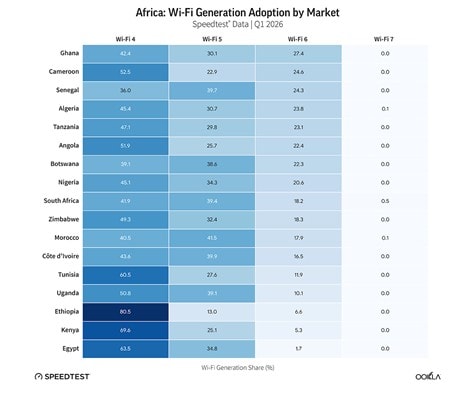
Nearly half of Africa’s Wi‑Fi samples (49%) in Q1 2026 were still running on Wi‑Fi 4, a standard finalised back in 2009. South Africa stands out as the only African country registering meaningful use of the 6GHz band, though this accounts for just 0.2% of connections.
Uptake of Wi‑Fi 6 has grown, but penetration remains far below global averages, leaving households and businesses dependent on outdated technology.
WIFI 7
Globally, Wi‑Fi 6 adoption has surged from 6% in 2022 to 27% in 2026, becoming the dominant upgrade path.
Wi‑Fi 7 is beginning to emerge, accounting for nearly 2% of global connections, with Singapore leading at 25% adoption thanks to aggressive government and telco initiatives.
In North America, 13.8% of Wi‑Fi traffic now runs on the 6GHz band, a sixfold increase in just two years. Meanwhile, older standards are in decline: Wi‑Fi 4 and Wi‑Fi 5 have dropped to 34% and 39% of samples, respectively.
South Africa
In South Africa, regulation is not a barrier. The Independent Communications Authority of South Africa (Icasa) opened the lower 6GHz band for licence‑exempt use in 2023, paving the way for Wi‑Fi 6E and Wi‑Fi 7.
The bottleneck lies in equipment. Many households hold onto routers and smartphones for years, while service providers have been slow to bundle 6GHz‑capable hardware.
Economic constraints also play a role, with the high cost of upgrading devices limiting adoption in comparison with wealthier markets.
Challenges
According to the Ookla report, Africa faces a stark challenge: with nearly half of users still on Wi‑Fi 4, the continent risks falling dangerously behind global peers. South Africa, however, has an opportunity.
As the only African nation with visible 6GHz activity, it could spearhead regional adoption if operators accelerate hardware upgrades and bundle next‑generation routers with fibre packages.
Globally, consumer Wi‑Fi 7 equipment is forecast to grow from 3.6% of the installed base in 2025 to 13.8% by 2030, driven by aggressive bundling and fibre penetration in advanced markets.
Digital divide
South Africa has among the highest internet penetration rates on the continent, but a digital divide persists, leaving many young people without internet access.
In April, President Cyril Ramaphosa placed digital transformation at the heart of South Africa’s economic “rebound,” stressing that technology is no longer a luxury sector but the foundation of the country’s industrial strategy.
He framed his remarks around the “3Ds” – Digitisation, Decarbonisation, and Diversification – positioning South Africa as a future‑focused economy with significant opportunities in technology.
For South Africa, the choice is clear: embrace the transition now, or risk being left behind in the digital divide.