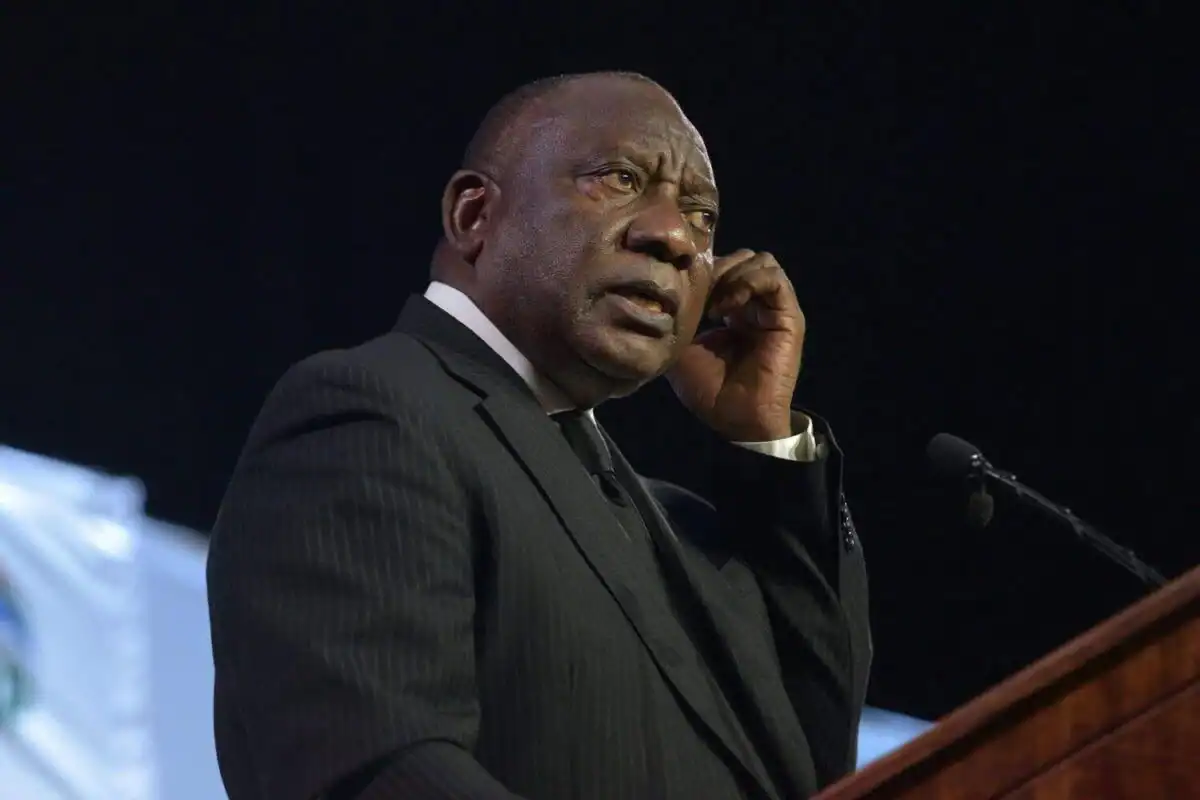
The buffalo is the most dangerous of the big five. It’s also the animal Cyril Ramaphosa farms, which landed him in the Phala Phala scandal.
To survive the Section 89 impeachment process, the president will have to draw on that animal’s legendary imperviousness to pain and lethal talent for ambushing its pursuers.
This week, in the Presidency budget vote, Ramaphosa instead opted for disdain. He will not descend into the grubby arena of “political theatre”.
Ramaphosa will avoid questions
Above all, he will not answer awkward questions if he can avoid it. “We are not distracted by the clamour of some political parties for attention … or [their] electoral posturing,” he told the National Assembly.
This is a strategy well suited to Ramaphosa’s personality: aloof, evasive of scrutiny, yet armoured by the ill-deserved reputation for statesmanship. It is also a desperate strategy.
Impeachment is admittedly highly unlikely. Even a vote of no confidence is improbable. The government of national unity (GNU) parties control almost 72% of the National Assembly. But it is the process that is most dangerous.
Ramaphosa faces an inquisitorial examination
If his legal stalling fails, Ramaphosa faces an inquisitorial examination that could be disastrous for him and the ANC. There is a sense, now, that the tide has turned. The impeachment inquiry will make or break reputations, not only of politicians but of parties.
Ramaphosa is one, the ANC another. The impeachment committee’s first task was to elect a chair. The light relief was Build One South Africa leader Mmusi Maimane – the lay pastor in eternal search of a flock – who put his name forward but couldn’t find a seconder.
The appointment went to Rise Mzansi’s Makashule Gana, who plays second fiddle in Songezo Zibi’s parliamentary duet.
Gana was elected by 19 votes to 12, defeating United Africans Transformation leader Wonderboy Mahlatsi.
Makashule Gana political style
The ANC, DA, and most GNU-aligned parties rallied behind Gana; Mahlatsi drew support from the anti-GNU benches, like uMkhonto weSizwe, the EFF, and ActionSA.
Gana’s political style is a little bloodless. This, however, is a gladiatorial process.
The test will be whether Gana anaesthetises the committee in procedural nit-picking or gives full scope to those members who are not just seat-fillers but have sharp teeth – the DA’s Glynnis Breytenbach and the EFF’s Julius Malema spring immediately to mind – and the appetite to draw blood.
It is a test, too, for the DA. In 2022, the DA supported the impeachment process. When it entered the GNU, under John Steenhuisen, it reversed that position.
That was tactically understandable, since it did not want to collapse the GNU at the first hard bump in the road.
DA will not shield Ramaphosa
But following the Constitutional Court ruling, the DA’s room for political manoeuvring has become considerably constrained. Geordin Hill-Lewis said the party will not shield Ramaphosa if the evidence points to wrongdoing.
The DA’s challenge is to show participation in the GNU has not neutered its role as the main constitutional opposition to ANC abuse, or it risks being outflanked by a resurgent ActionSA.
For the ANC, the calculation is brutal. Ramaphosa has become, at best, a liability. The conversation inside the ANC is now about damage control.
Can the party afford to go into the November local government elections with a president dangerously mired in impeachment hearings? If not, will he jump, or must he be pushed?
A wounded buffalo may yet turn the tables on its tormentors. The question is whether the GNU parties have the nerve to bring down the rogue beast.