Having failed to fully leverage its strategic geographical location to become Africa’s primary gateway, Uganda has now been handed another economic lifeline from an unlikely source – technology.
As artificial intelligence (AI) rapidly becomes central to business operations and everyday life, Uganda is increasingly positioning itself as a potential regional hub for applied AI innovation.
Yet beneath the ambition lies a difficult reality, the country’s infrastructure, policy environment, and digital ecosystem may not yet be ready for the demands of the AI age.
Uganda’s dream of building a $500 billion economy within the next 15 years through science, technology, and innovation (STI) has elevated the importance of critical digital infrastructure such as data centres, fibre optic connectivity, reliable electricity, cooling systems, and water resources.
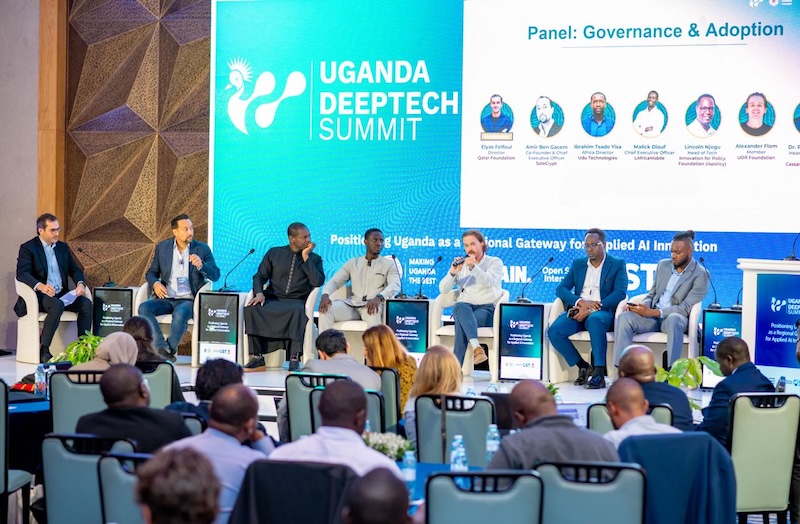
During the recently concluded second edition of the DeepTech Summit held as part of National Science Week, participants repeatedly acknowledged both Uganda’s enormous potential and the deep structural challenges standing in its way.
The summit, which attracted at least 65 local participants and 42 international delegates from the technology sector, largely agreed that Uganda could indeed emerge as East Africa’s gateway for applied AI, but only if deliberate investments, policy reforms, and infrastructure upgrades are prioritised.
While countries such as Kenya continue to dominate Africa’s AI ecosystem alongside Egypt, Nigeria, Morocco, Tunisia, and South Africa, Uganda’s strategic advantage lies in its geography. Bordering South Sudan, Kenya, the Democratic Republic of Congo, Rwanda, and Tanzania, the country remains well-positioned to become a regional technology and data transit hub.
Across the continent, AI adoption is already transforming sectors including fintech through fraud detection and lending algorithms; healthtech through telemedicine and diagnostics; agritech through crop monitoring and predictive farming; and edtech through personalised learning systems and AI tutoring platforms.
CEO of SoleCrypt, Amir Ben Gacem, said power infrastructure remains the backbone of any serious AI ambition. He explained that Tunisia strategically invested in large-scale green energy projects in the south of the country before connecting them to northern fibre optic infrastructure capable of powering national and international digital operations. Previously, Uganda’s biggest challenge was often viewed as overregulation or slow implementation.
For years, Rwanda was accused of simply adopting and implementing shelved Ugandan policies, sometimes almost word for word, and turning them into successful economic strategies.
Today, however, the challenge appears broader. Uganda’s policy and governance systems are struggling to keep pace with the speed of AI development despite the country’s ambitious digital aspirations.
As governments across Africa accelerate the development of Digital Public Infrastructure (DPI), experts at the summit argued that Uganda can no longer afford to treat AI readiness as optional. Houda Chozz, CEO of Open Startup, said governments must take the lead in enabling AI ecosystems because of the enormous infrastructure costs involved.
“In Uganda, Morocco, South Africa, Tunisia…we cannot avoid this conversation. The government needs to help the private sector pave,” he said.
Chozz added that communities whose data is being collected and processed by AI systems must also become active participants in innovation if adoption is to succeed sustainably.
To avoid what experts described as “data colonisation” and to preserve digital sovereignty, Ben Gacem warned that African countries must intentionally build localised digital ecosystems capable of processing and storing local data for local AI models.
Without that intentionality, Africa risks once again playing catch-up in a technological revolution increasingly driven by data ownership and computational power. James Byaruhanga, managing director of Roke Cloud and one of the brains behind Uganda’s sovereign cloud infrastructure, ABQ Cloud, argued that Uganda’s ambitions are often undermined by contradictory policy decisions.

He cited the government’s facilitation of redundant data sites at Raxio and Datanet, while at the same time denying tax exemptions on imported equipment critical for expansion. According to Byaruhanga, Uganda’s first AI infrastructure deployment was too small to satisfy market demand, forcing operators to rapidly expand server and GPU capacity.
The country, he said, now needs to increase GPU capacity nearly 12-fold within the next year alone.
“And the cost of infrastructure and equipment is still very high. There’s a lot of work to be done around taxation, incentives, make it easier for computing,” he said.
Despite improvements in fibre optic connectivity, especially within Kampala, where prices have fallen significantly, internet quality remains inconsistent. It is increasingly common, he noted, to find Ugandans juggling multiple internet dongles and routers from different service providers as they search for stable connectivity.
This has further widened the digital divide between urban and rural communities. Byaruhanga also criticised the country’s fragmented digital systems, saying many institutions continue to build in silos with limited interoperability.
In a related multistakeholder dialogue on business and digital rights, Ronald Mugisha, senior cyber and fraud risk officer at the Uganda Bankers Association, revealed that banks and telecom companies continue rejecting some renewed national IDs because the upgraded system failed to integrate seamlessly with the old one.
Despite assurances from authorities, the issue remains unresolved. Mugisha further questioned why banks and other institutions are charged Shs 500 per data verification request by the National Identification and Registration Authority (NIRA), arguing that such access should ideally be free to support digital growth.
Still, despite the obstacles, many experts remained optimistic about Uganda’s AI future. Ibrahim Tsado Yisa, Africa Director at Udu Technologies in Nigeria, said a recent audit mapping Africa’s AI infrastructure, power systems, skills shortages, and GPU gaps exposed the continent’s weaknesses but also clarified its opportunities.
He argued that African governments and institutions often become consumed by grand ambitions while overlooking the foundational technological realities required for implementation.
He stressed the importance of democratising AI access through governments, academia, and private sector collaboration so that AI becomes accessible to ordinary people rather than remaining confined to elite institutions.
Most organisations, he noted, still lack machine learning engineers and instead rely heavily on domain experts without specialised AI expertise.
“The single one thing that we found is we cannot single out any one thing as a breaker. Things are fused together, but there is a need for infrastructure to compute-intensive workloads with advanced cooling and low-latency networking,” he said.
Yisa also called for the development of Afrocentric AI models built using authentic African languages, imagery, and cultural data instead of relying entirely on imported systems trained on foreign contexts.
He revealed that banks in Nigeria were recently given 18 months by the central bank to implement AI-driven machine learning systems aimed at improving operational efficiency and personalisation.
“What we’re trying to do and are still working on is to get AI to the point of being treated like a utility, like electricity. Currently, it is being treated like a secret code, gold deposit – something so exclusive that people don’t know what to do with it. Let us democratise it.”

Malick Diouf, CEO of Lafrica Mobile in Senegal, warned African governments against losing local talent to international technology firms. With more than 20,000 languages spoken across Africa and literacy levels still uneven, he argued that foreign-built AI systems may never fully solve uniquely African challenges.
He urged governments to intentionally invest in local talent development from an early stage. Gilles Q Hacheme, senior research scientist at Microsoft AI for Good Lab, dismissed fears that AI will simply eliminate jobs, arguing instead that the technology is already creating entirely new industries and solutions.
“Humanity has the ability to solve any challenge if we just put any level of focus and put enough resources to make it happen,” he said.
Hacheme explained how Microsoft’s AI systems are already being used for crop mapping, disaster response, and climate monitoring. Under the TEMP project, Microsoft is reportedly building a platform capable of identifying every building in the world using satellite imagery between 2018 and 2025 to better analyse disasters such as earthquakes and floods.
“We don’t do this alone, and that is why the local ecosystem is so important,” he said.
Alexander Flom, co-founder of the UOR Foundation, raised concerns about the environmental, geopolitical, and economic consequences of centralised AI systems. He argued that current AI systems repeatedly compute answers from scratch inside giant foreign-owned data centres, consuming massive amounts of energy while extracting and monetising users’ data.
Flom called for the promotion of decentralised AI systems that allow users to maintain ownership of their information while reducing costs and dependency on centralised infrastructure. He warned that Africa risks losing not only its best talent to foreign opportunities but also its valuable local data and computational sovereignty.