President tells Africa CEO Forum that Nigeria is opening up for investors through policy reforms, local value addition and infrastructure expansion……
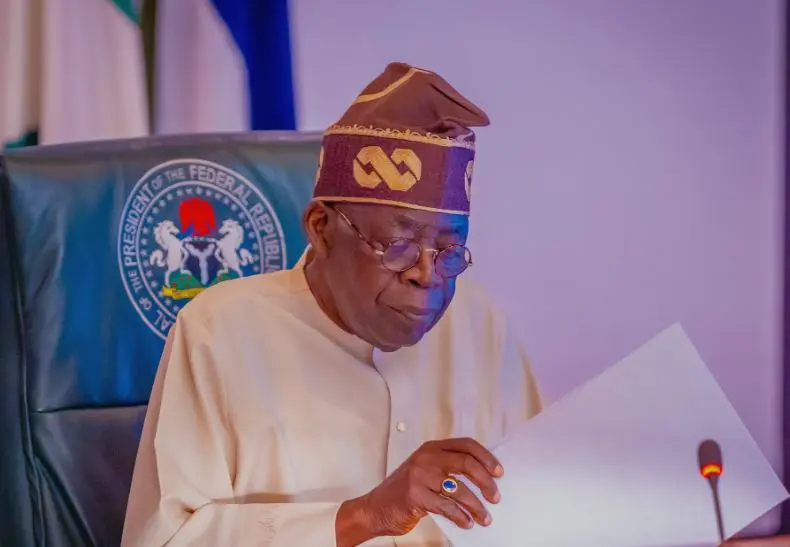
President Bola Tinubu has declared that Nigeria is on track to attract nearly $20 billion in foreign direct investment in 2026, citing sweeping economic reforms and efforts to remove long-standing barriers to investment.
Speaking on Thursday at the Africa CEO Forum in Kigali, Rwanda, Tinubu said his administration’s policies are beginning to reposition Nigeria as a more attractive destination for global investors.
The President made the remarks during a high-level panel discussion moderated by renowned British journalist Zainab Badawi, alongside Gabonese President Brice Clotaire Oligui Nguema.
According to Tinubu, the Federal Government’s decision to dismantle regulatory bottlenecks, improve transparency and stabilise the economy is already yielding positive results.
“Removing all the bottlenecks gives you the necessary incentives for direct foreign investment into the country,” Tinubu said.
“This year alone, I can beat my chest that Nigeria is attracting close to $20 billion in foreign direct investments.”
The President also used the forum to push for greater economic independence across Africa, insisting that the continent must stop exporting raw materials while importing finished products at higher costs.
Tinubu stated that Nigeria is moving aggressively toward local value addition, especially in the mining and manufacturing sectors.
“No one can take metal out of Nigeria without adding value,” he declared.
“You can excavate the dust, all the minerals, and go, but no. I can produce batteries for cars with my minerals.”
He argued that African countries must begin to treat their natural resources as strategic assets capable of financing industrialisation and economic development.
Speaking on Nigeria’s energy sector, Tinubu highlighted the growing impact of the Dangote Petroleum Refinery, describing it as proof that strong collaboration between government and the private sector can transform critical industries.
He explained that the government supported the project through favourable policies, access to crude supply and regulatory backing.
“Nigeria could not survive with over 200 million people in peace without a refinery,” Tinubu said.
“A risk-taker like Dangote must be encouraged by the government.”
According to the President, the refinery has already positioned Nigeria as a net exporter of petroleum products, including aviation fuel and petrol.
Tinubu also defended the Federal Government’s decision to supply crude oil to the refinery in naira, saying the move helps reduce pressure on foreign exchange demand and eliminates unnecessary banking complications.
“My formula is: what is the denominated currency in Nigeria? That is the naira,” he said.
“No letter of credit, no bank scrambling, no exchange rate instability.”
The President further criticised international credit rating agencies, accusing them of consistently underestimating the growth potential of African economies.
He questioned whether global agencies truly understand the scale of opportunities available across the continent, pointing to Rwanda’s economic growth and tourism expansion as examples.
On tax reforms, Tinubu said his administration is replicating the revenue model used in Lagos State, which he described as one of Africa’s leading economies.
He stressed that taxation must be simple, accessible and technology-driven.
“Tax reform must be written in English, understandable and not Japanese in English,” Tinubu stated.
“You can pay your taxes from your telephone. You can access and evaluate yourself so easily from your phone.”
The President also spoke extensively on agriculture and infrastructure, revealing that Nigeria is developing 6,000 mechanised agricultural zones while investing heavily in storage systems, energy access and transportation networks to support food production.
He highlighted the Sokoto-Badagry superhighway project as a major infrastructure initiative expected to improve regional trade and agricultural logistics.
Tinubu further disclosed that Nigeria has already deployed more than 90,000 kilometres of fibre optic cable nationwide as part of efforts to deepen digital connectivity and support emerging technologies.
According to him, Africa must embrace artificial intelligence, e-commerce and digital innovation if it hopes to compete globally.
Speaking on the importance of preparing young Nigerians for the digital economy, Tinubu added jokingly, “I am a politician. If I don’t get them ready for that, they’ll vote me out.”
He concluded by urging African nations to fully implement the African Continental Free Trade Area agreement and strengthen regional cooperation instead of operating in isolation.
“Africa needs to put its money where its mouth is,” he said.
“I believe in Africa first, because I started with Nigeria first.”
The Africa CEO Forum, held annually in Kigali, brings together African presidents, global investors and top business executives to discuss economic integration, investment opportunities and private sector growth across the continent.