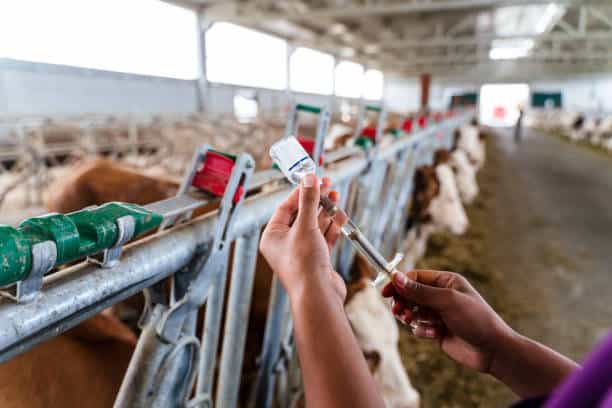
Close up of veterinarian hand holding syringe in front of cow on ranch
Around 13 million doses of foot-and-mouth disease (FMD) vaccinations are expected to arrive in South Africa in the next few months.
However, as authorities move to combat the spread of the disease in animals, a key question remains: will consumers of meat from vaccinated animals experience any long-term negative effects?
Millions more doses expected
On Wednesday, 22 April, Agriculture Minister John Steenhuisen announced the arrival of two million doses of FMD vaccine.
The vaccine arrived from Dollvet, in Turkey, and is expected to be distributed throughout the country over the next few days.
This delivery is the first batch of six million vaccines that are still expected to arrive.
Arrival of batches confirmed
According to the report, an additional five million doses have been ordered from Biogenesis Bago in Argentina and have been placed with Onderstepoort Biological Products (OBP).
These doses will arrive in two batches of 3.5 million and 1.5 million doses, once the South African Health Products Regulatory Authority (Sahpra) approves the section 21 application for their importation.
Access to the international market
“It needs to be made clear that the department has procured all matched vaccines currently available on the international market, and we have ensured that we have access to a steady supply,” said Steenhuisen.
According to Steenhuisen, the incoming vaccines will allow South Africa to access international red meat markets that have been closed for decades due to FMD outbreaks.
“We will push forward to make sure that we achieve our goal – vaccinate the national herd to achieve World Organisation for Animal Health (WOAH) recognition of FMD-free status with vaccination.”
Although infections remain widespread across the country, the solution to prevent them is currently being implemented. The key question remains: is meat from vaccinated animals safe for long-term human consumption?
Safe for consumption?
Millions of vaccines are set to be rolled out over the next few months, as Sahpra has granted permission to import them from Turkey and Argentina.
According to Sahpra’s spokesperson, Rodgers Baloyi, the Department of Agriculture (Animal Health Directorate) has commenced the rollout, and vaccinations are currently underway.
“It is important to note that the implementation of the vaccination programme is being led by the National Department of Agriculture,” he said.
Long-term effects
“Sahpra is not aware of any long-term adverse effects associated with the consumption of meat from vaccinated animals,” Baloyi added.
“Each consignment is accompanied by a package insert that clearly specifies the required withdrawal period before vaccinated animals may be slaughtered for human consumption.”
Sahpra also emphasised that the responsibility to communicate directly with the public rests with the Department of Agriculture, which oversees the vaccination programme.
Allocation strategy
Based on the report, the Department of Agriculture is implementing a targeted allocation strategy derived from animal risk and population figures.
The latest batch of Dollvet vaccines will be distributed according to an amended risk policy as follows:
- 135 400 doses have been allocated to the Eastern Cape
- 182 400 doses will be distributed to the Free State
- 124 800 doses for Gauteng
- 192 000 doses will be sent to KwaZulu-Natal
- 144 000 vaccines have been allocated to the North West
- 150 000 doses to the Western Cape and
- 150 000 vaccines will be transported to Limpopo
According to the latest report, there will be dedicated allocations of vaccines to support key agricultural sectors and ensure continuity in the food supply chain.
A total of 100 000 vaccines will be directed to the dairy industry, 150 000 doses to the feedlot industry and another 150 000 to the pig industry.
Steenhuisen said 239 000 doses will be held back for immediate emergency deployment where required.
You are what you eat
Despite no evidence of long-term effects from consuming meat from vaccinated animals at this stage, Sahpra has encouraged members of the public to contact the Foot-and-Mouth Disease (FMD) Command Centre if concerns arise.
“All imported vaccines have undergone the necessary testing and have been approved by regulatory authorities in their respective countries of origin,” said Baloyi.
He said Sahpra will continue to monitor the effectiveness of the vaccine on the ground.