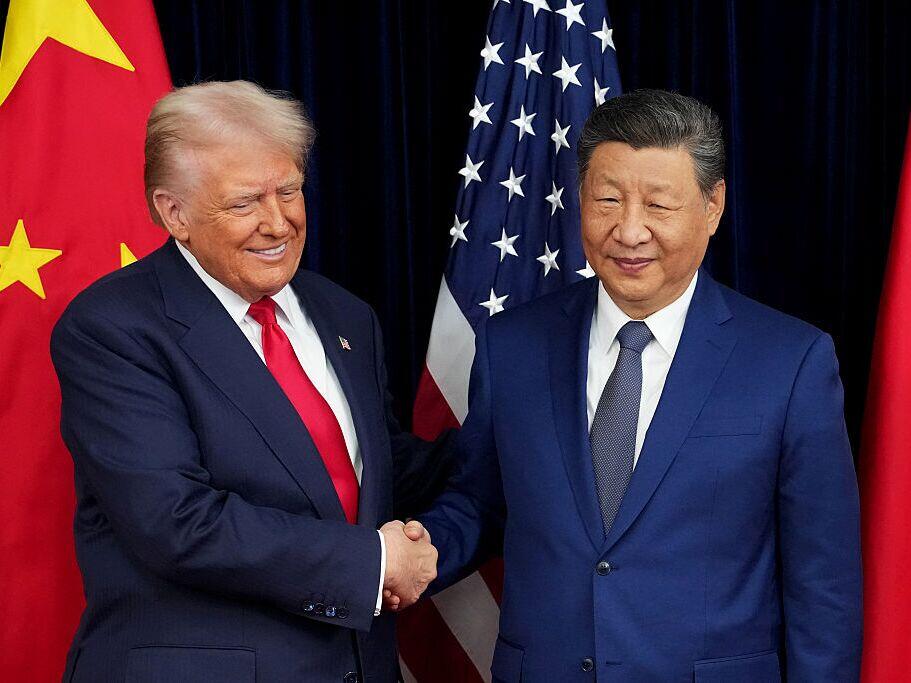
BUSAN, SOUTH KOREA - OCTOBER 30: U.S. President Donald Trump greets Chinese President Xi Jinping ahead of a bilateral meeting at Gimhae Air Base on October 30, 2025 in Busan, South Korea. Trump is meeting Xi for the first time since taking office for his second term, following months of growing tension between both countries. (Photo by Andrew Harnik/Getty Images)
China is accelerating efforts to end the Iran war, navigating a delicate diplomatic path as it prepares for a summit with US President Donald Trump while avoiding alienating Tehran.
President Xi Jinping’s mid-May meeting with Trump is shaping Beijing’s approach to the Middle East conflict, even as the world’s largest crude oil importer, reliant on the region for half its fuel, seeks to safeguard energy supplies, analysts say.
China’s measured response has preserved its back-channel influence, with Trump crediting Beijing for helping bring Iran to recent peace talks in Pakistan.
“You’ve heard President Trump repeatedly mention how the Chinese talked to the Iranians,” said Eric Olander. “That puts them in the room with negotiators, even if it’s not a seat at the table.”
China is also seeking to advance trade interests and its claims on Taiwan at the summit, with sources describing Trump as transactional and responsive to flattery.
The dominant view in Beijing is to “butter him up, give him a red-carpet welcome and preserve strategic stability”, one person said.
China’s Foreign Ministry did not respond to questions ahead of the summit, the first visit by a US president in 8 years, scheduled for May 14 and 15.
Facing a growing threat from a US naval blockade of Iranian ports, China has intensified diplomatic engagement while avoiding strong criticism of Trump’s handling of the war to ensure the summit proceeds smoothly, analysts say.
Xi broke his silence on the crisis with a four-point peace plan calling for peaceful coexistence, national sovereignty, adherence to international law and balancing development with security.
After Trump warned Iran that “the entire country can be taken out in one night”, Chinese Foreign Ministry spokesperson Mao Ning responded cautiously, saying China was “deeply concerned” and urging all sides to play a “constructive role in de-escalating the situation”.
Foreign Minister Wang Yi has held nearly 30 calls and meetings seeking a ceasefire, while special envoy Zhai Jun has visited 5 Gulf and Arab capitals.
Travelling at one point by road to avoid contested airspace, Zhai said he could hear air-raid sirens.
Xi unveiled his peace plan during a meeting with Khaled bin Mohamed bin Zayed Al Nahyan, as China deepened ties with a regional rival to Iran while encouraging Tehran towards dialogue.
China’s “sense of urgency and the mode of intervention at the tactical level are shifting” as the war drags on, said Cui Shoujun.
Some analysts say Iran depends more on China, allowing Beijing to push for a ceasefire while safeguarding its summit goals.
“Beijing’s ideal outcome,” said Drew Thompson, “is the maintenance of no-strings-attached relationships with anti-Western countries like Iran but also preserving its opportunity to achieve some form of modus vivendi with the US.”
While China helped bring Iran to talks, its influence remains limited without a military presence in the Middle East to back its diplomacy.
“While the Iranians are keen to play up their relationship with China and have asked Beijing to serve as a guarantor of a ceasefire, Beijing has shown zero interest in assuming such a role,” said Patricia Kim. “Beijing appears content to remain on the sidelines as the United States bears the brunt of the pressure.”
At the summit, China may agree to purchase aircraft from Boeing and expand agricultural imports, with talks expected to focus narrowly on trade and stability.
“There is zero chance China will reach some sort of grand bargain with the United States,” said Scott Kennedy.
Faridah Abdulkadiri