Brent holds above $87 as US-Iran tensions revive inflation concerns and fuel bets on further US rate hikes….
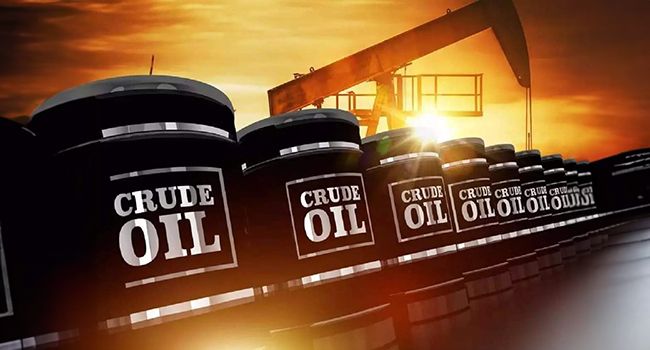
Oil prices extended their recent rally on Tuesday as hopes of a quick agreement to reopen the Strait of Hormuz faded, raising fresh concerns about inflation and increasing expectations that the United States Federal Reserve could raise interest rates later this year.
Crude prices have climbed by roughly 10 per cent over the past week, as Washington and Tehran remain locked in a standoff over the strategic waterway despite earlier signs that negotiations could produce a breakthrough.
By 0405 GMT on Tuesday, Brent crude futures were down 10 cents, or 0.11 per cent, at $87.62 a barrel, while US West Texas Intermediate (WTI) futures slipped 5 cents, or 0.06 per cent, to $82.08 a barrel.
The modest declines came after both benchmark contracts surged by about 5 per cent on Monday, extending a sharp recovery in oil prices as traders reassessed the prospects for a near-term resolution to the crisis.
The latest setback came after US President Donald Trump said on Monday that Washington would seek compensation from Iran for the conflict as part of any eventual peace negotiations.
Trump cited attacks and killings over several decades that he said had been backed or carried out by Tehran.
The statement came in response to an Iranian demand for US war reparations as a condition for resolving the crisis.
The exchange has further complicated efforts to reach an agreement on the Strait of Hormuz, one of the world’s most important oil shipping routes.
Trump had signalled a softer approach to the confrontation a day earlier, saying he was “low-keying” his strategy and indicating that he was prepared to allow economic pressure to build rather than immediately pursue further military action.
The latest statements, however, have raised doubts about how quickly the two sides can reach an agreement.
“In the absence of any positive headlines on negotiations to reopen the strait, pressure on oil prices has been upward,” Jason Wong of BNZ said.
Stephen Innes, global strategist at Quintex Intel, described the situation as a contest in which both sides were attempting to use oil supplies and trade routes as leverage.
“In effect, both sides are trying to weaponise the oil barrel without firing another shot,” Innes said.
“Washington is trying to choke Iran’s ability to get its crude out, while Tehran is squeezing the artery through which everybody else’s crude gets through.”
He added: “It is quite the game of chicken.”
The prolonged disruption is now feeding into expectations about the direction of US monetary policy.
A sustained increase in crude prices could push up transport, production and consumer costs, making it more difficult for policymakers to bring inflation under control.
That has complicated expectations surrounding the Federal Reserve, particularly as traders assess whether the central bank may need to raise interest rates this year.
A surprise decline of more than 20,000 US jobs last month had previously reduced expectations of a rate increase by easing concerns about economic overheating.
However, a renewed increase in energy prices could put pressure on inflation and force the Fed to reconsider its policy stance.
Cleveland Federal Reserve President Beth Hammack said Monday that a single 25-basis-point rate move would probably have only a limited effect on the economy.
“I would say in general, one 25-basis-point move probably doesn’t do a whole lot for the economy,” Hammack told Yahoo Finance.
“So it’s probably some number of (movements). But I don’t want to prejudge what that number is going to be.”
Markets are now awaiting the release of US consumer price data on Wednesday, with investors expected to scrutinise the figures for clues about the Fed’s next policy decision.
The oil rally came against a mixed backdrop for Asian equities following a lacklustre session on Wall Street.
Shanghai, Wellington, Taipei and Manila traded lower, while Hong Kong, Sydney, Singapore and Seoul recorded gains.
Tokyo’s market was closed for a public holiday.
At about 0215 GMT, the Hang Seng Index was up 0.1 per cent at 25,946.16, while the Shanghai Composite had fallen 0.5 per cent to 3,948.19.
WTI was up 0.3 per cent at $82.40 a barrel, while Brent was also 0.3 per cent higher at $87.97 at that point in the session.
Currency markets were relatively subdued, with the euro trading at $1.1546 against the dollar and sterling at $1.3512.
The dollar stood at 159.18 yen, while the euro traded at 85.46 pence against the pound.
In the United States, the Dow Jones Industrial Average closed 0.1 per cent lower at 53,975.98, while London’s FTSE 100 ended down 0.4 per cent at 10,862.50.
The Strait of Hormuz remains at the centre of the oil market’s concerns.
The waterway is a critical route for global energy shipments, meaning prolonged restrictions or uncertainty around its reopening can quickly translate into higher risk premiums in crude prices.
For now, traders are closely watching developments between Washington and Tehran.
A breakthrough that restores normal traffic through the strait could ease some of the recent pressure on oil prices. But continued deadlock, particularly if accompanied by further restrictions on Iranian crude exports, could keep prices elevated.
That prospect is becoming increasingly important for central banks and investors because a prolonged oil shock would not only affect energy markets—it could also feed directly into inflation, interest rates, currencies and global economic growth.