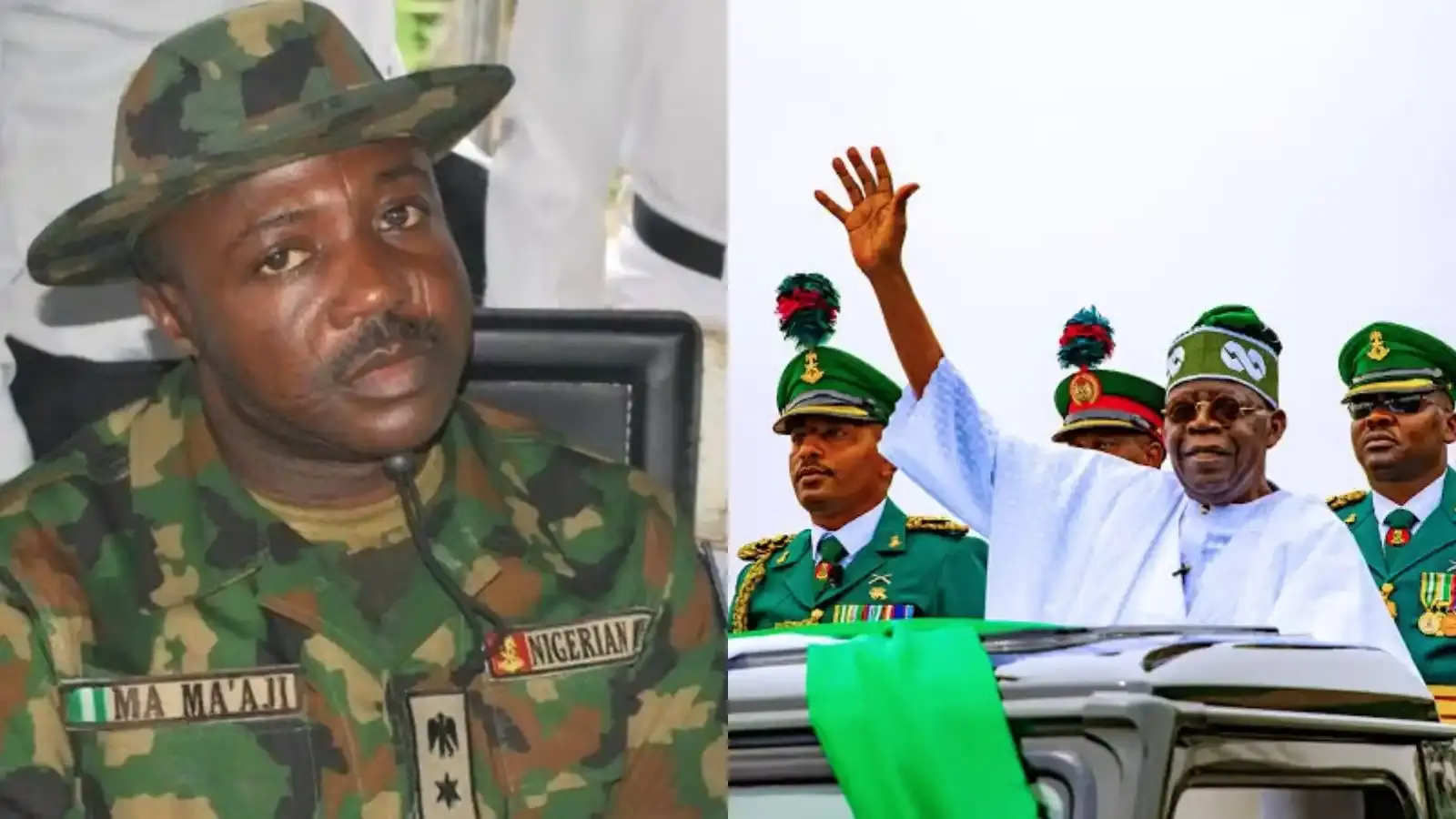
A Nigerian Army colonel identified as Mohammed Alhassan Ma’aji has emerged as a central figure in the alleged plot to overthrow President Bola Ahmed Tinubu’s government, as new details from investigations and court proceedings shed more light on the conspiracy that was uncovered in 2025.
Ma’aji is alleged by military investigators to have played a leading role in organising the failed plot, which reportedly involved serving and retired military personnel as well as alleged civilian collaborators.
The allegations have now moved from the secrecy of military investigations into the courtroom, where the accused are being given an opportunity to challenge the evidence against them.
In January, Nigeria’s Defence Headquarters confirmed for the first time that its investigation had identified officers facing allegations of plotting to overthrow the elected government. The military said those with cases to answer would be arraigned before appropriate military judicial panels in accordance with the Armed Forces Act and due-process requirements.
By April, the military had inaugurated a General Court Martial to try 36 serving personnel over allegations including mutiny and conspiracy to overthrow the Tinubu administration.
Ma’aji at the Centre of the Allegations
Military investigators reportedly identified Colonel Ma’aji as the alleged principal architect of the plot and accused him of helping coordinate and finance the operation. He was reportedly among the officers detained after the investigation began in late September 2025.
An interim investigation reportedly identified an Army colonel as the alleged coordinator of a network involving officers across the Army, Navy and Air Force. Investigators reportedly examined alleged plans involving critical national installations, including the Presidential Villa, military barracks and airports.
However, these remain allegations presented by investigators and reported publicly, rather than findings finally established by a court.
Confessions Become Part of the Evidence
The case took another dramatic turn in May, when a court in Abuja heard video recordings and statements obtained during investigations into the alleged conspiracy.
The Federal High Court admitted statements from six defendants as exhibits while beginning a trial-within-trial to determine whether the statements were made voluntarily.
Defence lawyers had challenged the evidence, alleging that some statements were obtained through coercion, torture or other unlawful means.
In separate proceedings, video recordings played before the court included statements in which two defendants acknowledged knowledge of the alleged plot, while another denied involvement. The defence has continued to contest the circumstances under which the statements were obtained.
That distinction is crucial: an alleged confession is evidence in a criminal proceeding, not proof of guilt by itself.
A Plot That Shocked Nigeria
The alleged conspiracy first came to public attention in September and October 2025, when security agencies began arresting military officers suspected of involvement.
The controversy intensified after the government cancelled the traditional Independence Day parade scheduled for October 1. At the time, the cancellation was linked in public reports to security concerns surrounding the alleged coup plot.
The Defence Headquarters initially rejected that connection, insisting that the cancellation was intended to allow President Tinubu to attend a strategic bilateral meeting outside Nigeria and to enable security forces to maintain their operations against terrorism, insurgency and banditry. It described the investigation into 16 arrested officers as a routine internal disciplinary process.
Months later, however, the military acknowledged that its investigation had identified personnel facing allegations of plotting to overthrow the government.
Alleged Plans to Seize Power
Investigative findings have painted a far more serious picture of the alleged conspiracy.
Investigators reportedly believed the plotters had discussed plans to seize control of the Presidential Villa and eliminate or capture senior political figures, including President Tinubu and other top government officials.
The alleged plan was also said to involve neutralising elements of the military leadership and taking control of strategically important locations.
Other reports have alleged the recovery of weapons, ammunition, vehicles and cash during investigations into suspects connected to the conspiracy.
The allegations, if ultimately proven, would represent one of the most serious threats to Nigeria’s constitutional order since the country returned to civilian rule in 1999.
From Military Barracks to the Courtroom
Nigeria has a long and troubled history of military intervention in politics. The country experienced several coups following independence, including successful military takeovers that repeatedly interrupted democratic government.
But since the restoration of civilian rule in 1999, Nigeria has maintained an uninterrupted democratic system despite periodic rumours and allegations of coup plots.
That makes the current case particularly sensitive.
The government has repeatedly stressed that the armed forces remain loyal to the Constitution, while the military says the judicial process is intended to establish accountability without compromising due process.
For the accused officers, however, the proceedings represent a critical opportunity to challenge the allegations and the evidence being presented against them.
A Test for Nigeria’s Democracy
The alleged coup plot has therefore evolved from a secret security investigation into a major test of Nigeria’s democratic institutions.
The question now is not simply whether a group of officers discussed or planned a military takeover. It is whether prosecutors can prove the allegations in court, whether the evidence was lawfully obtained and whether those found culpable will face punishment under Nigerian law.
For Ma’aji and the other accused personnel, the presumption of innocence remains fundamental until guilt is established through due process.
For Nigeria, the case carries an even larger significance.
More than two decades after the country firmly returned to civilian government, the proceedings will test whether allegations of military insubordination can be dealt with through constitutional institutions rather than through the political upheavals that once defined Nigeria’s history.
The alleged plot may have failed to seize power, but its full story is now being played out in court — where investigators’ claims, alleged confessions and the defence’s challenges will ultimately face their most important test.