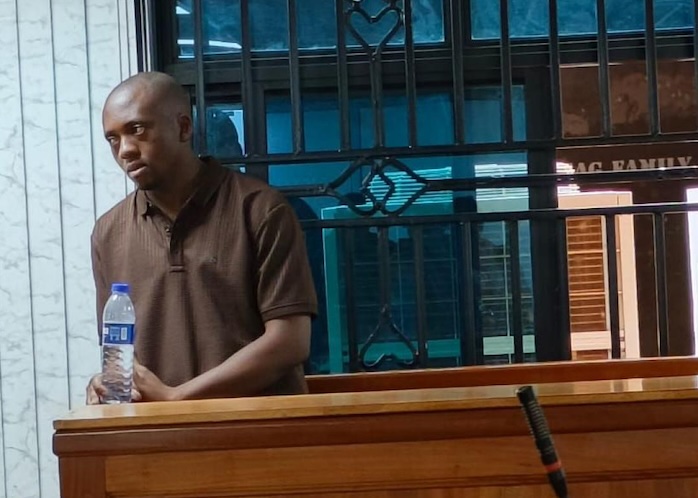
A Congolese national working as a cashier in Uganda has been committed to the High court for trial over allegations of bringing $1.6 million (about Shs5.9 billion) into Uganda without declaring the cash to authorities.
Samuel Muhindo Musyenene is employed by MK Cash Express Limited, a money remittance company operating as MK-Cash Point at Nakasero Complex in Kampala.
Muhindo was on Monday committed to the High court for trial after chief state attorney Jonathan Muwaganya told grade one magistrate Esther Asiimwe that investigations into the money laundering case had been completed.
According to the indictment filed by the Office of the Director of Public Prosecutions, Muhindo allegedly entered Uganda with $1,596,250 on July 4, 2026, through Kikorongo-Mpondwe in Kasese district without declaring the cash to the Uganda Revenue Authority (URA) as required by law.
The prosecution alleges that the amount exceeded the statutory threshold of 1,500 currency points, above which cross-border currency must be declared.
According to the prosecution, MK Cash Express facilitates the transfer or transportation of money between Uganda and the Democratic Republic of Congo (DRC), mainly serving business clients from the DRC.
The prosecution alleges that on July 4, security agencies conducting an operation in the Kikorongo-Mpondwe area to prevent Congolese nationals from travelling further into Uganda stopped a bus carrying several Congolese nationals, including Muhindo.
The passengers were taken to Kikorongo police station as arrangements were made for their return to the DRC. It was at the police station, according to the prosecution, that Muhindo disclosed that two bags in his possession contained $1,596,250.
The money was subsequently verified and exhibited by the authorities. When questioned about how the money had entered Uganda, Muhindo allegedly failed to provide proof that it had been declared at the point of entry.
The prosecution said Muhindo was therefore suspected of violating mandatory currency reporting requirements under Part III of the Anti-Money Laundering Act.
On July 5, Muhindo’s co-worker and supervisor, Joachim Kakule Kagheri, travelled from Kampala to Kasese to follow up on him. Kakule was also arrested, and the two were later transferred to Kampala to facilitate further investigations.
A joint team of investigators from several security agencies was subsequently constituted to establish the source of the money, its intended purpose and how it had been brought into Uganda.
According to the prosecution, investigations established that Muhindo, with the assistance of unidentified colleagues on the DRC side, had been used by the company to transport money into Uganda on behalf of several Congolese businesspeople.
Investigators further established, according to the prosecution, that neither Muhindo nor his colleagues had declared the money despite its alleged value exceeding the mandatory reporting threshold.
However, the prosecution’s case summary states that investigators did not link Muhindo, the money or his company to any subversive activities in Uganda. The prosecution also said investigators had verified the identities of several businesspeople who claimed ownership of the money.
Despite this, prosecutors maintain that Muhindo’s alleged failure to declare the cash constituted a breach of Uganda’s anti-money laundering requirements.
The prosecution said it will seek to prove the charge before the High court and maintains that Muhindo has no valid defence to the allegations.