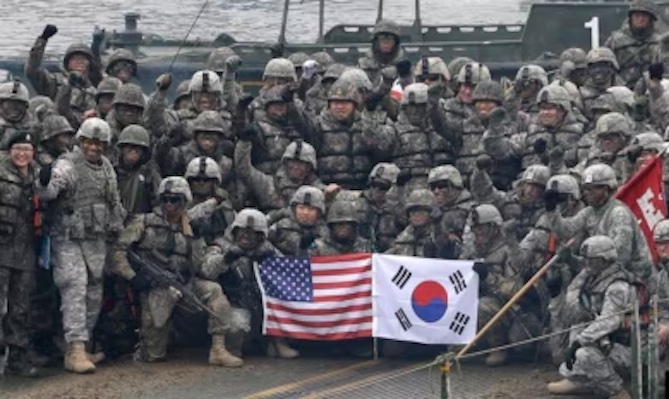
South Korean and US troops will begin annual military exercises next week to strengthen their readiness against North Korean threats, days after Pyongyang resumed ballistic missile testing banned by the United Nations.
The 11-day Ulchi Freedom Shield exercise will begin next Monday and maintain a scale similar to previous years, with about 18,000 South Korean troops expected to participate, South Korean military spokesperson Jang Do-young told reporters on Monday.
US military spokesperson Ryan Donald said the exercise would incorporate realistic threats, including “lessons from recent conflicts”, to strengthen the allies’ readiness and capabilities through combined, joint and all-domain operations.
He pointed to North Korea’s deployment of troops to support Russia’s war in Ukraine in recent years.
“DPRK soldiers have been deployed and fought in Ukraine and they’ve taken those lessons they learned there and brought them back to North Korea,” Donald said, using the abbreviation for North Korea’s official name.
“That changes the DPRK capability and our training accounts for that threat.”
Ulchi Freedom Shield is one of two major combined military exercises conducted annually by South Korea and the US, alongside their spring training.
The US military said the exercise includes “live, virtual, constructive and field-based training.”
North Korea had not immediately commented on the planned drills.
Pyongyang has consistently described major US-South Korean military exercises as rehearsals for an invasion and has responded to previous drills with weapons tests and strong rhetoric.
South Korean and US officials maintain that their joint exercises are defensive in nature.
The announcement comes days after South Korea, the US and Japan detected a short-range ballistic missile launch from North Korea on Thursday.
It was North Korea’s first ballistic weapons test since late June. The missile landed in waters off the country’s east coast.
South Korea and Japan condemned the launch as a provocation and a threat, noting that multiple UN Security Council resolutions prohibit North Korea from conducting ballistic missile activities.
The US Pacific Command said Washington remained committed to defending the US homeland and its allies in the region.
North Korea has accelerated efforts to expand its nuclear and missile programmes since leader Kim Jong Un’s diplomacy with US President Donald Trump broke down in 2019.
Experts say Kim may view a larger weapons arsenal as a way to gain greater leverage and secure concessions from Washington in future negotiations.
North Korea’s provision of troops and ammunition to Russia has also raised concerns in South Korea, the US and other countries that Moscow may have transferred sensitive military technology to Pyongyang.
Such technology could strengthen North Korea’s nuclear and missile capabilities, while experts say the deployment of North Korean troops has also provided them with battlefield experience.
Faridah Abdulkadiri