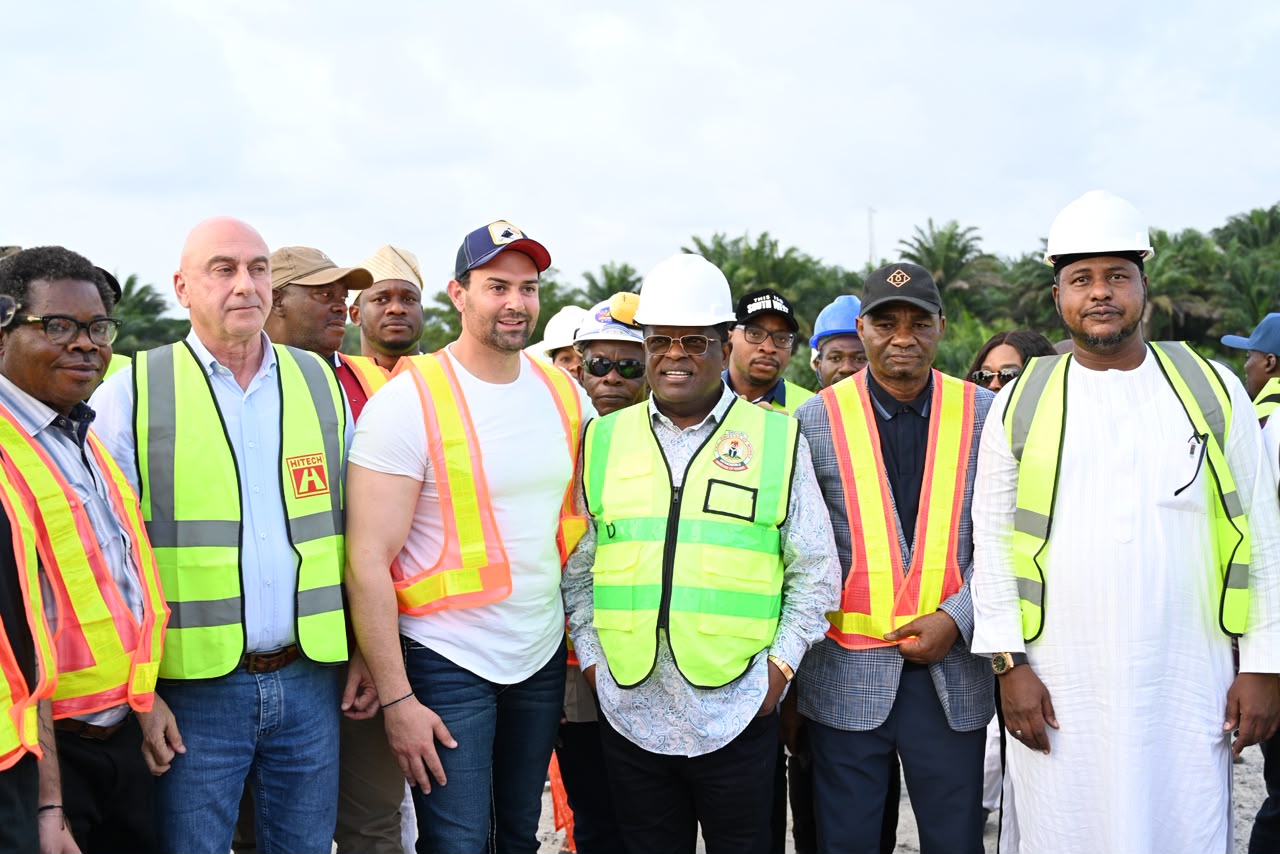
The Minister of Works, Senator David Umahi, has dismissed suggestions that the Lagos-Calabar Coastal Highway would not extend beyond Epe in Lagos State, saying construction has already advanced across several states.
Umahi made the clarification on Wednesday while inspecting Section 4B of the highway project in Ondo State, in response to comments previously made by former Cross River State Governor, Donald Duke, questioning the project’s progress.
According to the minister, ongoing construction across multiple sections of the coastal highway demonstrates the Federal Government’s commitment to delivering the landmark infrastructure project under President Bola Tinubu’s Renewed Hope Agenda.
“The Lagos-Calabar Coastal Highway is already on course. We have gone beyond the point that was being questioned,” Umahi said.
He disclosed that work is progressing simultaneously in Lagos, Ogun, Ondo, Cross River and Akwa Ibom states, with some sections already recording more than 60 per cent completion.
The minister noted that the project is expected to stimulate economic growth by creating employment, improving security, enhancing transportation and opening new opportunities for agriculture, commerce and education.
According to him, more than 1,000 workers have been engaged on one section of the project alone, while local communities have also benefited through indirect employment and security partnerships.
Umahi described the coastal highway as a transformational project that would reshape economic activities along Nigeria’s coastline and urged critics to offer constructive alternatives rather than outright opposition.
He reaffirmed President Tinubu’s commitment to completing the highway, expressing confidence that the project would be delivered as planned.
Addressing concerns over the highway’s alignment, the minister said the route was adjusted strictly on engineering and economic grounds rather than to favour any private interests.
He explained that the original coastal alignment encountered soil deposits as deep as 50 metres and would have required the construction of three major bridges spanning ocean channels of about 3.5 kilometres each, making the project significantly more expensive.
According to him, the revised alignment was adopted to reduce construction challenges and costs while complying with the President’s directive to minimise crossings over large bodies of water without compromising project quality.
Umahi also described the Lagos-Calabar Coastal Highway as one of the most transparent and cost-effective infrastructure projects undertaken in the country.
He said international financiers had expressed confidence in the project’s engineering design and procurement process, noting that the first financing package attracted subscriptions beyond the required amount.
The minister commended HITECH Construction Company for the quality of its work, professionalism and cordial relationship with host communities, describing the firm as a dependable partner in delivering the project.
He expressed optimism that the Tinubu administration’s infrastructure programme would leave a lasting legacy, adding that roads constructed under the current administration are designed for durability with minimal maintenance requirements.
The Lagos-Calabar Coastal Highway is one of the Federal Government’s flagship road projects aimed at improving connectivity, boosting trade and accelerating economic development along Nigeria’s southern corridor.