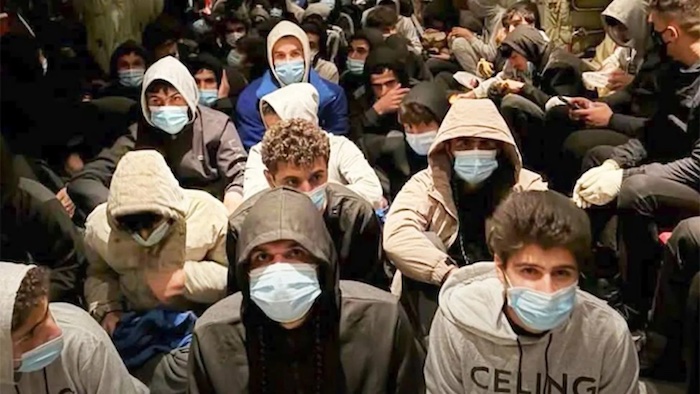
More than 300 migrants attempting to reach the United Kingdom last summer were kidnapped, tortured, and threatened with forced organ removal by a militia in Libya, in what appears to be one of the most disturbing cases of migrant abuse documented along the Mediterranean route.
The victims, all young men from Iraqi Kurdistan, were seized while transiting through Libya and held in what survivors described as overcrowded, inhumane detention conditions. Their families were then forced to pay ransom demands of $5,000 (£3,700) per person, with captors warning that failure to pay would result in organs being harvested.
Investigators who have spoken to released hostages and reviewed photo and video evidence say there are indications that forced medical procedures may have taken place, although this has not been independently verified.
According to testimonies from former captives, the militia responsible for holding the migrants demanded payment from families, claiming an earlier smuggling agreement had not been honoured by an Iraqi Kurdish trafficker involved in arranging the journey.
The armed group allegedly warned families that if payment was not made promptly, it would be recovered “with a kidney”.
Some of the Libyan captors also sent distressing images and videos to families showing the detainees in captivity. In one widely circulated clip, a young man is heard being told he is being taken to a doctor for kidney removal.
A consultant who later reviewed one of the images told investigators that visible scars appeared consistent with surgical incisions used in kidney operations, though there is no confirmation that organ removal occurred.
The migrants’ journeys were reportedly organised by smuggling networks operating from Iraqi Kurdistan, including a trafficker identified as Noah Aaron, who is now serving a 10-year prison sentence in France for separate money laundering and smuggling offences.
Aaron and the Libyan militia are believed to have worked together previously. Both are said to originate from Ranya in Iraqi Kurdistan, a region described in a Chatham House report as “riddled with active smuggling networks”.
Investigators say the relationship between the smugglers collapsed over payment disputes, triggering the hostage-taking of migrants already in Libya.
Experts say the crisis reflects the breakdown of governance in Libya, a key transit country for migrants heading to Europe.
Anthony Dunkerley, a United Nations adviser who has investigated human trafficking in Libya, described the country as having a “huge vacuum of government”, warning that rival militias effectively control large parts of the territory and collaborate with smuggling networks.
Within this environment, migrants are routinely moved through guarded compounds where they are detained and used for ransom.
In February, investigators speaking in Ranya were approached by families of some of the victims. One father said his son had been among those held and described how the smuggling network charged thousands of dollars to organise the journey from Iraqi Kurdistan through North Africa and across the Mediterranean.
He said he eventually paid the ransom and his son was among 110 hostages later flown back to Iraq in a government-organised repatriation flight in January.
However, he showed investigators a photograph allegedly sent by his son while in captivity, showing a raw scar he believes may have resulted from a forced organ removal.
Soon after, dozens of other families came forward with similar accounts and images.
One 16-year-old survivor described being held in a cell with 178 other people.
“We didn’t see the Sun for six months,” he said.
He added that conditions were so cramped that prisoners were forced to sleep sitting upright, while all detainees shared a single toilet. “Those who took too long would be beaten,” he said.
Another released hostage said he was tortured, including having his leg burned, and showed visible scars to investigators.
Food, survivors said, consisted of “one piece of bread per day” and was only provided if families paid additional money.
At least one hostage is confirmed to have died, though the total number still in captivity remains unknown.
While some families were able to secure release by paying ransom demands, Kurdish authorities fear that others may have been subjected to organ harvesting, though this has not been independently verified.
Investigators say kidnapping for ransom along Libya’s migration routes is well documented, but the scale and alleged brutality of this case stands out.
Criminal networks, they say, exploit Libya’s fragmented security landscape to operate with relative impunity.
Despite repeated warnings and documented abuse, officials say migration flows from Iraqi Kurdistan to Europe continue.
Hemn Merany, a senior official at the Kurdistan Regional Government’s Ministry of the Interior, said returned victims are being encouraged to speak publicly about their experiences to deter others.
He recounted the case of a father whose son died in Libya following a suspected forced organ removal. At the funeral in Ranya, he discovered that two of the boy’s cousins had already left for Europe.
“The very sad part of this business is we do not learn,” Merany said.
Boluwatife Enome