Screenshot
Former Minister of Education, Dr Oby Ezekwesili, has urged Nigerians to reject the growing acceptance of the country’s decline as inevitable, describing the situation as the product of a failed national design that citizens must challenge.
Ezekwesili, who reaffirmed her support for former Anambra State Governor Peter Obi ahead of the 2027 presidential election, said Nigerians should “vote for themselves” by demanding leadership founded on character, competence and capacity rather than primordial considerations.
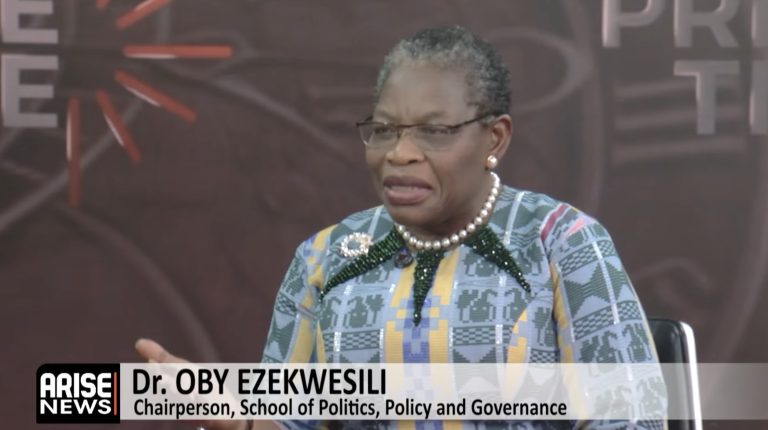
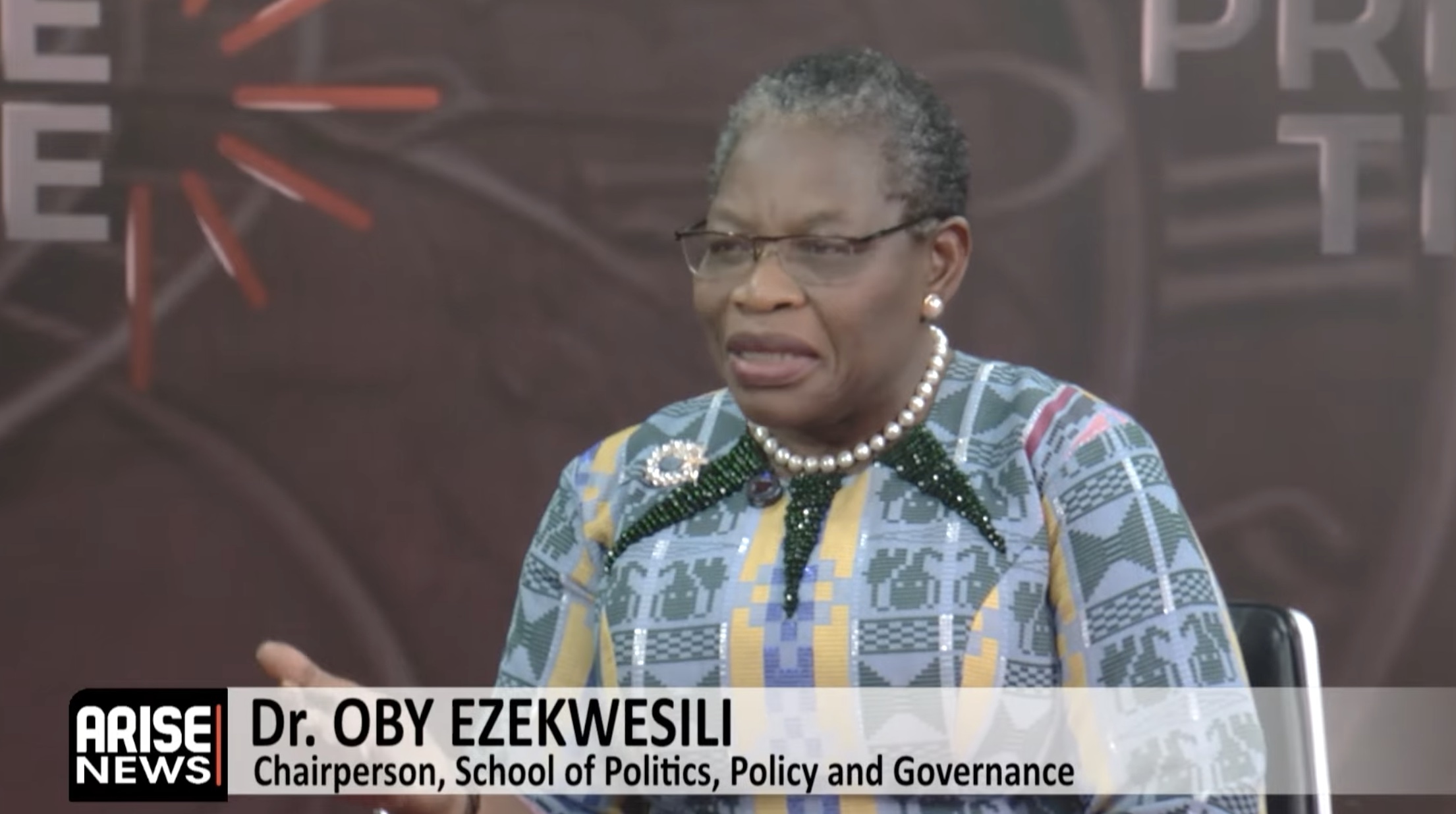
The founder and chairperson of the School of Politics, Policy and Governance (SPPG), founder and CEO of Human Capital Africa, and co-chair of the World Economic Forum Africa Regional Stewardship Board spoke in an exclusive interview with ARISE NEWS on Monday.
Ezekwesili, a co-founder of Transparency International and the Bring Back Our Girls movement, discussed Nigeria’s political future, the state of its democracy and what she described as the need for fundamental reforms beyond another cycle of elections.
She argued that one of Nigeria’s greatest problems was the resignation of citizens to deteriorating conditions and the accompanying erosion of the dignity and value of human life.
“What we have to show for it is the complete collapse of the dignity of the human being and the dignity of life. It’s like we have zeroed out on the value of life, and yet we continue to think that somehow, if we just keep doing elections, we’ll be fine,” she said.
“I am challenging that and saying that Nigerians should at least vote for themselves. If no one votes for you in terms of the leaders you’re choosing, vote for yourselves.”

According to her, Nigerians should not regard the country’s deterioration as an unavoidable fate.
“The greatest tragedy of the country is this resignation—that this is our destiny. I say no, this is by design.
“It is not our destiny, this is by design. This design needs to be challenged,” she said.
Ezekwesili also called for a renewed national conversation aimed at establishing a common identity, shared values and a social contract capable of strengthening cohesion among Nigerians.
She described the Nigerian construct as having been effectively “orphaned”, arguing that the absence of social cohesion and social capital was worsening the country’s problems.
“The design that we run right now has not worked for us, we do need to design again,” she said.
According to the former minister, Nigeria failed after independence to undertake the kind of national conversation required to establish shared values and a common national vision.
She argued that the country consequently struggled to make a complete transition from merely being a country into a cohesive nation.
“What I am arguing for is that since the independence of our country, we’ve not really had the kind of conversation that we should have had immediately the British left the scene,” she said.
Turning to the 2027 presidential election, Ezekwesili said she would not rule out the possibility of Nigerians reaching a political tipping point and voting against established patterns of incumbency, despite the financial resources and political structures traditionally available to those in power.
She acknowledged, however, that widespread economic hardship could significantly influence electoral choices because people struggling to meet their immediate needs may attach greater importance to short-term financial or material benefits.
Ezekwesili said research associated with FixPolitics and the SPPG had demonstrated how low productivity and low household incomes could affect citizens’ political decisions.
She nevertheless maintained that there were moments when voters could decide they had endured enough and collectively demand a different direction.
“But we’ve also seen situations where the people vote for themselves. They come to that point where they sort of say, ‘You know what? Okay, we’ve had it. We’ve really had it. We can’t continue on this trajectory because it actually is too injurious,’” she said.
Reaffirming her support for Obi, Ezekwesili said her assessment remained based on the three criteria of character, competence and capacity rather than ethnic, religious or other primordial considerations.
She recalled taking a similar position during the 2023 presidential election and said her assessment had not significantly changed.
“In 2023, I made it very clear that, using the criteria on which I see leadership either fail or succeed to govern well… the other two candidates score considerably lower than what you would assign to former Governor Obi, and so I was going to stand with Governor Obi.
“I don’t think that anything has really significantly changed,” she said.
Ezekwesili, however, cautioned against reducing the broader conversation about Nigeria’s future to Obi or any single presidential candidate.
“Don’t make this about Peter Obi. I don’t want us to personalise. I’m interested in the construct,” she said.
She argued that Nigerians should assess those seeking public office at all levels on ethical character, competence and capacity, saying these attributes increase the likelihood that decisions in government would advance the common good rather than private interests.
Ezekwesili consequently called for more credible Nigerians possessing those attributes to contest local government, state and federal elections, both for legislative and executive positions.
Speaking about her previous experience in government, the former minister also addressed her differences with former Vice President Atiku Abubakar, saying her concerns were not personal but related to what she described as resistance to reforms she considered critical to Nigeria’s development.
She recalled Nigeria’s debt burden and the effort to create fiscal space for greater investment in health, education and other growth-enhancing sectors.
According to her, concerns from international partners over Nigeria’s management of public resources contributed to her determination to pursue reforms in public procurement and demonstrate that the country could achieve greater value for money.
Ezekwesili said the experience reinforced her belief that Nigeria’s problems require institutional reforms rather than simply changing personalities at election time.
While maintaining her preference for Obi based on her stated leadership criteria, she said the deeper issue for Nigerians should be building institutions and a political system capable of consistently producing leadership that serves the public interest.
Favour Odima