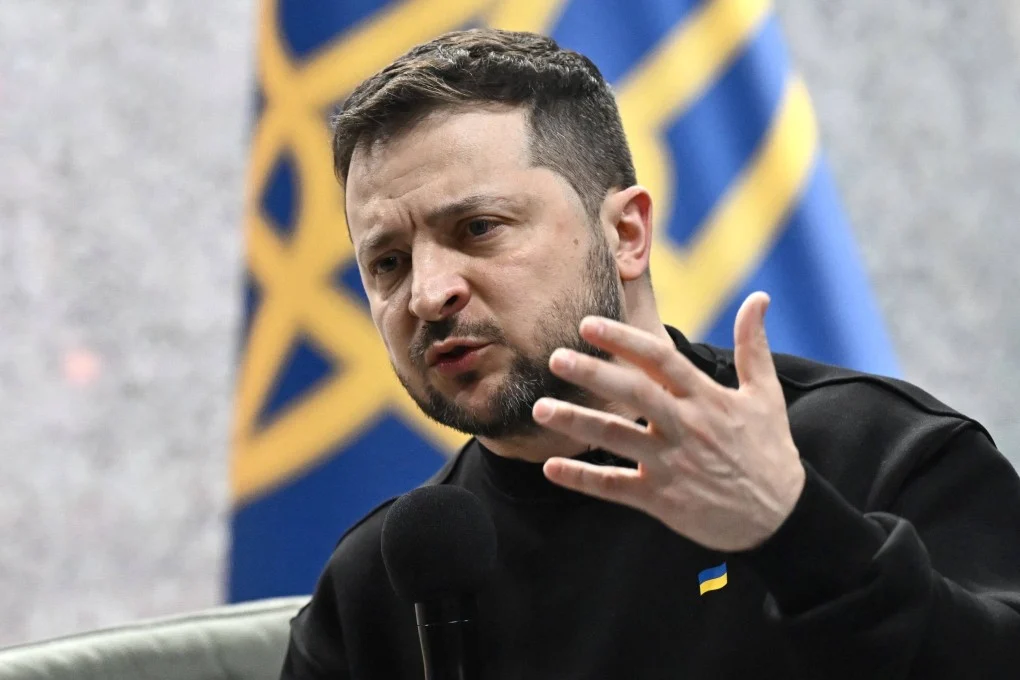
Ukrainian President Volodymyr Zelensky is preparing to deliver a revised set of proposals to the United States aimed at ending the war sparked by Russia’s February 2022 invasion.
The move comes as he continues high-level diplomatic engagements across Europe, including a meeting with Pope Leo XIV in Italy.
On Monday, Zelensky held talks with European leaders in London and Brussels amid intensifying pressure from U.S. President Donald Trump for Kyiv to accept a settlement.
Trump has publicly accused Zelensky of not reviewing earlier U.S. proposals, the initial version of which European partners considered too favorable to Moscow.
According to Zelensky, Washington’s original 28-point plan has now been scaled down to 20 points following negotiations over the weekend.
“Ukrainian and European officials will now work through these 20 points,” Zelensky said during an online press conference. “We do not agree with everything our partners have brought forward. While much of this stems from the Russian position, we will still refine our response and send our perspective to the U.S. tomorrow evening.”
A key component of the American plan reportedly required Ukraine to surrender territories not yet seized by Russia in exchange for security guarantees—provisions that fall far short of Kyiv’s long-standing aim of joining NATO. Zelensky stressed that both the territorial question and the nature of international security guarantees remain major obstacles.
“Do we envision ceding territory? We have no legal right under our constitution or international law—and no moral right either,” he declared.
“The crucial issue is understanding what our partners are prepared to do if Russia launches new aggression. So far, we have not received a clear answer.”
Focus on Security Guarantees
Earlier in the day, Zelensky met Pope Leo XIV at Castel Gandolfo near Rome. According to the Vatican, the Pope “expressed his urgent desire for current diplomatic efforts to yield a just and lasting peace” during their 30-minute meeting. Zelensky is also scheduled to meet Italian Prime Minister Giorgia Meloni later Tuesday.
Meloni has remained a strong supporter of Ukraine, though divisions persist within her governing coalition. While Italy continues supplying weapons—restricted to use within Ukraine’s borders—the government recently postponed a decision on renewing military aid beyond December 31. Critics within her coalition, particularly Matteo Salvini’s League party, have questioned whether such aid is still necessary given ongoing diplomatic negotiations.
Nevertheless, Meloni reaffirmed Italy’s position last week: “As long as there is war, we will do everything we can to help Ukraine defend itself.”
Zelensky’s European tour also included meetings in London with the leaders of Britain, France, and Germany, followed by talks in Brussels with EU and NATO chiefs.
European Commission President Ursula von der Leyen reiterated Europe’s stance after Monday’s discussions: “Ukraine’s sovereignty must be respected. Its long-term security must be guaranteed, as a first line of defence for our Union.”
French President Emmanuel Macron wrote on X that Europe is preparing “robust security guarantees and reconstruction measures” for Ukraine, noting the central challenge is finding “convergence” between the European-Ukrainian position and that of the United States.
Since returning to office in January, Trump has oscillated in his approach to the conflict—initially scolding Zelensky for insufficient gratitude, then expressing frustration over stalled efforts to persuade Russian President Vladimir Putin to end the war. His administration recently imposed sanctions on Russian oil firms in a renewed bid to pressure Moscow.
About the Author