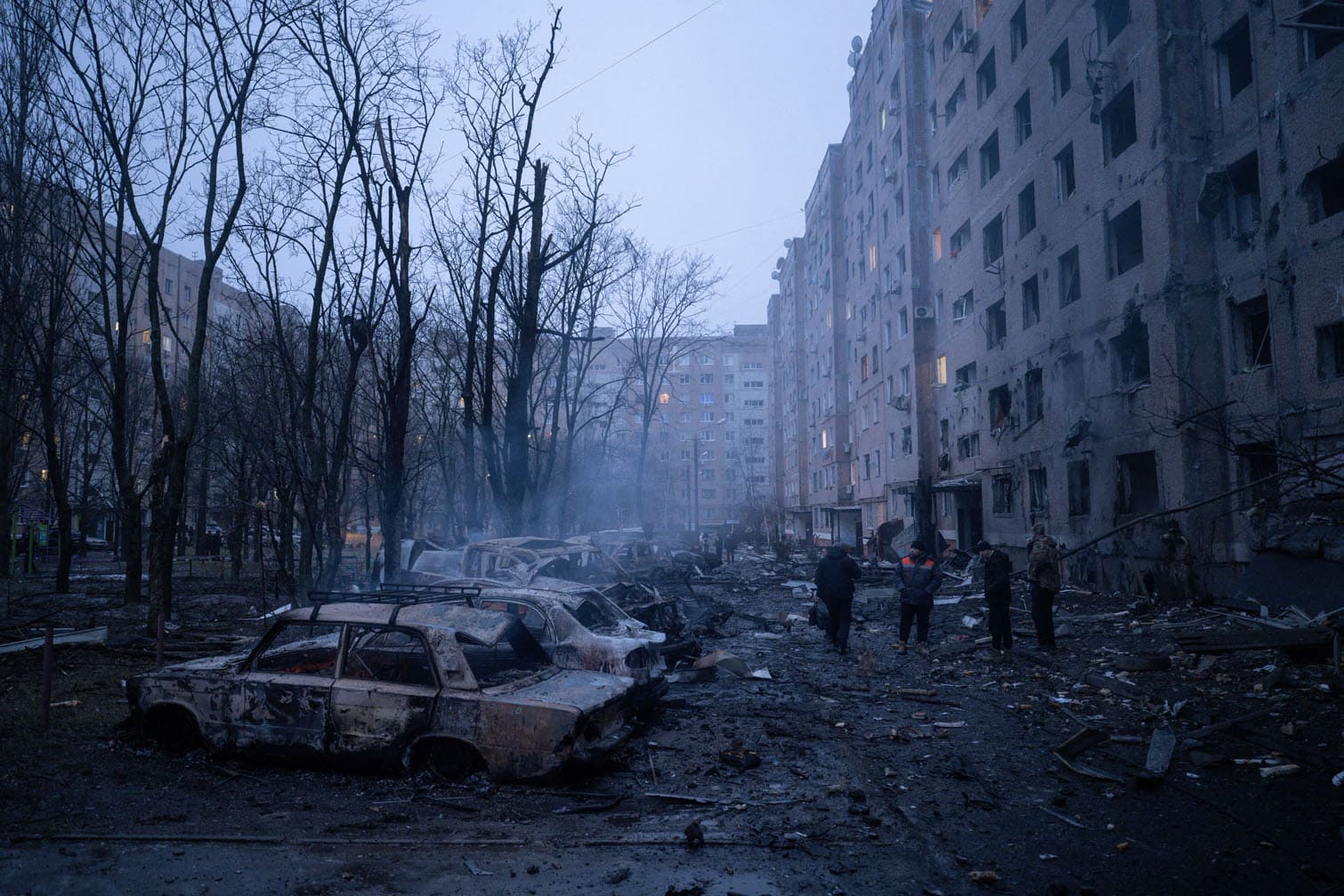
In this handout photograph taken and released by the press service of the 93rd Kholodnyi Yar Separate Mechanized Brigade of the Ukrainian Ground Forces on February 8, 2026, local residents stand next to burnt-out cars in the courtyard of a damaged residential building following an air attack in Kramatorsk, Donetsk region, amid the Russian invasion of Ukraine. (Photo by Iryna Rybakova / The 93rd Kholodnyi Yar Separate Mechanized Brigade / AFP) / RESTRICTED TO EDITORIAL USE - MANDATORY CREDIT "AFP PHOTO / IRYNA RYBAKOVA / PRESS SERVICE OF THE 93RD KHOLODNYI YAR SEPARATE MECHANIZED BRIGADE" - NO MARKETING NO ADVERTISING CAMPAIGNS - DISTRIBUTED AS A SERVICE TO CLIENTS
Supplementing its numbers on the frontlines with the impoverished men of world is Russia’s modus operandi, say critics.
Two European researchers and a diplomat on Friday gave a presentation on the alleged tactics used by the Russian military to bolster its military machine.
Four South Africans returned home this week after spending time near the disputed territories of eastern Ukraine, with the researchers singling out one local political party for criticism.
Hijacking of visas
The European External Action Service hosted researchers Thierry Vircoulon and Vincent Gaudio, along with the Ukrainian foreign ministry’s Director-General of African Affairs Liubov Abravitova.
Vircoulon, Senior Researcher at the French Institute of International Relations, elaborated on his study of African military labour.
Based on testimonies from the recruits and their families, he delved into how public recruitment was supplemented by a “discreet” form of coercion.
The latter involved job offers secured with quick visa approvals through groups masquerading as work and travel agencies.
Co-founder of Inpact, Vincent Gaudio, said the men were lured with offers of unskilled work, stating that “it has become a business” for recruiters in high-volume countries.
“Once in the hands of the Russian army, they are sent for basic military training, then deployed to do the most dangerous work on the frontlines,” said Vircoulon.
Gaudio also accused the Russians of hijacking visa extensions, deceiving departing migrants into signing visa contracts before handing them battle fatigues.
Over 1 400 Africans recruited in two years
Both researchers referenced Russian state-funded private military company Wagner Group as having operations in high-volume countries.
Vircoulon said the profile of private recruiters was broad, featuring individuals aged between 30 and 40 and who were involved in civil society, business and politics.
In South Africa, the uMhkonto weSizwe (MK) Party, through Duduzile Zuma-Sambudla, were tied to the recruitment of South Africans, with Vircoulon mentioning the MK party specifically as being aligned to Russia.
The MK party was contacted by The Citizen for comment on claims it was a conduit of Russia’s recruitment; however, no response was received at the time of publication.
Inpact displayed a list of African prisoners of war captured by Ukrainian forces, and their research showed that 1 417 African men had been recruited by Russia between 2023 and 2025.
The recruits range in ages between 18 and 57, with the average being 31 and most commonly between 18 to 25.
Inpact listed 32 South African recruits, with Egypt and Cameroon having the largest contingent with 361 and 335, respectively.
Families of recruits relayed that they had trouble getting money or were not getting paid, and if they did it was “never the amount initially promised”.
He adds that the Africans record a high mortality rate due to a lack of training.
Families explained that when their sons or brothers were killed in action, Russians would demand money to have body repatriated
Vircoulon admitted that a “minority” did know they were going to Russia for military service, but families said most were lured on false pretences.
ALSO READ: Ramaphosa and Putin discuss repatriation of South Africans recruited to fight in Ukraine
The vast majority of recruits were men, but the women who were recruited ended up in factories supporting the war effort, such as those building drones.
Vircoulon suggested the recruitment tactics showed that the Russians were unable to recruit their own citizen and that Africans came at a cheaper cost.
He stressed that it was not only African men, but also people from impoverished parts of Asia and the Middle East.
“Russian soldiers are more and more costly and luring foreigners is a form of cheaper labour. It is about exploiting the migrants,” said Vircoulon.
‘Complicity in international crimes’
Kenya was among the first nations to raise the alarm, demanding its citizens back and an end to Russian exploitation.
Russia has repatriated some recruits, with Vircoulon saying this was “a surprise” as these men were witnesses of alleged Russian abuse.
Abravitova said that Russia required 156 soldiers per square kilometre of Ukrainian territory and that large volumes of men were needed to sustain the Russian waves of attack.
She stated that President Volodymyr Zelensky signed legislation allowing foreign enlistment in the Ukrainian army, but said it proved problematic.
“It became very obvious that it was not allowed by the laws of many countries, but some foreign nationals have proven to find their way to Ukraine by other means,” said Abravitova.
Vircoulon also weighed in, stating that France recruited foreign nationals through its Foreign Legion but was “totally different” in the way it was implemented.
“This recruitment is not misrepresented though fake job placements that they are never paid for,” he said.
When questions were previously raised about a South African joining the Israeli Defence Force (IDF) to fight Hamas in 2023, the Department of International Relations and Cooperation cited the Regulation of the Foreign Military Assistance Act.
Dirco stated that anyone wishing to join a foreign military required approval from the National Conventional Arms Control Committee and the Minister of Defence and Military Veterans.
Warning that citizenship would be lost for naturalised residents, Dirco said they would not support anyone taking a stance opposed to this.
“South African citizens should be made aware of the consequences of joining the IDF or any foreign armed forces involved in conflicts with a view to preventing inadvertent complicity in international crimes or violations of domestic law,” Dirco stated in 2023.
NOW READ: Kenyan families urge Govt to repatriate relatives recruited by Russia
About the Author