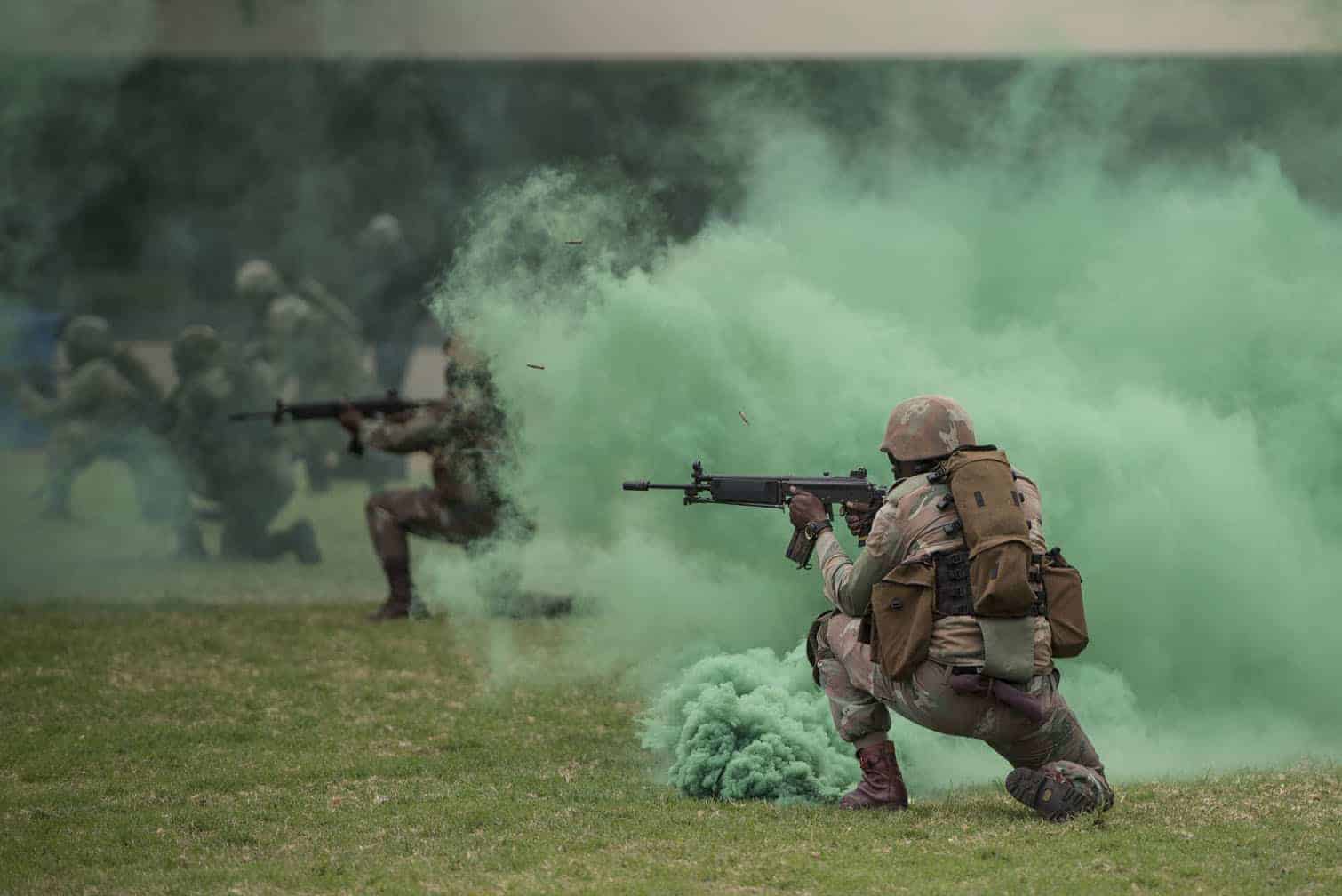
Members of the South African National Defence Force (SANDF) take part in a capability demonstration, 19 April 2025, at the Rand Show, at the Johannesburg Expo Centre in Nasrec. The display featured a combat simulation and static displays of military assets. Picture: Michel Bega/The Citizen
President Cyril Ramaphosa’s deployment of the South African National Defence Force (SANDF) for domestic issues has the potential to degrade soldier morale.
This was the opinion of an academic who has spent years interviewing soldiers, including the SANDF members who returned from deadly combat action in the Democratic Republic of Congo (DRC).
Ramaphosa said during his State of the Nation Address on Thursday that the SANDF would be sent to fight gangsterism in the Cape Flats and illegal mining in Gauteng.
Loss of dignity and pride
The Portfolio Committee on Defence met on Friday to hear the results of studies done by academics on the deployment challenges within the military.
Stellenbosch University Professor Lindy Heinecken spoke about the dynamics of using the military to augment domestic law enforcement capabilities.
The author of several books, her most recent was Military Operations in Response to Domestic Emergencies and Global Pandemics, where her and co-author Christian Leuprecht analysed the military-civilian relations in 26 countries.
Heinecken stated that soldiers felt that their combat training, which focused on the use of lethal force, was not conducive to the policing of civilians, which required restraint, de-escalation and negotiation.
“The moment the military is deployed in a law enforcement and coercive role, it has a severely negative effect on the public image of the military,” said Heinecken.
She explained that soldiers reacted positively to disaster relief missions, but felt internal crime-fighting deployments were a form of punishment.
“There was a feeling that utilising troops internally means they lose value, exposes their gaps even more, and they risk losing their dignity and pride.”
Noting that nations across the world were increasingly using militaries for internal roles, Heinecken quoted a soldier she had recently interviewed.
“Soldiers have a temper. They become too rough, leading them to assault the civvies. It is not good for the community.”
‘A Mickey Mouse military’
Heinecken relayed how soldiers she interviewed felt they were being misused, adding that frequent or inappropriate deployments were seen as damaging to the military’s primary combat capability.
The professor interviewed troops last year who were present at the Sake Air Base in North Kivu, DRC, where 14 soldiers were killed by M23 rebels.
Regarding concerns around their safety, soldiers said they had a lack of suitable weapons, vehicles and body armour.
“This was a recurring theme that had a major impact on their morale [but] not so much the commitment to their work,” said Heinecken.
Soldiers expressed concerns at knowing the rebels had superior firepower, but used another quote from an interviewee to illustrate the disconnect between their personal confidence and the trust in their leaders.
“We have soldiers who have hearts, but now we have these politicians who are making the whole defence force a Mickey Mouse military.
“Why am I saying this? Even when you look at SAMIDRC, we fought with the minimum, but we were able to stop those guys from entering our base and taking our equipment.”
Heinecken said the soldiers were not asked directly about these matters, but took the opportunity to share on their own volition.
“These are the issues that the soldiers raised themselves in response to the circumstances under which they were deployed,” the professor said.
Battlefield trauma
By voluntarily opening up about their experiences, Heinecken was able to understand the mental stress the DRC deployees had suffered.
She said the soldiers relayed a lack of psychological support and lack of medical support, with them stating that debriefings were rushed and that their personal relationships were deteriorating.
Soldiers are encouraged to make use of voluntary counselling, but soldiers were reluctant as “men did not volunteer for counselling”.
The pressures of mixed-gender battalions was also expressed, as the majority of female soldiers were said to have remained in their bunkers during combat.
“The deployment of women who had limited or no deployment experience was described as highly problematic,” Heinecken stated.
“Especially for the older male soldiers with substantial deployment experience, this reinforced the stereotype that woman were not suited for fighting and that they create problems on the base.”
Heinecken clarified that there was no animosity towards the female soldiers, explaining the males felt a great duty to protect them from the potential horrors of defeat.
“They expressed the fear that if the rebels broke through the perimeter, that the men would receive a bullet in the head, but the women would be raped.”
NOW READ: ‘We need the truth’: committee says defence ministry is stalling accountability
About the Author