Uganda has recorded a steady rise in gold exports over the past decade, with the only notable dip occurring in the 2022/23 financial year, when a tax dispute between the government and industry players led to a temporary suspension of exports.
Since then, export earnings have rebounded sharply, climbing to an estimated $5.2 billion (about Shs 18.8 trillion) in 2025, up from $3.8 billion (Shs 13.6 trillion) a year earlier. Gold now accounts for just under half of Uganda’s total export earnings, firmly entrenching the mineral as the country’s leading foreign exchange earner.
Yet the surge has reignited an old and uncomfortable question: who actually benefits from Uganda’s gold boom, and how transformative is it for the wider economy? Critics increasingly point out that the country’s socio-economic indicators do not reflect the windfall of a single commodity earning over $5 billion annually.
One complicating factor is the opacity surrounding domestic production. While some estimates place Uganda’s gold output at about 3,200 kilogrammes in 2023, President Museveni has on several occasions claimed that the country’s gold deposits are estimated at 32 tonnes or more, with a notional value running into trillions of dollars. These figures, however, remain largely unverified.
In theory, rising production and export earnings should generate broad-based benefits along the value chain, from miners and processors to traders, exporters, and supporting industries. In practice, analysts argue that this has not materialised.
Multiple studies suggest that much of the gold refined and exported from Uganda is not mined locally, a conclusion that appears consistent with the scale of mining activity on the ground.

For years, there have been suspicions that a portion of Uganda’s gold exports originates from conflict-affected areas in the Democratic Republic of Congo and Sudan, regions subject to international sanctions aimed at preventing mineral revenues from financing armed conflict.
Another significant source is Tanzania, which industry insiders describe as the largest supplier of unrefined gold to Uganda. Official records indicate that mineral imports from Tanzania were valued at Shs 1.08 trillion ($270 million) in 2023.
Financial analyst and investment adviser Alex Kakande says his analysis of Uganda’s gold trade reveals a strong link between export volumes and mineral imports from Tanzania.
“The correlation between the two was undeniable, with both gold exports and mineral imports from Tanzania (predominantly gold, as suggested by the data, though not explicitly named in the Bank of Uganda’s reports) escalating in the same pattern,” he says.
Employment figures further complicate the narrative. The gold sector directly employs about 35,000 people, more than 80 per cent of whom are artisanal and small-scale miners. The remainder work in medium- and large-scale mining operations and refineries, most of which are foreign-owned. Indirectly, hundreds more earn livelihoods in mining areas such as Mubende in central Uganda, Busia in the east, and the Karamoja sub-region.
Large-scale operations such as the Chinese-owned Wagagai mine alone employ between 3,000 and 5,000 workers. Even so, gold’s employment footprint pales in comparison to coffee, which, despite now earning less foreign exchange, supports about 2.5 million people, roughly a third of Uganda’s households.
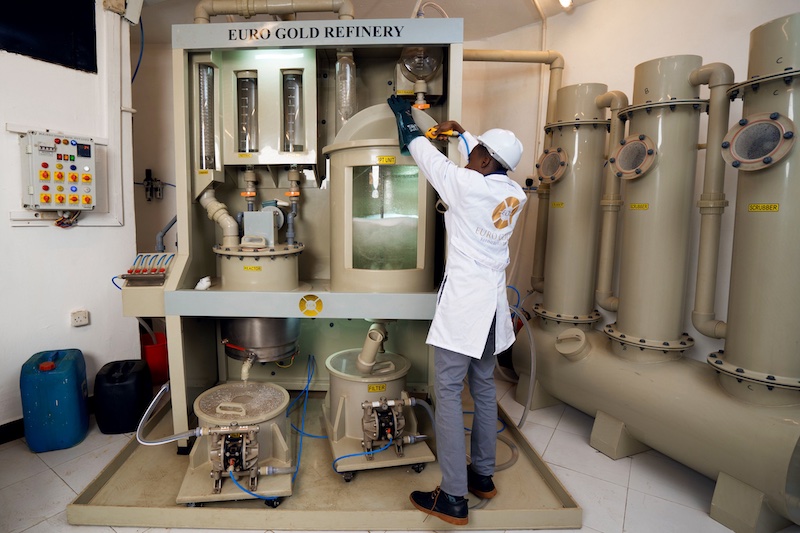
Policy choices also shape the distribution of benefits. Uganda’s investment regime allows foreign-owned mining and refining companies to repatriate 100 per cent of their profits, limiting domestic capital accumulation from the sector. The country currently hosts nine gold refineries, including Euro Gold Refinery, launched in August 2025, alongside Africa Gold, Simba Gold, Oasis Gold Uganda, Billion Refinery, and Global Refineries.
Government revenue from the sector remains modest relative to headline export figures. Some estimates put annual tax collections from gold exports at just Shs 35 billion. While the law provides for royalties of 3 to 5 per cent on domestically mined gold, an export levy of $200 per kilogramme on refined gold, and other statutory fees, alongside provisions for up to 20 per cent royalties to local governments, enforcement and compliance challenges persist.
Experts cite smuggling, tax evasion, and avoidance, as well as weak state capacity to effectively capture revenues, as key constraints.
At the macroeconomic level, however, gold exports have delivered tangible gains. The Bank of Uganda (BoU) has repeatedly credited rising export earnings with stabilising the shilling, which has remained relatively steady against major currencies for more than two years. In 2025 alone, the shilling appreciated by 2.48 per cent against the US dollar, outperforming most regional peers.
Gold has also bolstered foreign exchange reserves. By late 2025, reserves had climbed to a record $5.7 billion, equivalent to four to five months of import cover up from $3.8 billion a year earlier.
In a bid to deepen local benefits, the BoU last year announced plans to begin purchasing gold domestically, emphasising that only gold mined within Uganda would qualify. The central bank says the initiative is intended to support artisanal miners, promote value addition, strengthen foreign reserves, and reduce exposure to volatility in international financial markets.
Gold’s role as a stable asset, policymakers argue, makes it an attractive hedge amid global economic uncertainty. However, structural constraints remain. Most Ugandan refineries are not internationally certified, effectively locking the country out of lucrative markets in the European Union and the United States.
As a result, while Uganda’s gold boom has strengthened macroeconomic indicators, its direct and visible impact on livelihoods, public revenue, and structural transformation remains limited, and unevenly shared.
About the Author