Last week, Mawokota South member of parliament Yusuf Nsibambi defected from the Forum for Democratic Change (FDC) and joined the ruling National Resistance Movement (NRM).
He joins a long list of opposition figures who, in spite of declining political appeal, find themselves embraced by the NRM. As Geofrey Serugo writes, Nsibambi’s defection could open gates for more opposition figures to switch sides and join government.
Throughout his time in opposition politics, Nsibambi was never the most vocal or most influential. However, he was always seen as a voice of authority owing to his many years as a law don at Makerere University. He was also known for his vast wealth.
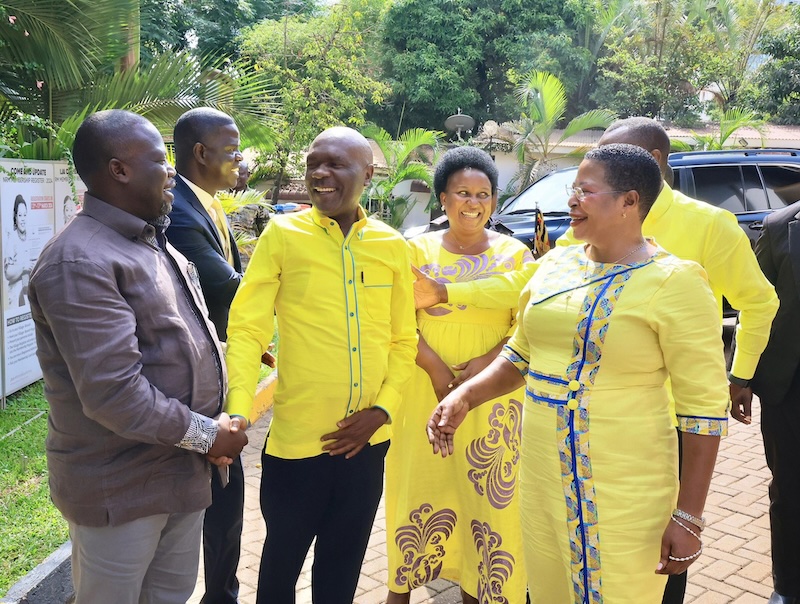
Last week, Nsibambi was officially received in NRM by Anita Among, the speaker of Parliament, who also serves as the NRM vice chairperson (female). His decision comes after he lost the election to NRM candidate Suzan Nakawuki.
Nsibambi’s surprise move followed an earlier meeting between President Museveni and notable opposition figures at State House, Entebbe. After the meeting, Nsibambi expressed surprise at the one- hour engagement the President accorded them, a departure from previous meetings that often were brief.
Among the key issues discussed in that meeting was the fate of political prisoners, particularly Dr Kizza Besigye and dozens of NUP supporters as well as prospects for political dialogue.
“We believe dialogue is possible, and it was on the agenda. The President said he has no problem with the release of political prisoners and urged us to rehabilitate them,” Nsibambi said after the meeting with the President.
In his inaugural remarks after joining NRM, Nsibambi said: “I am a newcomer, but I have the zeal and strength to work for the NRM in whatever capacity to ensure that Uganda and our people have smiles on their faces. I came with my FDC card, and when I leave here, I want to go and return it.”
Nsibambi, widely expected to follow in the footsteps of Joyce Ssebuggwawo, the former FDC acting president who was appointed minister even after losing the Lubaga LC-III chairperson elections in 2021, will have his work cut out to prove that the defection is in the interest of national dialogue.
“His biggest task is to secure the unconditional release of Dr Besigye and if he secures that, his stock as a voice of reason will rise,” says Muhammad Tamale, a social critic.
“It will also be in government’s best interest to have a person like Nsibambi act as a bridge between incarcerated individuals. So, even after crossing, leading opposition figures have evaded openly criticizing him.
WHO IS NSIBAMBI?
Five years after ending his 27-year career as a lecturer at the School of Law at Makerere University, Nsibambi became more actively involved in politics through Reform Agenda and later the FDC, where he served in various capacities, including vice president for the Buganda region.
“No one can believe that I lost Mawokota, but I sincerely lost because the population decided differently. As opposition parties, over the last five years, we have never sat down to agree on a common position on key issues in parliament,” he said.
Nsibambi’s turnaround has been seen as a gamechanger in opposition politics. An NRM insider who preferred not to be named but has been crucial in the negotiations that wooed Nsibambi told us that at the very least Nsibambi will be appointed a state minister and will go a long way to influence how government works with the opposition.
“He plays mature politics of realism and we have high hopes in him. NUP wouldn’t have lost billions of shillings in their boycott of Inter-Party Organization for Dialogue (IPOD) if they had heeded Nsibambi’s advice. He has already hinted at persuading government to release political prisoners, especially Dr Kizza Besigye,” says the source.
“Indeed, he could score highly if he negotiates their release. It is interesting that a number of key opposition figures are discreetly working with NRM and Nsibambi’s crossover could trigger their openness.”
On the other hand, a top NUP official who preferred anonymity says it is just a matter of time before more opposition figures, especially losers in the most recent elections, come out to join NRM.
“We know them and they pretend to work in the best interest of some of our incarcerated comrades yet they are deal-chasers. You are going to see them pretend to work in the best interest of our suffering colleagues,” says the official.
Over the years, President Museveni has attracted prominent figures from opposition parties into the ruling party, often appointing them to ministerial and other influential positions to strengthen his administration.
FIRST OPPOSITION FIGURES TO WORK WITH MUSEVENI
Nsibambi is neither the first nor likely the last opposition figure to cross to or work with the NRM. Dr Paul Kawanga Ssemogerere was the first major opposition figure to work with Museveni under the broad- based government arrangement in 1986.
Unlike many others, he did not join the NRM officially. As leader of the Democratic Party, Ssemogerere agreed to cooperate with Museveni and was appointed minister of Internal Affairs, minister of Foreign Affairs, and later minister of Public Service.
He also served as deputy prime minister. Ssemogerere later resigned in 1995 to contest against Museveni following the promulgation of the Constitution. Other notable opposition figures who previously worked with Museveni and the NRM/ NRA include Evaristo Nyanzi, who served as minister for Commerce, and John Ssebaana Kizito, who served as minister for Regional Cooperation in 1986.
The most recent high-profile individual is DP president Norbert Mao, who is the current minister of Justice and Constitutional Affairs. However, critics argue that after serving one or two terms in such roles, some of these individuals have been sidelined, paving the way for new entrants.
Nsibambi joins a list of former FDC stalwarts who includes speaker Among, deputy speaker Thomas Tayebwa; state minister for the Environment Beatrice Atim Anywar, who advocated against the cutting of Mabira Forest and Ssebugwawo, minister of state for Information and Communication Technology and National Guidance.
Among and Tayebwa were instrumental in the just-concluded presidentialelections. Tayebwa joined the NRM ahead of the 2016 elections while Among joined in 2020 and went ahead to be elected the deputy speaker of parliament in 2021.
After being elected unopposed in the January 2026 elections, Among mobilised support for President Museveni, while Tayebwa traversed several areas, particularly in western Uganda, persuading opposition candidates to step down in favour of NRM flag bearers, a strategy he successfully executed.
MUSEVENI’S EFFORTS TO WEAKEN THE OPPOSITION
In 2016, Museveni stated that by 2021 there would be no opposition left, a comment widely interpreted as reflecting the ruling party’s efforts to persuade opposition figures to work with the government. During presidential campaigns in Mbale in November, 2020, Museveni said opposition parties were fortunate that he was too busy to focus on them.
geofreyserugo1992@gmail.com
About the Author