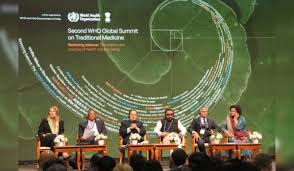
The World Health Organization (WHO), in collaboration with the Government of India, has launched its Second Global Summit on Traditional Medicine, bringing together ministers, scientists, Indigenous leaders, and practitioners from over 100 countries.
The Summit seeks to advance the WHO Global Traditional Medicine Strategy 2025–2034, promoting stronger evidence, improved regulation, better integration into health systems, and increased collaboration and community engagement.
Traditional medicine (TM) includes both codified and non-codified practices that have evolved over centuries. For millions, TM is an accessible and culturally aligned healthcare option, and for many others, it offers a personalized, natural alternative to modern medicine. According to WHO, nearly 90% of member states report that 40–90% of their populations use TM.
In his remarks, WHO Director-General, Tedros Ghebreyesus, said, “WHO is committed to blending centuries of traditional wisdom with modern science and technology to achieve health for all.
“By using innovation from AI to genomics responsibly and ethically, traditional medicine can provide safer, smarter, and more sustainable solutions for communities worldwide”, he added.
Speaking further, WHO Chief Scientist, Sylvie Briand, stressed the importance of rigorous science and strong regulations: “We must apply the same standards to both biomedicine and traditional medicine while respecting biodiversity, cultural practices, and ethical principles.
Technologies such as AI, genomics, and advanced data analytics can revolutionize how we study and apply traditional medicine”, she added.
Globally, nearly 4.6 billion people lack access to essential health services, while over 2 billion face financial barriers. Integrating TM into health systems can expand access, reduce costs, promote prevention, and improve overall health outcomes.
Studies show that combining TM with conventional healthcare can enhance efficiency, encourage appropriate use of treatments like antibiotics, and contribute to universal health coverage.
About the Author