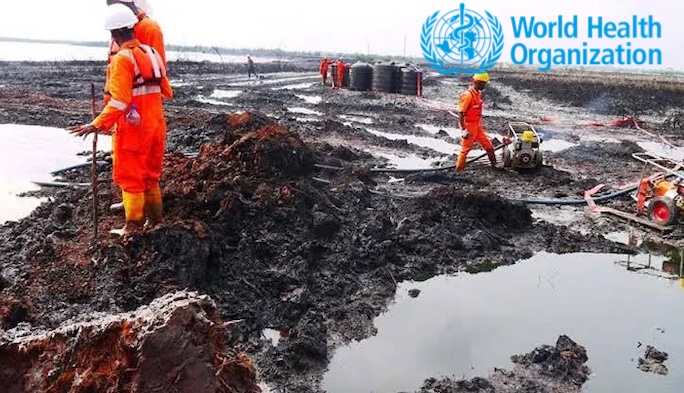
World Health Organisation (WHO) has commenced health impact study of Ogoni, as part of the recommendations by the United Nations Environmental Programme (UNEP) report on the clean-up and remediation of impacted sites of Ogoniland.
The study, which is to determine the correlation of oil exploration and pollution to the health status of Ogoni people, is being carried out by the International Agency for Research on Cancer (IARC), a subsidiary of WHO.
It would be recalled that the Hydrocarbon Pollution Remediation Project (HYPREP) Project Coordinator, Professor Nenibarini Zabbey, said it had commissioned WHO to carry out the study, in continuation of the implementation of the UNEP report by HYPREP.
Speaking during a visit to the traditional heads of Gokana and Tai local government areas, on Tuesday, Lead Scientist, International Agency for Research on Cancer, Ann Olysson, stated that the study was part of UNEP’s recommendations on Ogoni.
Olysson said, “We are about, with your permission, to begin a study that was originally recommended by the UNEP study. We are in collaboration with HYPREP to conduct the test and the choice of our agency to conduct the study is in international recognition for this type of study.”
Project Coordinator of UNEP and Lead Researcher between 2009 and 2011 that led to the report, Mr. Michael Cowing, said one of the key recommendations of the report was health assessment of the population of Ogoni.
Cowing said the study, which was going to last for about two and a half years, kicked-off middle of 2025 with the desk work, the mapping, the research.
He said the study will be carried out on 4,000 persons across the most impacted and non-impacted communities to ascertain results.
He stated, “And now with your approval, with your permission, we are going to engage in the field work. Simply what that means is across Ogoniland we’re looking to have something in the order of 4,000 participants representing the most impacted communities in Ogoniland.
“We know where the epicentres of contamination are, we’ve plotted the communities over those maps, and they will be the impacted communities where we will focus the study, but we are also doing studies in unimpacted communities so we can compare the different results.
“We are going to be looking at particular people involved in particular activities, whether it’s farming, fishing, sand mining, artisanal refining, different levels of exposure to hydrocarbon, so it’s going to be a very comprehensive study.”
Professor of Land Management at the Rivers State University (RSU), Professor Iyenemi Kakulu, stated that people will be scientifically selected for the study.
Kakulu said, “We are here on a friendly note to ask for your support, to grant us access into your kingdom, so that we can roam around, talk to your people, and be intentional about the participants we seek to be part of the study
“Basically, we will talk to people, we will try and reach people in the homes where they live, in some communities that will be scientifically selected, and when we go to those communities, we’ll crave your indulgence to be able to speak to their chiefs and gain access into the communities to do the work that we need to.”
Kakulu added, “We are also interested in occupational hazards, people who are exposed by the nature of the work that they do in and around the Ogoni land, they would also be subjects of interest to us, and we will go to them, talk to them, seek their voluntary consent to take part in the study, which is basically collecting some views, some human samples, blood, urine, and things like that.”
Earlier, HYPREP Project Coordinator, Zabbey, represented by Director, Technical Services, Damian Paul-Aguiyi, told the traditional council that the delegation was in their domains to seek support in terms of security, sensitisation, and collaboration.
Paul-Aguiyi emphasised that the study was not a contracted job and called on the traditional rulers to sensitise their people and give the team an enabling environment to carry out the study.
Responding, His Royal Majesty, King Samuel Nnee, Gbenemene Tai Kingdom, assured of the support of his people, stating that before the coming of oil exploration the Ogoni and, indeed, Africans lived longer.
He said, “Whatever support you need I can assure you that you will have it because what are we talking about is the health of our people.”
King Nnee stated that at first the people doubted that HYPREP will carry out the remediation.
“But I can tell you of the truth that we have seen. HYPREP went beyond cleaning the soil and a touch on livelihood programmes that has reawakened dead and hidden potentials of our children,” he said.
The traditional ruler explained, “Today our children are here and there in every sphere of life. Our children are going places, if you see programmes that are packaged by HyPREP, it will marvel you that Ogoni sons and daughters are now licensed to do a lot of things we never imagined years ago.
“So, I want to welcome you. I want to say, God should continue to bless this thing. I’ve been part of you and I will continue to be part of you, because it is my responsibility to speak for my people.
“And if nobody has told you, I want to say it from the royal point of view, that you are doing well. And you are still doing well.
“God will grant your effort and give you all the knowledge you need to do more for all the people.”
The Gberemene and Natural Ruler of Gokana Kingdom, HRM King Festus Paago Bagia, represented by the traditional ruler of Goi community, MeneStephen Kobani, assured the visiting team of the support of his people, describing the study as a welcome development.
Blessing Ibunge
About the Author