The events at Lubaga Cathedral on Monday occurred exactly 44 years after armed soldiers of President Milton Obote stormed the cathedral and halted the liturgy at gunpoint.
The earlier incident occurred on February 24, 1982, during an Ash Wednesday Mass at Lubaga Cathedral, when soldiers of the Uganda National Liberation Army (UNLA) halted the liturgy and set off one of the most confrontational confrontations between church authority and state power in Uganda’s recent history.
According to reports, including an account in the Catholic newspaper Munno the following day, the incident occurred during Mass at 8:00 a.m. presided over by three priests attended by schoolchildren, and faithful marking the start of lent with the imposition of ashes. The mass had reached the homily stage when the interruption occurred.
“The armed men went up to the altar and ordered the priests to stop praying while pointing guns at them,” the archived news report reads in part.
Accounts given by eyewitnesses describe how the armed men dragged the priests from the altar in their vestments, forcing them outside. Congregants fled in panic for their lives. The soldiers then searched the presbytery, the cathedral archives, Emmanuel Cardinal Nsubuga’s residence, and nearby premises inch by inch, ostensibly looking for weapons or guerrillas.
Though nothing incriminating was found, they looted items from the cardinal’s home and from the church. Other sources indicate that around 60 people who had taken shelter there were detained.The raid on the cathedral followed a daring guerrilla attack the previous day (February 23, 1982) by Dr Andrew Lutakome Kayiira’s Uganda Freedom Movement (UFM) on Malire Barracks (located at Lubiri Palace in Mengo).
Rebels had shelled the barracks, reportedly from the Rubaga Cathedral compound, killing two UNLA soldiers in an attempt to destabilize Obote’s regime. Government forces repelled the assault, but suspicions lingered that the cathedral had been used as a launch point or hideout.
The violation did not go unchallenged. Cardinal Nsubuga, affectionately remembered by Kampala Catholics as a father of revered memory, issued a stern four-page pastoral statement condemning the “godless and sacrilegious” intrusion into a place of worship. He protested the use of military force against priests during solemn liturgy and issued an ultimatum: the government must apologize, or the Catholic Church would boycott all state functions.
On March 18, 1982, Obote met Cardinal Nsubuga at his parliamentary office in Kampala, acknowledged the military’s mistake, and formally apologized. In reconciliation, it was agreed that the cardinal would visit Luzira Prison to check on political prisoners, signalling a temporary easing of tensions.
This historical episode highlights the Catholic Church’s long tradition of firm yet measured resistance to state overreach into sacred spaces, while ultimately prioritizing dialogue and reconciliation to preserve its mission amid political turmoil.
Four decades later, tensions resurface
An adage says history repeats itself, though some writers argue that people, not history, repeat past mistakes, and a line often attributed to Mark Twain suggests that history does not repeat but rhymes.
Whether coincidence or telling, the events of February 24, 1982, unfolded on the very same date that, 44 years later, on February 23, 2026, echoes strikingly in today’s headlines. On Monday, a special Mass at Lubaga Cathedral, intended to pray for detained opposition leader Dr Kizza Besigye (held for over a year on treason charges amid reports of deteriorating health), the sick, and other prisoners, was postponed, reportedly following a direct intervention from President Yoweri Museveni.
Winnie Byanyima, Besigye’s wife, publicly stated that the president intervened, prompting the archbishop’s reluctant compliance after initial pleas to proceed. Despite the official postponement, hundreds of Besigye supporters gathered at the cathedral, conducting impromptu prayers and singing hymns without clerical leadership, turning the site into a spontaneous demonstration of solidarity.
Besigye, a four-time presidential challenger and founder of the Forum for Democratic Change (FDC), has been detained for over a year on treason charges, with his health reportedly deteriorating in custody.
In the wake of the Monday event, there has been widespread criticism over the Catholic Church’s decision to postpone a special Holy Mass. However, historian Dr Robert Ojambo has defended the institution’s approach as a deliberate strategy of caution rather than capitulation.
Ojambo, a senior lecturer and head of the department of History, Archaeology, and Heritage at Kyambogo University, argued that public outrage portraying the archbishop’s decision as weakness misses the broader historical pattern.
“The Catholic Church has been too careful while dealing with the state,” Ojambo stated, emphasizing that this prudence has enabled the Church to survive and maintain influence through turbulent regimes.
Ojambo highlighted key episodes from Uganda’s post-independence history to illustrate this approach. Right from independence, the Catholic Church seemed to be rubbing with the state, with archbishop Kiwanuka vs Mutesa and Obote.During Idi Amin’s brutal dictatorship (1971–1979), the Church openly condemned atrocities, including the expulsion of missionaries and threats against leaders like Cardinal Nsubuga.
Yet it avoided confrontation that could have invited total repression, unlike the fate of Anglican Archbishop Janani Luwum, who was assassinated in 1977.
“They played it simple,” Ojambo noted, “and no wonder they did not find themselves in harm’s way with the man branded as a dictator.
“The Church had strong grounds to escalate its protest. Fr. Clement Kigundu was murdered, and his body was burnt near Namanve. Msgr. Clement Mukasa was abducted in Masaka. Other clergy and lay Catholics faced harassment and intimidation. Despite these provocations, the Church’s response reflected restraint and calculation.
Its leaders chose measured statements, quiet diplomacy, and pastoral guidance over direct political showdown, a posture that helped the institution endure one of the most violent periods in Uganda’s post-independence history.
Under Milton Obote’s second regime (1980–1985), amid civil war and massacres in the Luwero Triangle, Catholic leaders quietly sympathized with rebels fighting the government but remained “too conscious not to overstep.”
This restraint preserved the Church’s neutrality as factions clashed, allowing it to emerge intact after Obote’s fall. This is in the background of the fact that it is now a public secret that the Catholic Church was supporting the rebels.
Ojambo suggested a similar dynamic is at play today under President Museveni’s long rule.”Something must be playing out,” he opined, implying the Church’s measured response protects its institutional role in a politically polarized environment where direct defiance could jeopardize its operations, social services, and moral authority.
The postponement has fueled debate over church-state relations, where the Catholic Church, representing a significant portion of the population, has historically balanced advocacy for justice with institutional survival.
The Archdiocese has not yet announced a rescheduled date for the Mass, leaving Besigye’s supporters and observers awaiting further clarity amid ongoing calls for his release.
For years, the government has long engaged cautiously, and at times contentiously, with politics and religion, even before independence, with the Catholic Church playing a pivotal role from its earliest days under Archbishop Joseph Kiwanuka.
As the first African bishop south of the Sahara and later Archbishop of Rubaga, Kiwanuka set a foundational tone for church-state relations through his influential pastoral letters. His most notable one, “Church and State: Guiding Principles,” issued in November 1961 amid the heated Legislative Council elections leading up to independence, outlined clear boundaries and responsibilities.
In it, Kiwanuka defended democratic processes, advocated for Buganda as a constitutional monarchy, condemned political extremism (such as that of the Kabaka Yekka party), and emphasized that rulers must respect religious and moral matters while the Church retains authority over souls and ethical judgments.
This document became a landmark in navigating the delicate interplay between temporal power and spiritual guidance.
Since then, the Catholic Church in Uganda, through its Bishops and Archbishops and sometimes priests, has consistently maintained this balanced approach. It has issued a series of pastoral letters addressing national issues, from “Shaping Our National Destiny” in 1962 (laying out values like justice, unity, and human dignity for the new nation) to later ones on elections, constitutional matters, peace, and the common good.
Catholic Church leaders have frequently spoken from the pulpit and in public statements, offering moral commentary on governance without fully aligning with any political faction, preserving institutional independence amid turbulent regimes.
This enduring tradition of measured engagement was evident just days ago, during celebrations marking 147 years since the arrival of the first Catholic missionaries—Fr. Simeon Lourdel (Mapeera) and Brother Amans Delmas—at Kigungu in Entebbe on February 17, 1879.
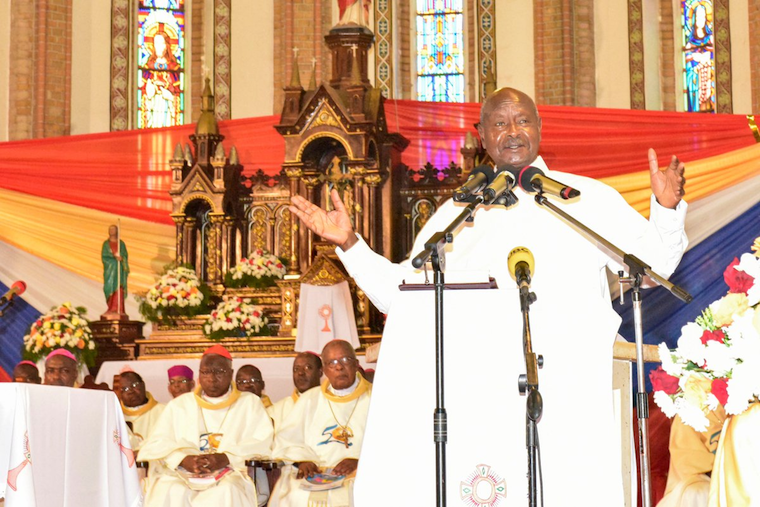
Archbishop Paul Ssemogerere, currently facing criticism for postponing a special Mass at Rubaga Cathedral, presided over the thanksgiving Mass and reflected on recent statements by President Yoweri Museveni.
On January 16 (or around the commemoration of Janani Luwum Day on February 16), President Museveni praised the martyred Anglican Archbishop Janani Luwum for dying as a martyr under Idi Amin’s regime, blaming Amin for the atrocities while warning current leaders against becoming “bad leaders” like the ousted dictator, urging persuasion over intimidation.
Museveni’s remarks, delivered during national prayers in Kitgum District honoring Luwum’s 49th martyrdom anniversary, drew significant praise for highlighting leadership accountability and rejecting authoritarianism.
In response, Archbishop Paul Ssemogerere challenged those in positions of authority to walk the talk on peace and accountability, urging them not to emulate the flawed leaders of the past who succumbed to tyranny and injustice. However, he passed on another key message, quoting Pope Francis to urge the faithful to “retain themselves” in the face of provocation by those with authority.
He emphasized that the Church’s path forward lies through dialogue, not war or confrontation, even when challenged or tempted toward escalation. This stance aligns with the Church’s long-standing preference for moral suasion, prayer, and peaceful advocacy over direct political clash, echoing Kiwanuka’s guiding principles and the bishops’ historical pattern of prudent navigation between state and religion.
About the Author